
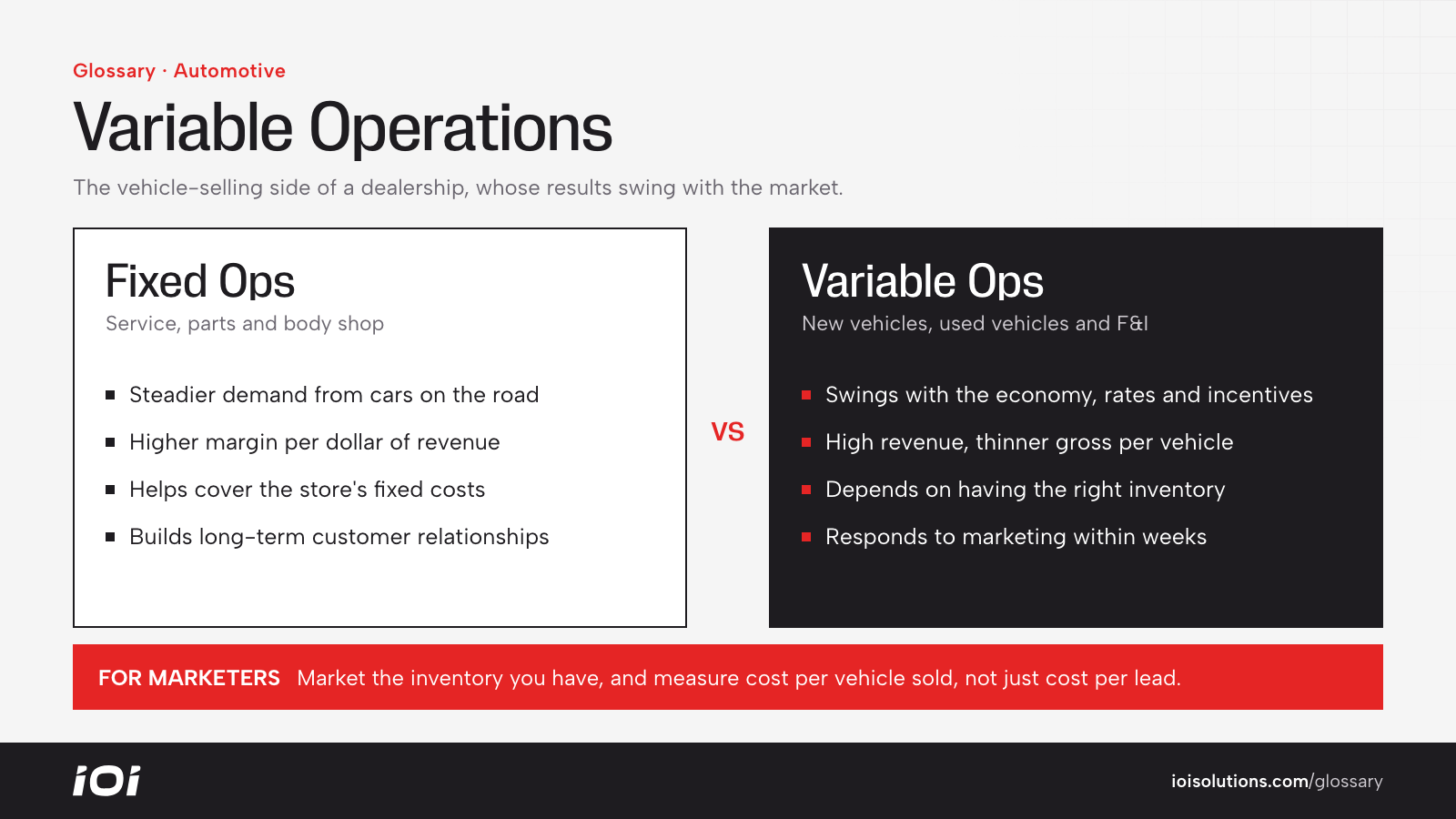
What Are Variable Operations?
Variable operations, sometimes called variable ops, are the parts of a dealership that sell vehicles. They usually include the new vehicle department, the used vehicle department and the Finance and Insurance (F&I) department.
The term “variable” reflects how unpredictable these revenues can be. Sales volume and profit per vehicle move with the economy, interest rates, manufacturer incentives, inventory supply, seasonality and competition. That contrasts with fixed operations (service, parts and body shop), which produce steadier income.
Why Variable Operations Matter
Variable operations generate most of a dealership’s revenue and attract most of its marketing spend:
- High revenue, thinner margins. Vehicle sales bring in large dollar amounts, but the gross margin on each vehicle can be modest, especially on new units.
- They feed fixed ops. Every vehicle sold creates a potential long-term service customer.
- They depend heavily on inventory. Having the right vehicles at the right price determines whether marketing can convert demand.
- They respond quickly to marketing. Changes in advertising, pricing and lead handling often show up in sales results within weeks.
How Variable Operations Work
Each department contributes differently:
- New vehicles: sold under the franchise agreement with the automaker. Profit comes from the front-end margin plus factory incentives, holdback and volume bonuses.
- Used vehicles: acquired through trade-ins, auctions and direct purchases from consumers, then reconditioned and sold. Used vehicles often carry higher front-end margins than new ones, and dealers have more control over sourcing and pricing.
- F&I: arranges financing and sells protection products, adding back-end gross to each deal.
Common metrics include units sold, front-end and back-end gross, total gross per vehicle retailed (PVR), days supply, inventory turn, aged inventory, lead-to-sale close rate and cost per vehicle sold.
How Variable Operations Affect Marketing
Most dealership advertising supports variable ops, so marketers need to understand the economics behind it:
- Market what you have. Campaigns should follow inventory: push models with strong supply, aged units that need to move and high-margin used vehicles.
- Measure cost per sale, not just cost per lead. Connecting CRM and DMS data shows which channels produce buyers, not just form fills.
- Balance new and used strategies. New vehicle ads often lean on incentives and OEM messaging, while used vehicle ads focus on specific units, price and value.
- Support acquisition. Campaigns that ask consumers to sell or trade their vehicle help dealers source used inventory without relying only on auctions.
- Respond to market shifts. When supply is tight, marketing may focus on acquisition and preorders; when supply is high, on conquest and aggressive offers.
For example, if days supply on a certain SUV climbs well above target, a dealer might shift budget toward vehicle listing ads and social inventory ads for that model, paired with a compliant incentive message. Once supply returns to normal, that budget can move back to the models and used units with the strongest margins.
Best Practices
- Align marketing plans with inventory reports every week, not once a month.
- Track sold vehicles back to lead sources to judge channels on actual sales.
- Merchandise every unit quickly with real photos and accurate pricing.
- Follow up on every lead fast; slow responses waste the spend that generated them.
- Coordinate with fixed ops so sales customers are welcomed into service after delivery.
- Plan for seasonality. Tax refund season, model-year changeovers and holiday sales events shift demand; build budgets and creative around those predictable swings instead of spending evenly all year.