
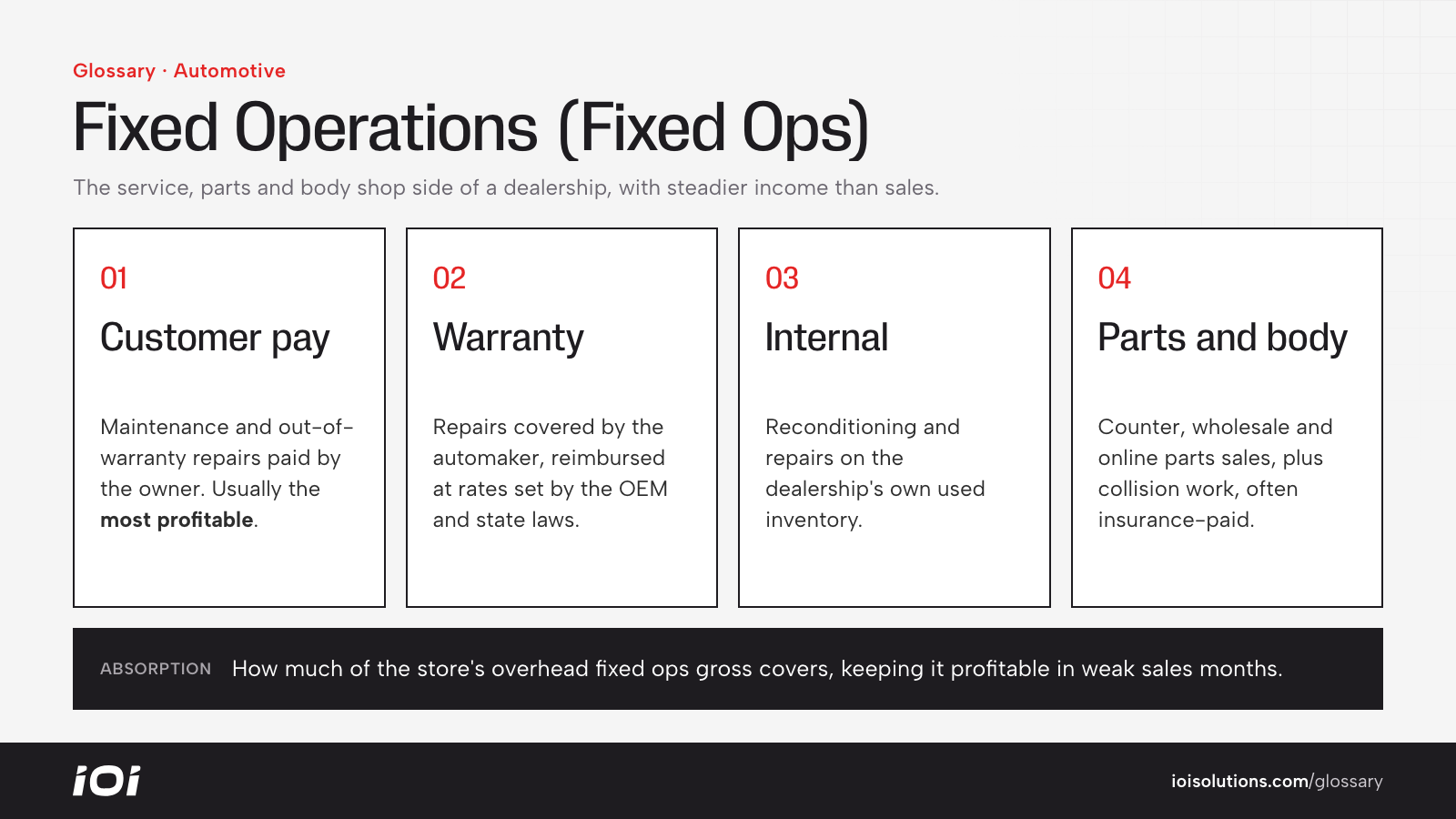
What Are Fixed Operations (Fixed Ops)?
Fixed operations, usually shortened to fixed ops, are the departments of a dealership that service and repair vehicles rather than sell them. Fixed ops typically include the service department, the parts department and, at many stores, the collision or body shop.
The name reflects how the business behaves. Vehicle sales rise and fall with the economy, incentives and inventory supply, while service and parts demand is steadier because vehicles on the road always need maintenance and repair. That consistency helps cover the dealership’s fixed costs, such as rent, utilities and salaried staff. The sales side is called variable operations.
Why Fixed Operations Matter
Fixed ops are often described as the backbone of dealership profitability:
- Steady gross profit: service and parts usually earn higher margins per dollar of revenue than vehicle sales.
- Service absorption: dealers measure how much of their overhead is covered by fixed ops gross profit. Higher absorption means the store can stay profitable even in weak sales months.
- Customer lifetime value: regular service visits build relationships that lead to the next vehicle purchase.
- Sales opportunities: the service lane is a natural place to identify customers who are ready to trade in or upgrade.
How Fixed Operations Work
Revenue in fixed ops comes from several sources:
- Customer pay: work paid directly by the vehicle owner, such as maintenance and out-of-warranty repairs. This is usually the most profitable segment.
- Warranty: repairs covered by the automaker, reimbursed at rates determined by the OEM and state laws.
- Internal: reconditioning and repairs on the dealership’s own used inventory.
- Parts sales: counter, wholesale and online parts sales to consumers and independent shops.
- Collision: body and paint work, often involving insurance claims.
Key metrics include repair order count, hours per RO, effective labor rate, technician productivity, parts-to-labor ratio, customer retention and customer satisfaction scores.
How Fixed Operations Affect Marketing
Many dealerships spend the bulk of their marketing budget on vehicle sales, even though fixed ops can deliver strong returns. Marketing for fixed ops focuses on:
- Retention: keeping customers coming back after the warranty period, when many drift to independent shops. Service retention programs, reminders and loyalty offers are central.
- Conquest service: attracting owners of vehicles bought elsewhere, or other brands, through search ads, local SEO and competitive pricing on common services.
- Specific service pages: pages for brakes, tires, batteries, oil changes and EV service help capture high-intent local searches.
- Recall and maintenance campaigns: notifying owners of open recalls or upcoming maintenance brings in work and builds trust.
- Online scheduling: an easy booking tool can turn search and email traffic into appointments.
- Service-to-sales: identifying customers with high repair costs or strong equity and connecting them with sales.
For example, a dealer could target owners whose factory warranty is about to expire with a message explaining the value of continuing service with factory-trained technicians and genuine parts.
Best Practices
- Give fixed ops its own marketing budget and goals, rather than leaving it whatever is left after sales.
- Use DMS service history to target customers based on mileage, last visit and declined work.
- Promote competitive services like tires, brakes and alignments to win price-sensitive customers.
- Measure booked and completed appointments, not just clicks or calls.
- Make the service experience easy with online booking, text updates and digital payment.
- Follow up on declined work. Recommended repairs that customers postpone are a ready-made list of future appointments; a timely, helpful reminder often brings them back.