
What Is Per Vehicle Retail (PVR)?
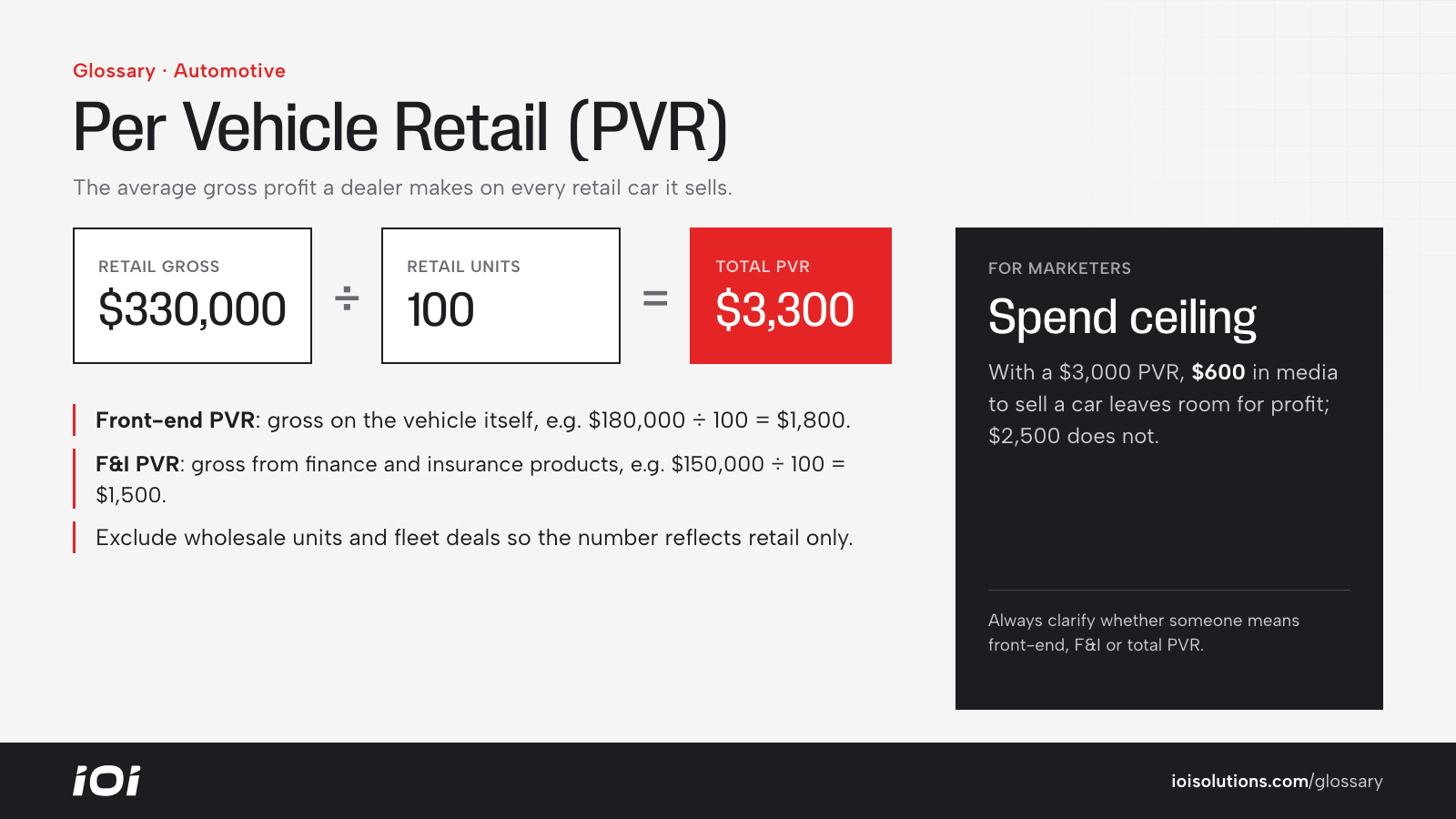
Per vehicle retail (PVR) is the average gross profit a dealership makes on each retail vehicle it sells. It is the go-to measure of how profitable each sale is, and it is usually reported for new and used vehicles separately.
Dealers talk about PVR in a few ways. Front-end PVR is the gross on the vehicle itself: selling price minus the vehicle’s cost and reconditioning. Back-end PVR, often called F&I PVR, is the gross from finance and insurance products such as financing reserve, service contracts and GAP coverage. Total PVR combines both. When someone just says “PVR,” clarify which version they mean, since practices differ between stores and groups.
Why Per Vehicle Retail (PVR) Matters
Unit volume makes headlines, but gross pays the bills. PVR tells a dealer whether volume is profitable, and it is one of the main numbers used to compensate sales staff, compare stores within a group and judge the impact of pricing strategy.
- Profit reality check: selling more units at a lower PVR can leave total gross flat or lower.
- Pricing feedback: sharp drops in front-end PVR often point to aggressive market-based pricing or aged inventory being discounted.
- F&I performance: back-end PVR shows how well the finance office is presenting products.
- Marketing ROI: PVR is the number that tells you how much you can afford to spend to sell a car.
How to Calculate Per Vehicle Retail (PVR)
PVR = Total Retail Gross Profit / Number of Retail Units Sold
For example, if a used department retails 100 vehicles in a month with $180,000 in front-end gross and $150,000 in F&I gross, front-end PVR is $1,800, F&I PVR is $1,500 and total PVR is $3,300. Wholesale units and fleet deals are typically excluded so the number reflects retail performance only.
How Per Vehicle Retail (PVR) Affects Marketing
For a marketer, PVR is the ceiling on what a sale is worth. It turns cost metrics into profitability decisions.
- Set a target cost per sale. If total PVR is $3,000, spending $600 in media to sell a car leaves room for profit, while spending $2,500 does not. That frames a sensible cost per acquisition target.
- Weight campaigns by gross, not just volume. A used truck campaign producing fewer sales at a higher PVR may beat a compact car campaign with more units and thin margins.
- Do not just buy the cheapest leads. Price-only shoppers can close at very low gross. Creative that sells value, selection and experience can protect PVR.
- Feed results back into bidding. When CRM data includes gross per deal, ad platforms can optimize toward valuable sales rather than raw lead counts.
For example, a store might find that its paid social leads close at a slightly lower rate than search leads but at a higher average PVR because they shop by payment rather than lowest price. That insight changes how budget should be split.
Best Practices
- Agree on a definition up front: front-end, back-end or total, and new versus used.
- Pair PVR with lead-to-sale close rate to estimate the gross value of a lead from each source.
- Track PVR by lead source in the CRM so marketing can be judged on profit, not just volume.
- Watch for PVR drops tied to aged units, which often signal inventory problems rather than marketing ones.
- Remember that PVR varies widely by brand, market and new versus used mix, so benchmark against your own history and your group.