
What Is a Trade-In?
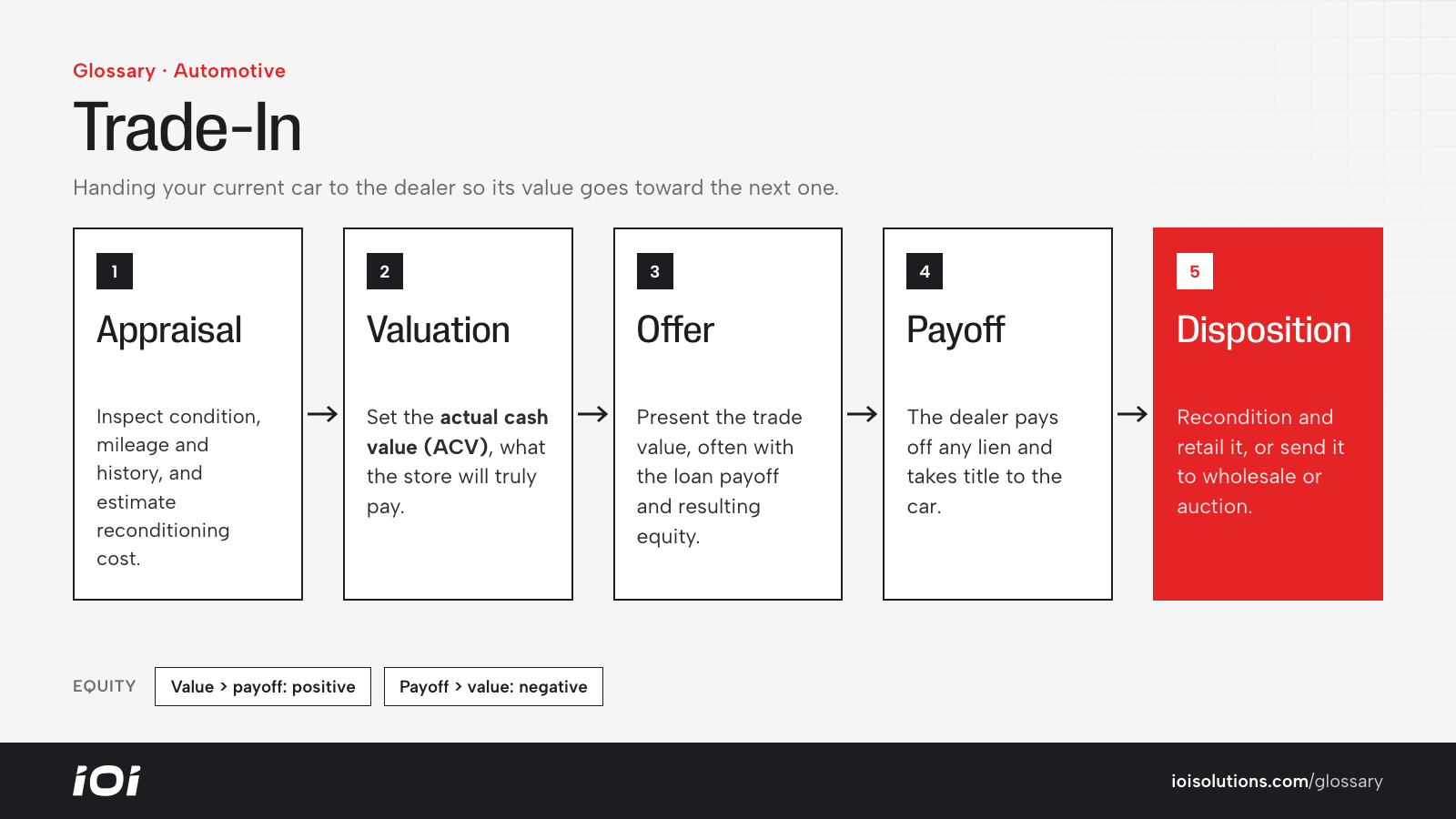
A trade-in is a vehicle that a customer hands over to a dealership as part of buying another vehicle. The dealer appraises the car, offers a value, and applies that value to the new deal, lowering the amount the customer needs to pay or finance.
If the customer still owes money on the trade, the dealer pays off the loan. When the payoff is less than the trade value, the difference is positive equity and reduces the new deal. When the payoff is more than the trade value, the customer has negative equity, and that shortfall is often rolled into the new loan.
Why Trade-Ins Matter
Trade-ins sit at the center of dealership economics for a few reasons:
- Used inventory supply. Trades are typically one of the most profitable ways for a store to acquire used cars, because the dealer buys at wholesale-level values without auction fees or transport.
- Deal structure. The trade value often matters more to the customer than the price of the new vehicle. A strong offer can close a deal that a discount could not.
- Tax advantage for the buyer. In many states, sales tax is calculated on the price after the trade value is subtracted, which gives trading in an edge over selling privately.
- Gross profit. How a trade is appraised, reconditioned, and resold has a direct impact on used-car gross and per vehicle retail results.
How a Trade-In Works
A typical trade-in follows these steps:
- Appraisal. A used-car manager or appraiser inspects the vehicle, checks condition, mileage, history reports, and market data, and estimates reconditioning cost.
- Valuation. The dealer sets an actual cash value (ACV), the amount it is truly willing to pay, based on what it expects to retail or wholesale the car for.
- Offer and negotiation. The trade value is presented, sometimes alongside the payoff and the resulting equity.
- Payoff and paperwork. The dealer pays off any lien and takes title.
- Disposition. The car is reconditioned and sold retail, or sent to wholesale or auction if it does not fit the store’s inventory.
Online tools now let shoppers get an instant trade estimate before visiting, usually subject to inspection. These estimates are a core part of digital retailing.
How Trade-Ins Affect Marketing
Trade-ins give dealership marketers one of their strongest hooks. Many shoppers do not start by asking “what car should I buy?” but “what is my car worth?” Capturing that question early puts the store in the deal before the shopper picks a vehicle.
For example, a dealer could run search and social campaigns around “sell my car” and “trade-in value” keywords, sending traffic to a trade appraisal tool on its website. Each completed appraisal is a high-intent lead with a known vehicle, which is also a sourcing opportunity even if the person does not buy.
Trade-in data powers retention marketing too. Through equity mining, stores identify customers whose current vehicles are worth more than they owe and invite them to upgrade. When used inventory is tight, “we will buy your car even if you do not buy ours” campaigns can become a primary acquisition strategy.
Messaging needs care. Advertising a guaranteed or inflated trade value that the store will not honor erodes trust quickly, and many states regulate how trade-in offers can be advertised.
Best Practices
- Put a trade tool on every key page. Vehicle detail pages, finance pages, and the homepage should all offer a quick way to value a trade.
- Follow up on appraisal leads quickly. Someone valuing their car is often close to a decision, either with you or a competitor.
- Be transparent about inspection. Explain that online estimates are confirmed in person and what can change the number.
- Market to sourcing as well as selling. Run campaigns that buy cars outright when your used supply is short.
- Track trades by source. Know which campaigns produce trades, not only sales, and value them accordingly.