
What Are Manufacturer Incentives and Rebates?
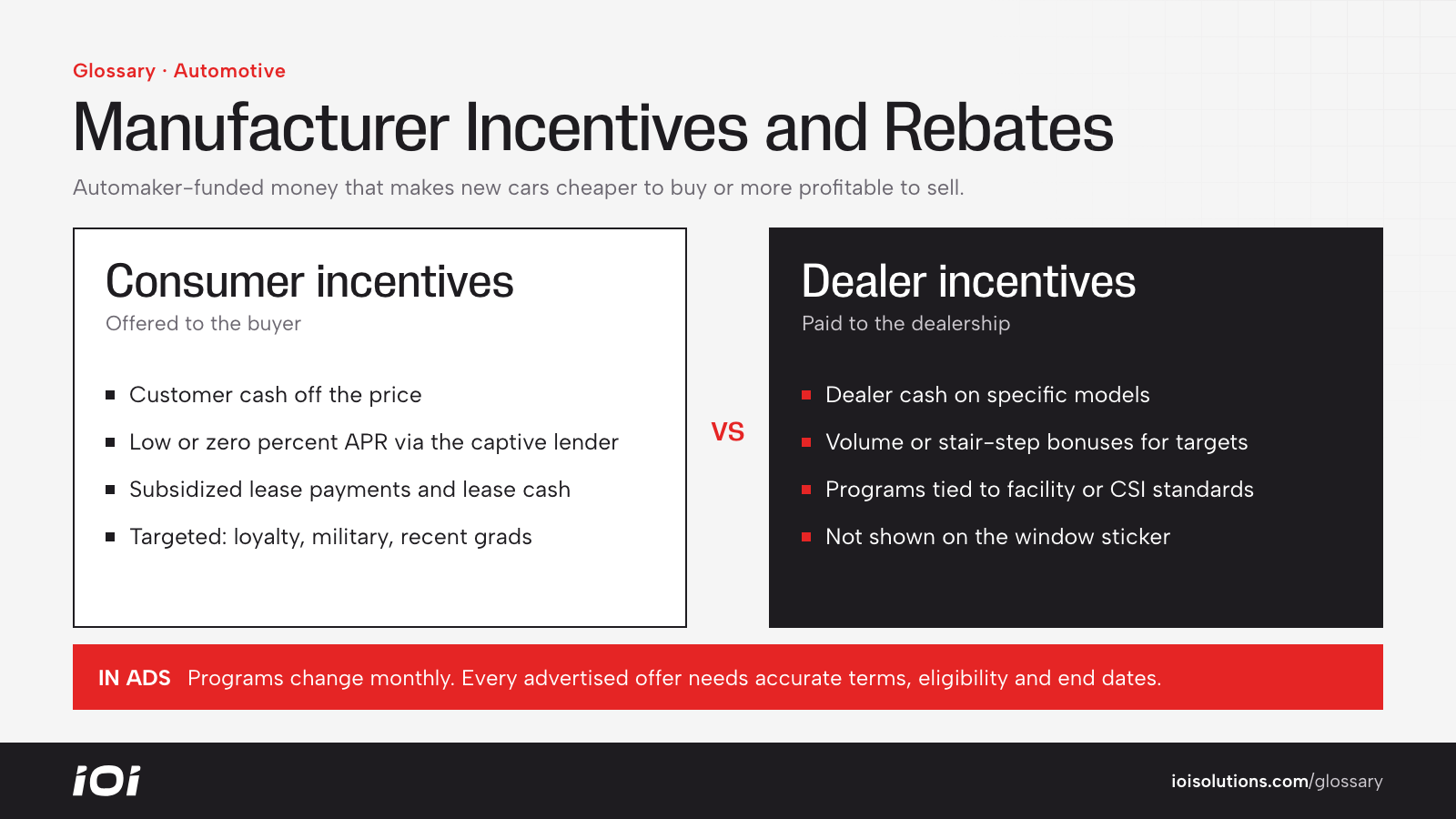
Manufacturer incentives are programs funded by an automaker to make new vehicles more attractive to buy or lease, or more profitable for dealers to sell. Rebates are one type: a fixed amount of cash taken off the price or paid to the buyer.
Incentives fall into two broad groups:
- Consumer incentives are offered to the buyer, such as customer cash, low or zero percent financing, subsidized lease payments, and targeted rebates for groups like recent graduates, military members, or current owners of the brand.
- Dealer incentives are paid to the dealership, such as dealer cash on specific models, volume or stair-step bonuses for hitting sales targets, and programs tied to facility or customer satisfaction standards.
Special financing and lease offers usually run through the manufacturer’s captive finance company and require credit approval.
Why Manufacturer Incentives Matter
Incentives shape what is actually advertised and what actually sells.
- Demand management. Automakers use incentives to clear outgoing model years, support slow-selling models, and respond to competitors.
- Deal economics. Incentives can turn an unprofitable deal into a profitable one, especially dealer-side money that does not appear on the window sticker.
- Shopper motivation. A strong offer, such as low APR on a popular model, can pull buyers into the market sooner.
- Messaging. Manufacturer offers drive national and regional advertising, and dealers echo them locally.
How Manufacturer Incentives Work
Programs are usually published monthly and can vary by region, model, trim, and model year. A typical month might include:
- Customer cash on several models, often available to anyone who qualifies to buy.
- Special APR through the captive lender, often as an alternative to cash rather than combined with it.
- Lease programs with reduced money factors, boosted residuals, or lease cash.
- Targeted offers for loyalty, conquest, military, first responders, or recent graduates.
- Dealer programs that pay the store per unit or for hitting volume targets.
Each offer has eligibility rules, start and end dates, and fine print about which incentives can be combined. Dealers rely on incentive data tools to keep track.
How Manufacturer Incentives Affect Marketing
Incentives give dealers their most compelling and most regulated advertising content. Every advertised offer needs accurate terms, eligibility, and expiration dates, and credit offers bring federal disclosure requirements under truth-in-lending rules.
Automaker advertising runs on tiers. National campaigns come from the manufacturer, regional campaigns from dealer associations, and local campaigns from individual stores, as described in tier 1, 2, and 3 advertising. Local ads that echo the current offers generally perform best when they match what shoppers already saw at the national level.
Many manufacturers also run co-op advertising programs that reimburse part of a dealer’s ad spend when the ads meet brand guidelines, which often include rules for how incentives are shown.
For example, a dealer with heavy inventory of an outgoing model year can build search and social campaigns around that model’s 0% financing offer, update website banners on the first day of the month, and remove the ads the day the program ends. Speed and accuracy are what separate effective incentive marketing from confusing ads.
A common pitfall is advertising a “starting at” price that stacks every possible rebate, including ones most buyers will not qualify for. That generates leads that fall apart at the desk and invites regulatory scrutiny.
Best Practices
- Update on day one. Refresh ads, landing pages, and VDP banners as soon as new programs start.
- Separate conditional rebates. Show universal offers in the headline price and list targeted ones separately.
- Include full disclosures. State eligibility, expiration, and credit terms clearly and consistently.
- Match budget to incentive strength. Shift spend toward models with the strongest offers and deepest inventory.
- Follow co-op rules. Build ads to brand guidelines so spend qualifies for reimbursement.
- Remove expired offers fast. Old offers left live create angry customers and compliance risk.