
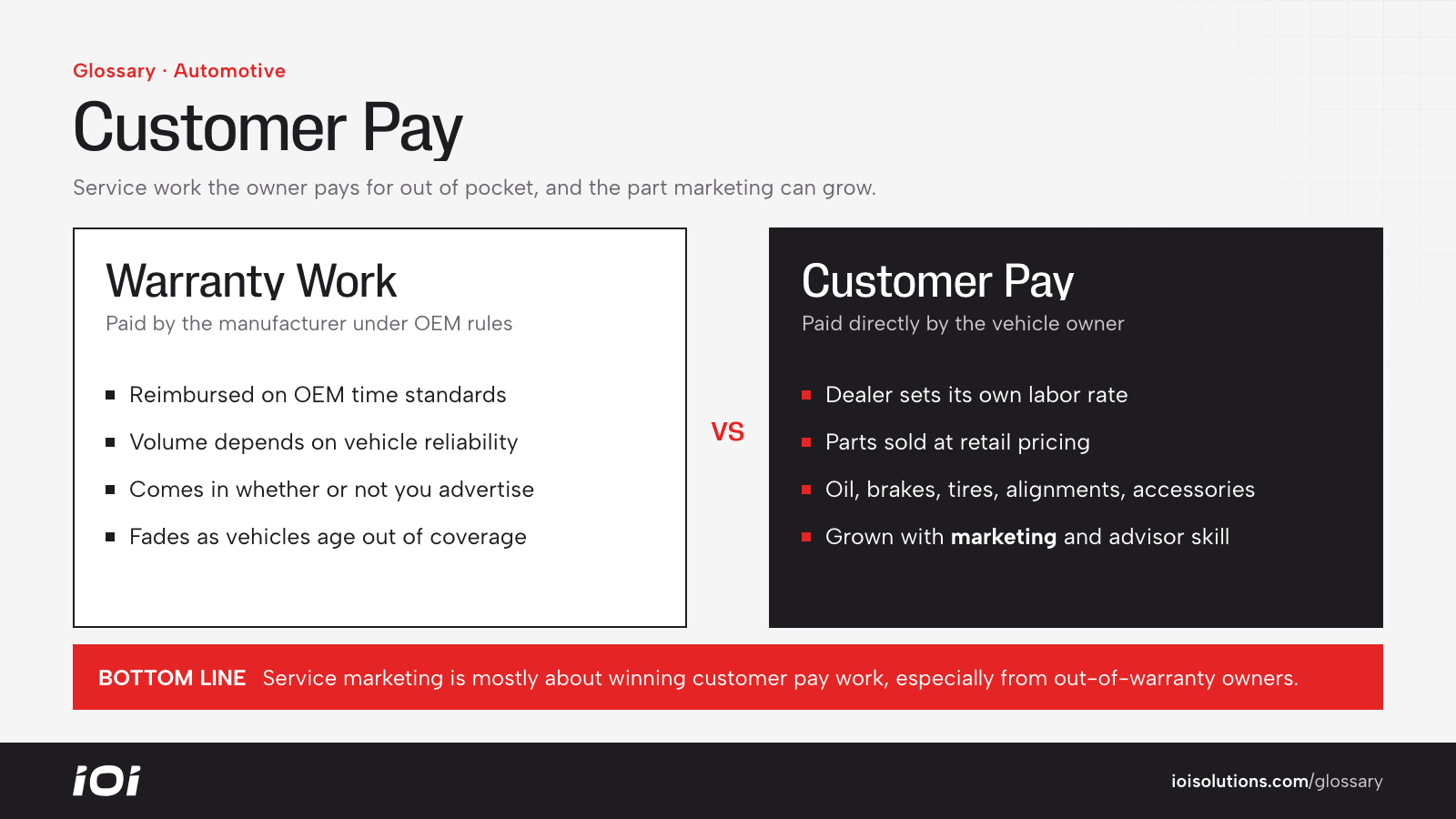
What Is Customer Pay?
Customer pay is service, repair and parts work that the vehicle owner pays for out of pocket. On a repair order, each job is assigned a pay type, and customer pay sits alongside warranty work (paid by the manufacturer) and internal work (paid by another dealership department, such as reconditioning used cars for sale). Some shops also break out insurance-paid or service contract work as separate pay types.
Oil changes, brakes, tires, alignments, out-of-warranty repairs and accessory installs are classic customer pay jobs. For independent shops that do no warranty work, nearly all revenue is customer pay.
Why Customer Pay Matters
Customer pay is usually the most profitable and most controllable part of a service business.
- Higher labor rates: dealers set their own customer pay rates, while warranty reimbursement is governed by OEM rules and state law.
- Parts margin: customer pay parts are sold at retail pricing set by the dealer or shop.
- Growth you can influence: warranty volume depends on how reliable the vehicles are, while customer pay can be grown through marketing, pricing and service advisor skill.
- Long-term stability: as vehicles age out of warranty, keeping those owners as customer pay clients protects fixed operations revenue.
How Customer Pay Works
When a service advisor writes up a vehicle, each repair line is coded with a pay type. Customer pay lines are billed at the shop’s posted labor rate, or a menu price, plus parts and any shop fees. At close-out, the customer pays those lines directly.
Key customer pay metrics include:
- Customer pay RO count: the number of visits with at least one customer pay line.
- Customer pay hours per RO: labor hours sold per visit.
- Customer pay dollars per RO: average labor and parts revenue per visit.
- Effective labor rate: the actual average rate earned once discounts and menu pricing are factored in.
How Customer Pay Affects Marketing
Service marketing is almost entirely about growing customer pay. Warranty and recall visits happen whether or not you advertise, so the marketing goal is to win paid work that would otherwise go elsewhere.
- Target out-of-warranty owners. Vehicles past their factory coverage are where dealers most often lose customers to independent shops and quick-lube chains.
- Promote high-demand services. Tires, brakes, batteries and alignments are common reasons drivers search for a shop.
- Use local search. A strong Google Business Profile and local service pages capture drivers searching for repair help nearby.
- Measure on paid revenue. Attribute customer pay RO dollars to campaigns, not just booked appointments.
For example, a dealer might notice its customer pay RO count falling for vehicles six years and older. A campaign offering competitive tire pricing and a free inspection to owners of older vehicles in its DMS could bring those customers back, and the results would show up in customer pay RO count and dollars.
A collision shop is a slightly different case: much of its revenue is insurance-paid, but deductibles, cosmetic repairs and add-ons like paint protection film are customer-funded and worth marketing directly.
Best Practices
- Report marketing results in customer pay ROs and revenue, separating warranty and internal work.
- Publish transparent prices for common services to compete with independent shops.
- Build campaigns around vehicle age and mileage milestones when customer pay needs naturally arise.
- Train advisors to present recommended work clearly, since marketing brings the car in but advisors grow the ticket.
- Follow up on declined customer pay work with timely, helpful reminders.