
What Is Effective Labor Rate (ELR)?
Effective labor rate is the average amount of labor revenue a service department or repair shop actually collects for each labor hour it bills. It is different from the posted or “door” rate, which is the hourly rate the shop advertises or lists on its menu board.
The two numbers rarely match. Discounts, coupons, fixed-price menu items, warranty rates, internal work on dealership vehicles, and goodwill adjustments all pull the effective rate below the posted rate. ELR shows what the shop is really earning for its technicians’ time.
Why Effective Labor Rate Matters
ELR is one of the most important numbers in fixed operations.
- Profitability. Small changes in ELR across thousands of hours can mean large changes in gross profit.
- Pricing reality check. It reveals whether discounts and promotions are quietly eroding margins.
- Warranty reimbursement. For franchised dealers, retail labor rates on customer pay work can influence the warranty labor rate the manufacturer pays. Many states have laws governing how that reimbursement is calculated.
- Benchmarking. Comparing ELR across advisors, job types, and time periods shows where money is being left behind.
How to Calculate Effective Labor Rate
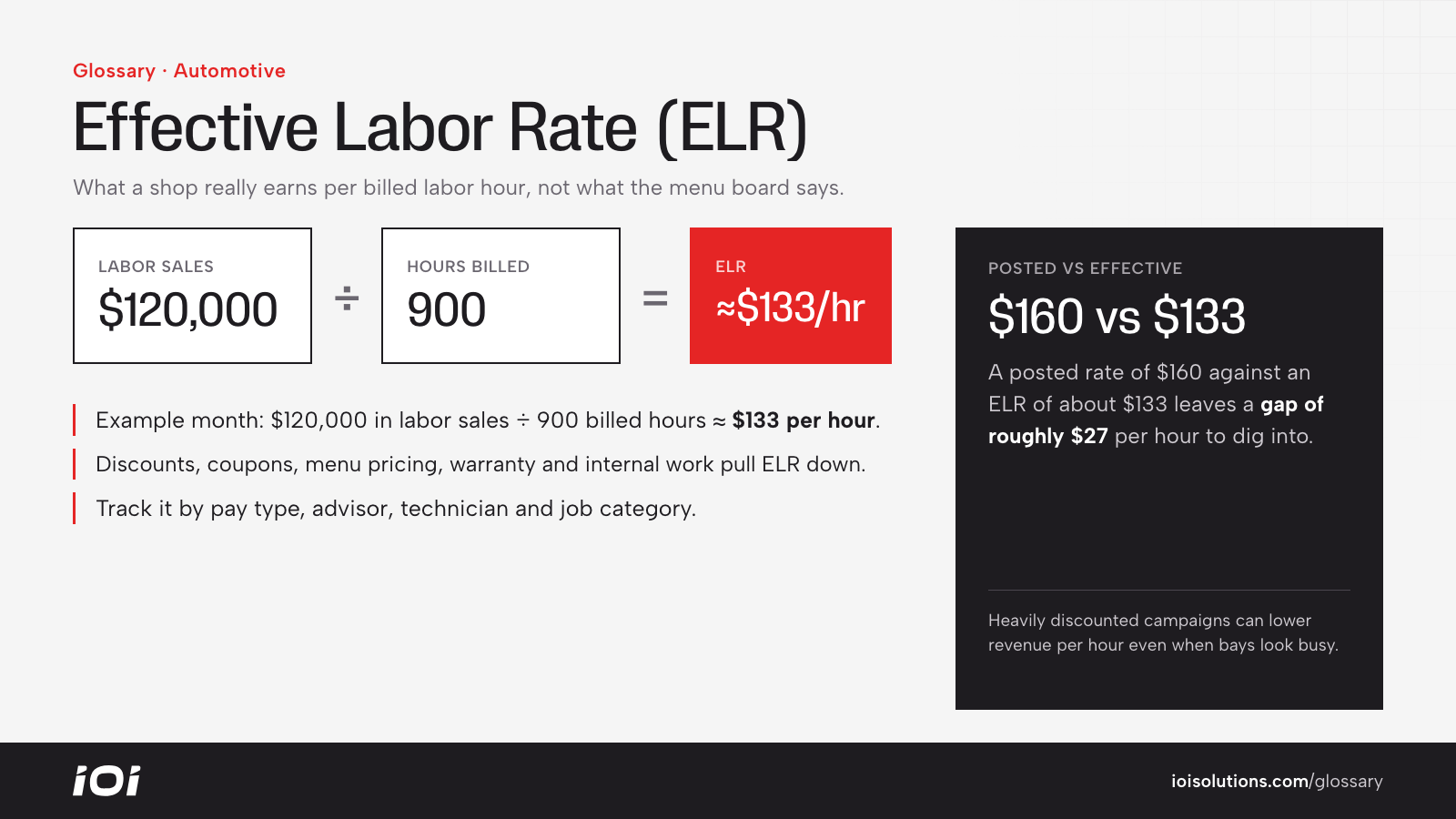
Effective labor rate = total labor sales ÷ total labor hours billed
For example, if a shop records $120,000 in labor sales and bills 900 hours in a month, its ELR is about $133 per hour. If its posted rate is $160, the gap of roughly $27 per hour is worth digging into.
Most shops calculate ELR separately by pay type:
- Customer pay ELR for work paid by the customer.
- Warranty ELR for manufacturer-paid work.
- Internal ELR for work on dealership inventory and company vehicles.
They also track it by advisor, technician, and job category, because maintenance menus often produce a lower ELR than diagnostic or repair work.
How Effective Labor Rate Affects Marketing
Service marketing directly affects ELR, sometimes in ways that are easy to miss.
Coupons and price-led promotions bring in car count, but every discounted labor hour lowers the effective rate. If a campaign fills bays with heavily discounted work, revenue per hour can fall even while the shop looks busy. Marketing plans should account for the labor discount being offered and whether the extra visits generate enough additional repair work to make up for it.
For example, a repair shop might run a low-priced brake inspection offer. If inspections lead to a good share of approved brake jobs at full rate, the campaign can raise total profit. If most customers take the discounted service and leave, ELR and profit both drop. Tracking ELR before and after the campaign tells the real story.
Marketing can also support a higher ELR. Messaging that emphasizes certified technicians, quality parts, warranties, convenience, and transparent digital inspections helps justify pricing and reduces the need to compete on discounts. Multi-point inspections that uncover needed repairs add full-rate hours to visits that began as low-margin maintenance.
What Is a Good Effective Labor Rate?
There is no universal benchmark, because labor rates vary widely by region, brand, and shop type. A useful internal target is to keep customer pay ELR as close to the posted rate as practical, often expressed as a labor rate realization percentage (ELR ÷ posted rate). Watch the trend over time rather than a single month.
- Measure by pay type. Separate customer pay, warranty, and internal work so problems are visible.
- Audit discounts. Review how often advisors discount labor and whether those discounts are approved.
- Price menus carefully. Make sure fixed-price menu items reflect real labor times.
- Judge campaigns by profit. Look at ELR and gross per RO, not just car count, after every promotion.
- Sell value, not discounts. Use marketing to explain quality and convenience so price is not the only reason to choose you.