
What Is Revenue Operations (RevOps)?
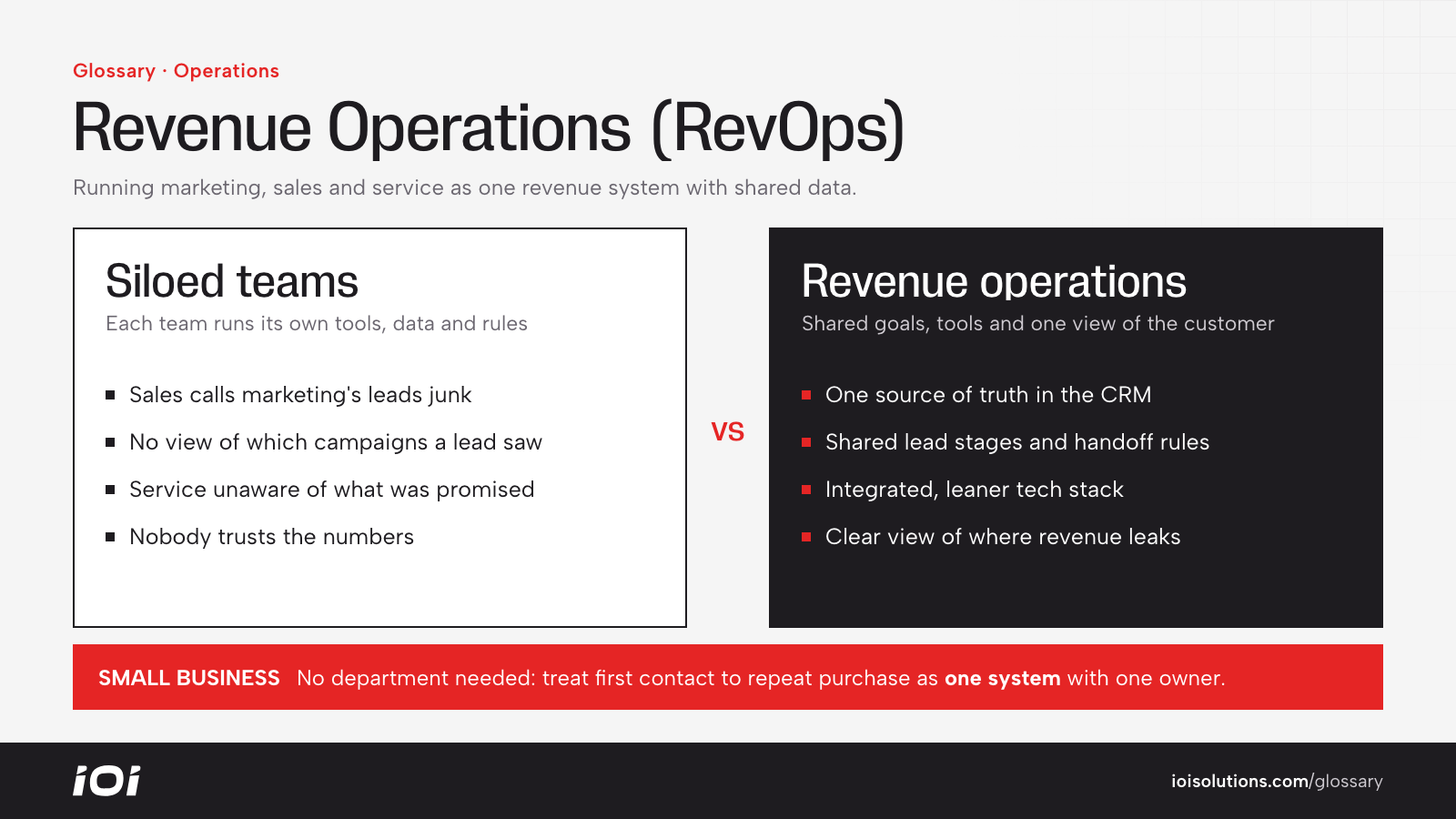
Revenue operations, or RevOps, is a business function that unifies the operational side of marketing, sales and customer success. Instead of each team running its own systems, data and processes, RevOps brings them together under shared goals, shared technology and a single view of the customer from first touch to renewal.
RevOps grew out of marketing operations, sales operations and customer success operations. It is especially common in B2B and subscription companies, but the principles apply to any business where leads pass between teams before becoming revenue. You do not need a dedicated department to benefit; even a small business can adopt the RevOps habit of treating the whole path from first contact to repeat purchase as one system with one owner.
Why Revenue Operations Matters
When teams operate in silos, problems pile up. Marketing reports lead volume that sales says is junk. Sales cannot see which campaigns a prospect engaged with. Customer success does not know what was promised during the sale. Data lives in disconnected tools, and nobody trusts the numbers.
RevOps addresses this by:
- Creating one source of truth for customer and pipeline data.
- Defining shared stages, handoffs and metrics across teams.
- Improving forecasting accuracy.
- Reducing wasted spend on tools and duplicated effort.
- Making it clear where revenue is being lost in the funnel.
How Revenue Operations Works
Process
RevOps maps the entire revenue process, including lead definitions, routing, follow-up rules, deal stages and renewal workflows, and removes friction at each handoff.
Technology
It owns and integrates the revenue tech stack: CRM, marketing automation, call tracking, sales engagement tools, billing and analytics. The goal is fewer, better-connected systems.
Data and Analytics
It maintains clean data, builds dashboards and reports on shared metrics such as pipeline, conversion rates by stage, sales cycle length, customer acquisition cost, churn and net revenue retention.
Enablement
It trains teams to use systems and processes correctly so the data stays reliable.
Revenue Operations in Automotive Marketing
Automotive businesses may not use the term RevOps, but they face the same challenges.
- Dealerships: Leads arrive from the website, third-party marketplaces, phone calls, chat and walk-ins. A RevOps mindset ensures every lead lands in the CRM with its source, gets routed to the BDC or a salesperson quickly, and is matched to a sale in the dealer management system. That makes it possible to see which marketing sources truly sell cars.
- Collision and repair shops: Connecting call tracking, online booking and the shop management system shows which channels produce completed repair orders, not just phone calls.
- Multi-location groups: Standardizing processes, lead definitions and reporting across rooftops or shops makes performance comparable.
- Automotive SaaS companies: Classic RevOps applies directly, aligning marketing, sales and customer success around pipeline and renewals.
For example, a dealer group might discover that the same shopper appears as three separate leads from three sources, inflating volume and confusing attribution. Deduplication rules and a shared lead definition fix both problems.
Best Practices
- Start with shared definitions. Agree on what counts as a lead, qualified lead, opportunity and sale.
- Make the CRM the center. Integrate other tools into it rather than letting data scatter.
- Track the full funnel. Connect first touch through closed revenue and repeat business.
- Pick a few shared KPIs. Hold marketing, sales and service accountable to the same outcomes.
- Audit data quality regularly. Duplicates, missing sources and stale records undermine every report.
- Simplify the stack. Remove tools that overlap or that nobody uses properly.