
What Is a Key Performance Indicator (KPI)?
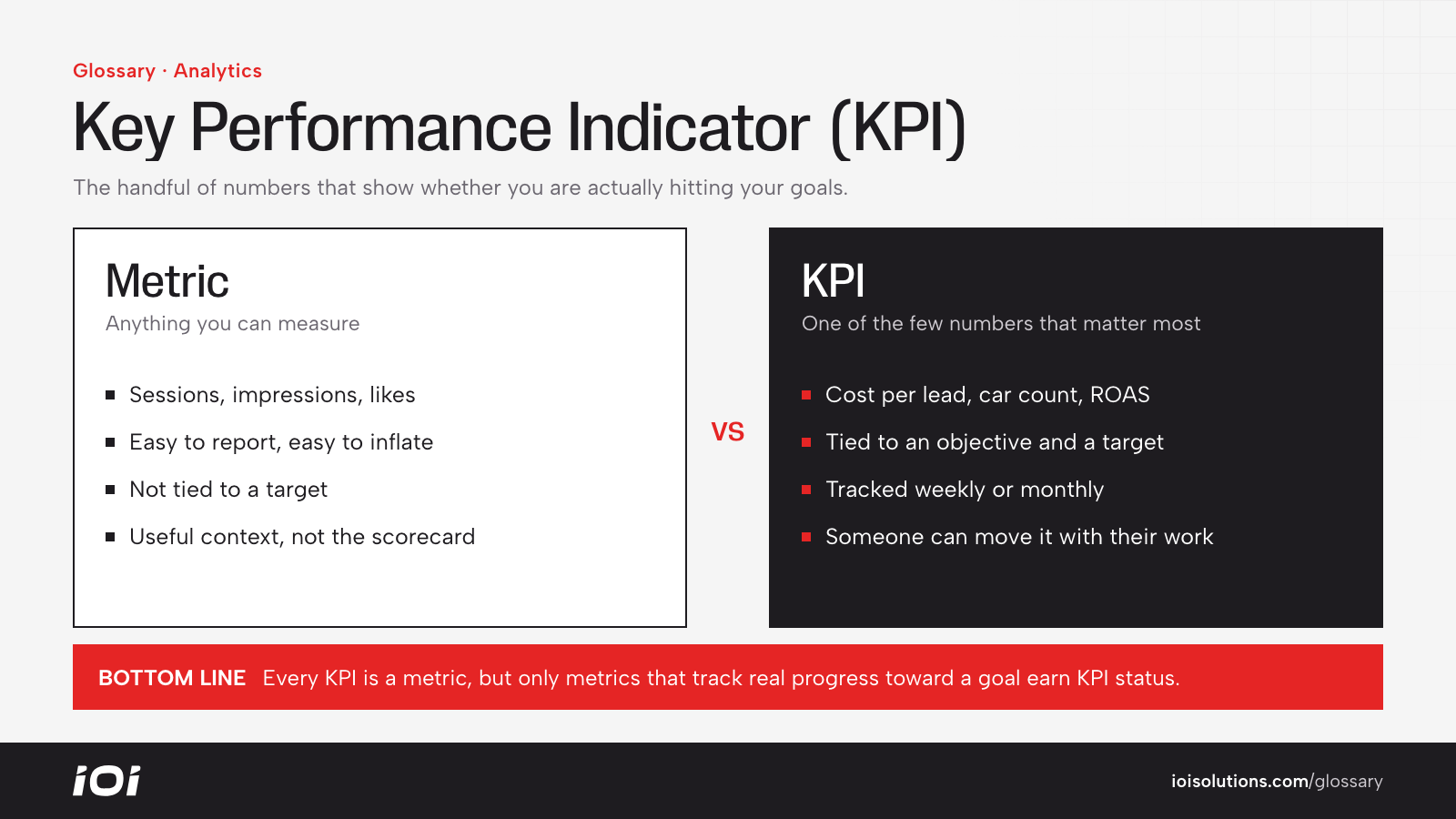
A key performance indicator (KPI) is a specific, measurable number that tells you whether you’re on track to hit an important goal. Not every metric is a KPI. A metric is anything you can measure. A KPI is one of the few metrics you’ve decided matter most, because it reflects real progress toward business results.
For example, website sessions are a metric. Qualified leads per month, cost per lead, and revenue from paid campaigns are more likely to be KPIs because they connect directly to growth.
Why KPIs Matter
Marketing produces an endless stream of data. Without clear KPIs, teams end up reporting whatever looks good, like impressions or likes, while the numbers that matter get buried.
Good KPIs:
- Create focus: Everyone knows what success looks like and what to prioritize.
- Enable faster decisions: When a KPI drops, you know where to look and what to fix.
- Align teams: Marketing, sales, and leadership work from the same scorecard.
- Hold partners accountable: Clear KPIs make agency and vendor performance easy to evaluate.
How KPIs Work
A KPI starts with a goal, then identifies the number that best indicates progress toward it. Useful KPIs are typically:
- Tied to an objective: They connect to a business outcome, often as part of a framework like OKRs.
- Measurable and reliable: The data source is accurate and consistent over time.
- Time-bound: They’re tracked against a specific period, like weekly or monthly.
- Actionable: Someone can influence the number through their work.
- Benchmarked: They have a target or baseline so you can tell whether performance is good or bad.
It also helps to separate leading indicators, which predict future results (like lead volume or appointment bookings), from lagging indicators, which confirm results after the fact (like revenue or profit). Many teams also choose one overarching North Star Metric with supporting KPIs beneath it.
KPIs in Automotive Marketing
The right KPIs depend on the business model:
- Dealerships: Cost per lead, cost per sale, lead-to-sale close rate, appointment show rate, VDP views, and gross profit per vehicle.
- Collision shops: Estimates requested, repair orders from marketing, average repair value, and cost per repair order.
- Repair and service shops: Booked appointments, cost per new customer, car count, and customer retention.
- Parts and accessories ecommerce: Return on ad spend, conversion rate, average order value, and repeat purchase rate.
- Automotive SaaS: Demo requests, qualified pipeline, customer acquisition cost, and churn.
Notice that most of these focus on outcomes like leads, sales, and revenue rather than clicks or impressions, which are better treated as diagnostic metrics. Those supporting numbers still matter, but mainly to explain why a KPI moved. If cost per sale rises, for instance, click-through rate, conversion rate, and lead quality help you pinpoint whether the problem is the ad, the landing page, or the follow-up process.
Best Practices
- Keep the list short. A handful of KPIs per team is enough. Track everything else as supporting data.
- Measure outcomes, not activity. Prioritize leads, sales, and revenue over vanity metrics.
- Define each KPI clearly. Write down exactly how it’s calculated and where the data comes from, so numbers don’t shift between reports.
- Set targets based on history. Use your own past performance as the baseline, since industry benchmarks vary widely.
- Review on a regular cadence. Weekly checks for leading indicators, monthly or quarterly for lagging ones.
- Connect marketing to sales data. Use CRM and marketing analytics integration so KPIs reflect actual revenue, not just form fills.