
What Is Forecasting?
Forecasting is the process of predicting future outcomes based on what you know today. In marketing and sales, forecasts typically estimate leads, conversions, revenue, customer demand or ad spend needs over a coming period, such as the next month, quarter or year.
A forecast is not a guess and not a goal. It is a reasoned estimate built from historical data, current trends and stated assumptions. Goals describe what you want to happen; forecasts describe what is likely to happen given your plan.
Why Forecasting Matters
Good forecasts turn marketing from a reactive cost into a planned investment.
- Budget planning. Forecasts show how much spend is needed to hit lead or revenue targets.
- Resource allocation. Staffing, inventory and capacity can be prepared ahead of demand.
- Early warning. Comparing actual results to forecast highlights problems before they become serious.
- Credibility. Leaders trust marketing teams that can predict results and explain variance.
How Forecasting Works
Common forecasting approaches include:
- Historical trend analysis. Project forward based on past performance, adjusted for growth or decline.
- Seasonal adjustment. Account for predictable patterns, such as busier months or holiday slowdowns.
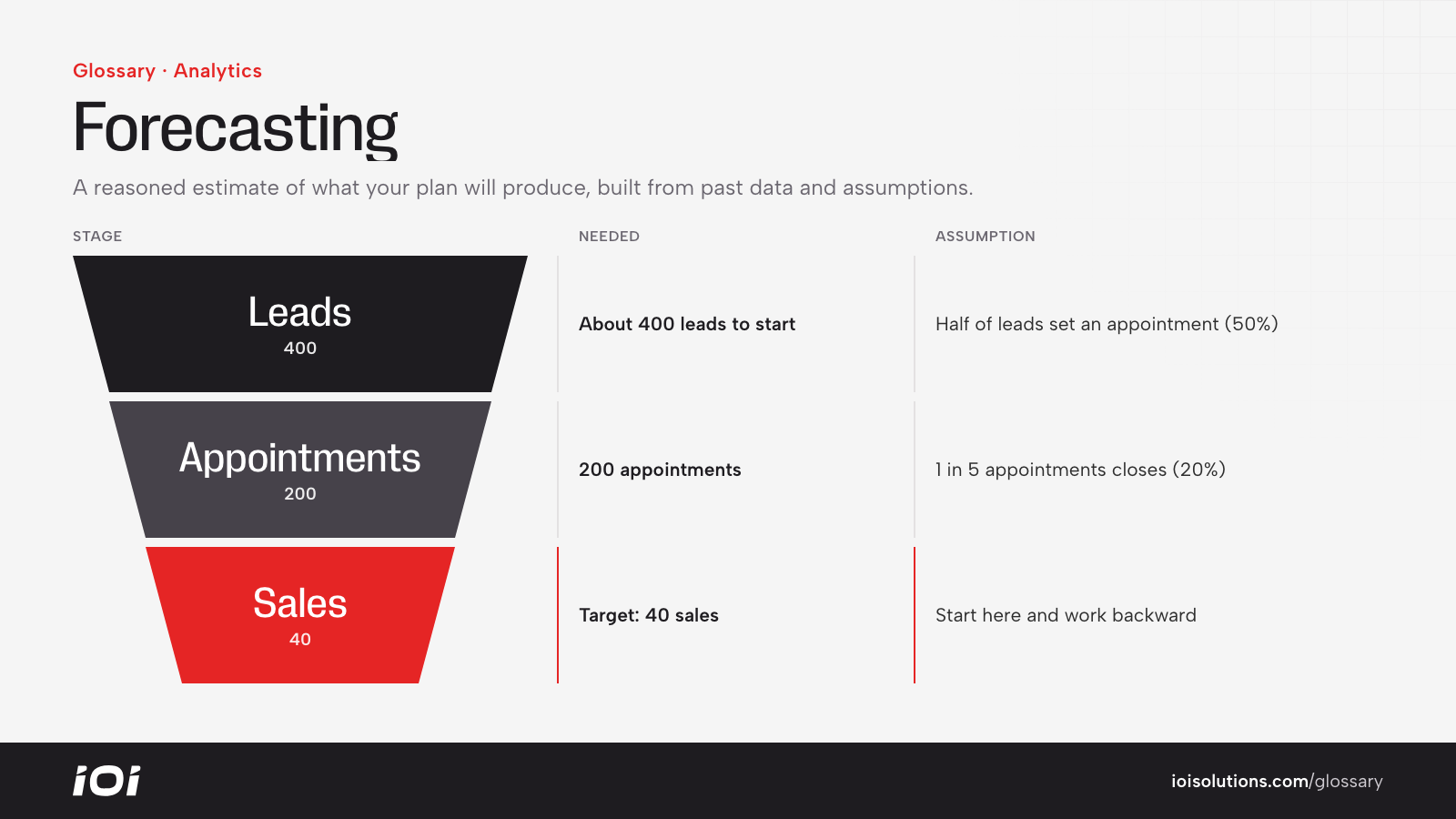
- Funnel-based forecasting. Work backward from a revenue target using conversion rates at each stage. For example, if you need 40 sales, close 20% of appointments and set appointments from 50% of leads, you need about 400 leads.
- Pipeline forecasting. Estimate future revenue from deals currently in progress, weighted by their likelihood to close.
- Statistical or machine learning models. Use larger datasets and multiple variables to predict outcomes.
Whatever the method, document your assumptions, such as expected cost per click, conversion rates and close rates. When results differ, you can see which assumption was wrong. Strong marketing analytics is the foundation, because forecasts are only as good as the data behind them.
Forecasting in Automotive Marketing
Automotive demand has strong patterns that make forecasting both valuable and complex:
- Dealerships forecast sales by new and used, model and month, factoring in inventory supply, incentive programs, model-year changeovers and holiday sales events. Marketing budgets should rise when supply and demand line up.
- Service departments and repair shops forecast car counts based on seasonality, weather and the size of their active customer base.
- Collision shops often see volume swings tied to weather events, such as winter storms or hail.
- Tire shops plan for seasonal surges when customers switch to winter tires or replace worn tires before road trips.
- Parts and accessories brands forecast around enthusiast seasons, new vehicle releases and holiday shopping.
For example, a dealership planning for a large inventory delivery could use its historical lead-to-sale rate and cost per lead to estimate how much advertising budget is needed to move those units within a target number of days. If the forecast shows the existing budget falls short, it can adjust before the inventory arrives rather than after it ages on the lot.
Best Practices
- Use clean, consistent data. Fix tracking gaps before relying on historical trends.
- Document assumptions. Write down the rates and costs your forecast depends on.
- Build ranges. Provide conservative, expected and optimistic scenarios rather than a single number.
- Account for seasonality and external events. Weather, incentives, supply changes and economic shifts all matter.
- Compare forecast to actual regularly. Review monthly and refine your model based on what you learn.
- Align with KPIs. Forecast the same metrics you use to manage the business.