
What Is Return on Ad Spend (ROAS)?
Return on ad spend, or ROAS, is a metric that compares the revenue generated by advertising with the amount spent on that advertising. It answers a simple question: for every dollar you put into ads, how many dollars in revenue came back?
ROAS is usually expressed as a ratio (such as 4:1 or 4x) or as a percentage (400%). It can be measured for an entire ad account, a single campaign, an ad group or even an individual ad, as long as revenue can be tied back to it.
Why ROAS Matters
ROAS is one of the most direct ways to judge whether paid advertising is pulling its weight. It helps you:
- Compare campaigns and channels on the same footing.
- Decide where to increase or cut budget.
- Set targets for automated bidding strategies such as Target ROAS in Google Ads.
- Spot campaigns that drive clicks but not revenue.
ROAS is not the same as profit. A campaign can show a strong ROAS and still lose money if product margins are thin, or if the figure ignores costs like agency fees, creative production and returns. That is why ROAS is best used alongside return on investment (ROI).
How to Calculate ROAS
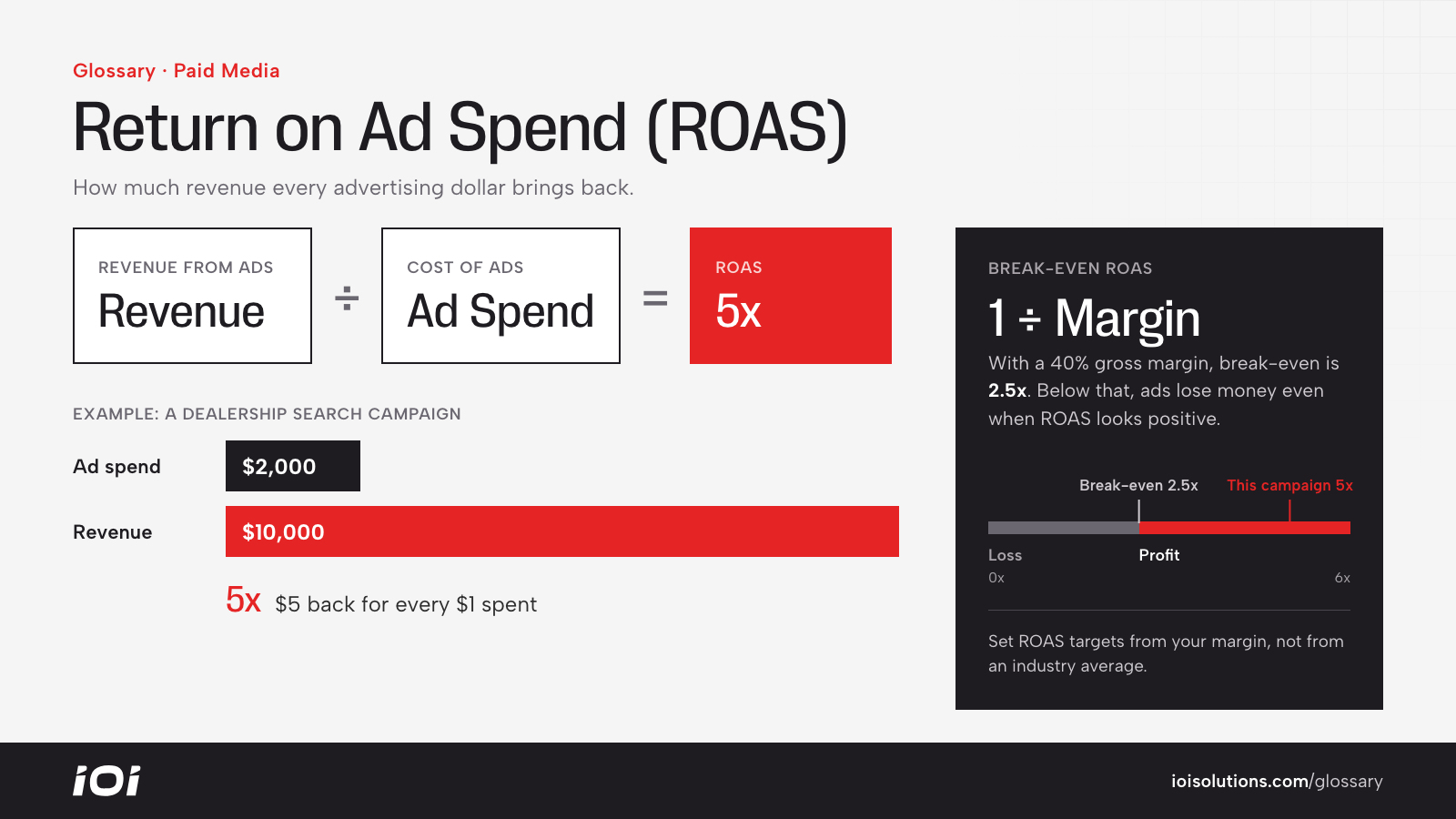
ROAS = Revenue attributed to ads ÷ Ad spend
For example, if a campaign costs $2,000 and generates $10,000 in tracked revenue, ROAS is 10,000 ÷ 2,000 = 5, often written as 5x or 500%.
Break-Even ROAS
To know whether a ROAS figure is profitable, calculate your break-even point:
Break-even ROAS = 1 ÷ Profit margin
If your gross margin is 40%, break-even ROAS is 1 ÷ 0.40 = 2.5. Anything below 2.5x loses money on the product sale before other costs; anything above contributes to profit.
Attribution Matters
The revenue in a ROAS calculation depends on how conversions are credited. Different platforms and different attribution models can report different ROAS for the same campaign, so be consistent in how you measure.
ROAS in Automotive Marketing
- Parts and aftermarket ecommerce: ROAS is a primary metric because online orders and their values are tracked directly. Higher average order value products, such as wheel and tire packages, can support lower conversion rates while maintaining healthy ROAS.
- Dealerships: Vehicle sales usually close offline, so true ROAS requires matching CRM or DMS sales back to ad-driven leads. Many dealers instead track cost per lead and cost per sale, then estimate ROAS using gross profit per vehicle.
- Collision and repair shops: Revenue comes from repair orders, so measuring ROAS means connecting calls and bookings to completed jobs in the shop management system.
- Detailers and wrap shops: High-ticket services like full wraps or paint protection film can produce strong ROAS from relatively few jobs, which makes careful lead tracking essential.
For example, a wheel retailer might find that its branded search campaign shows a very high ROAS, while prospecting campaigns look weaker, even though those prospecting ads introduced many of the buyers who later searched for the brand.
What Is a Good ROAS?
There is no universal target. A good ROAS depends on your margins, business model and goals, and it varies widely by industry and channel. A ratio around 3x to 4x is often cited as a general starting point for ecommerce, but a low-margin business may need much more, and a business focused on acquiring repeat customers may accept less. To improve ROAS:
- Know your break-even. Set targets from your actual margins, not industry averages.
- Track revenue accurately. Pass order values to ad platforms and import offline sales where possible.
- Cut waste. Add negative keywords, exclude poor placements and pause unprofitable products.
- Improve conversion rates. Better landing pages raise ROAS without raising spend.
- Raise order value. Bundles, upsells and free-shipping thresholds lift revenue per conversion.
- Look beyond last click. Judge upper-funnel campaigns by their contribution, not just their direct ROAS.