
What Is Average Order Value (AOV)?
Average order value (AOV) is the average dollar amount spent each time a customer places an order. It is a core ecommerce metric, but the same idea applies to any business that records individual transactions, including service shops that track the average ticket per repair order.
AOV doesn’t tell you how many customers you have or how often they buy. It tells you how much each transaction is worth, which makes it one of the three main levers of revenue: traffic, conversion rate and order value.
Why Average Order Value Matters
Raising AOV is often one of the cheapest ways to grow revenue, because you earn more from customers you’ve already paid to acquire. AOV matters because it:
- Determines how much you can afford to spend on advertising per order.
- Improves profit when fixed costs like shipping, payment fees and labor are spread across a bigger sale.
- Helps you judge whether promotions, bundles and upsells actually work.
- Feeds directly into return on ad spend, since ROAS rises when each conversion is worth more.
How to Calculate Average Order Value
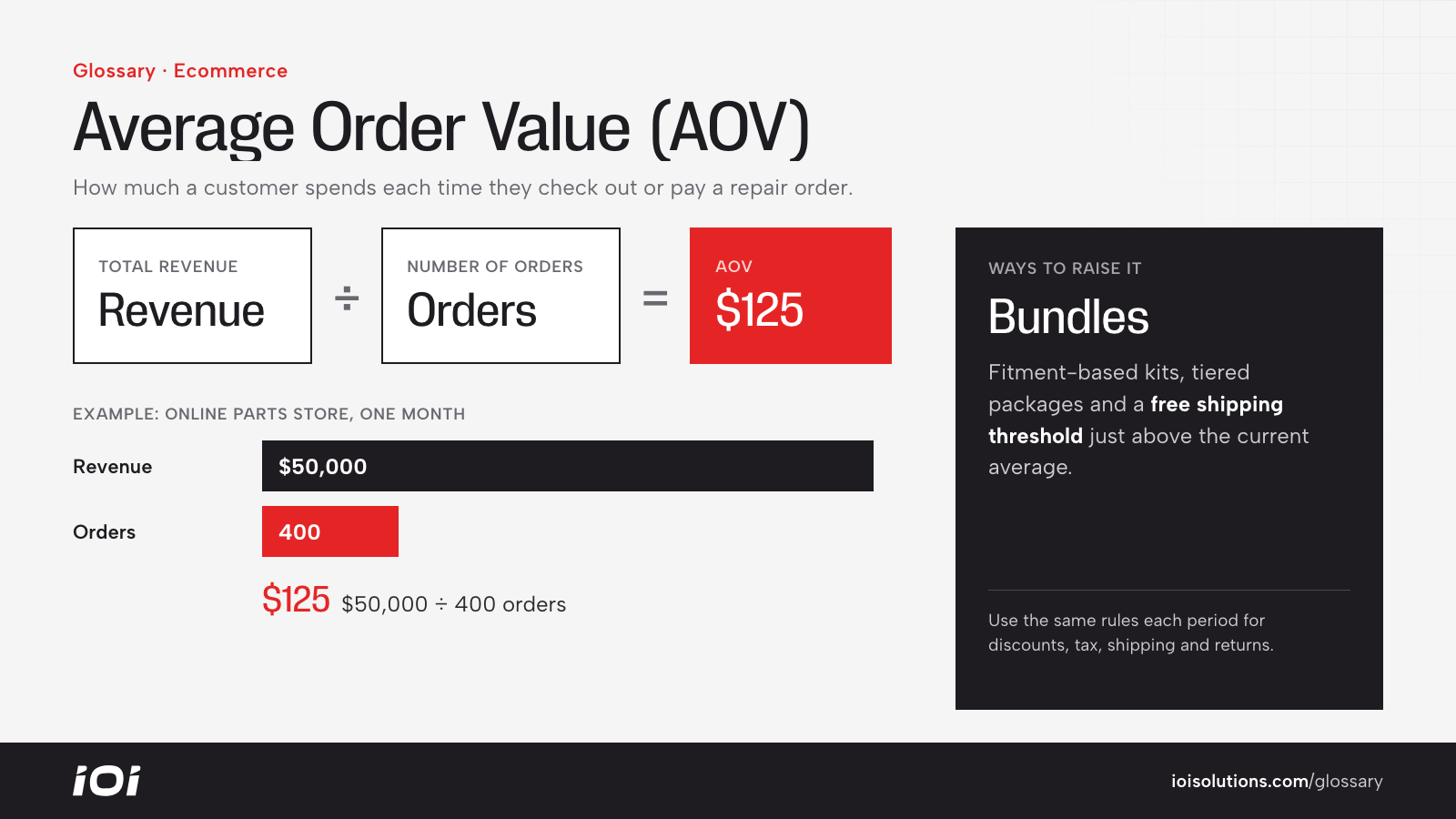
AOV = Total revenue ÷ Number of orders
For example, if an online parts store earns $50,000 from 400 orders in a month, its AOV is $125. Be consistent about what counts as revenue. Most teams calculate AOV after discounts and exclude taxes. Decide whether to include shipping charges and returns, and apply the same rules every period.
Averages can hide a lot. A handful of very large orders can pull AOV up, so it’s worth looking at the median and at AOV by product category, channel and customer type as well.
Average Order Value in Automotive Marketing
- Parts and accessories ecommerce: A brand selling truck accessories can raise AOV with fitment-based bundles, such as a lift kit with matching shocks and hardware, or with a free shipping threshold set just above the current average.
- Repair and tire shops: The service equivalent is average repair order value, sometimes called average ticket. Thorough inspections and clear recommendations for needed work raise it honestly.
- Detailers and protection shops: Tiered packages, such as offering paint correction or interior protection alongside a ceramic coating, give customers a reason to choose a larger package.
- Dealership service departments: Tracking average customer-pay repair order value by advisor and by marketing source shows which campaigns bring in more valuable visits.
AOV also guides ad strategy. For example, if a performance parts store finds that shoppers who arrive through vehicle-specific campaigns have a much higher AOV than those from generic campaigns, it can justify higher bids on vehicle-specific keywords.
What Is a Good Average Order Value?
A good AOV depends on your products, pricing and margins, and benchmarks vary widely by industry. Rather than chasing an outside number, track your own AOV over time and make sure it comfortably covers your acquisition cost and fulfillment costs.
- Offer relevant add-ons. Recommend items that genuinely complete the purchase, like installation hardware or maintenance kits.
- Bundle smartly. Package complementary products or services at a modest discount to the separate prices.
- Set a free shipping threshold. Place it a bit above your current AOV to encourage one more item.
- Use tiered pricing. Good, better and best options help customers self-select into higher value.
- Watch profit, not just AOV. Heavy discounts can raise order value while shrinking margin.
- Segment your data. Compare AOV by traffic source and campaign to direct budget toward higher-value buyers.