
What Is Attribution Modeling?
Attribution modeling is the set of rules used to decide which marketing touchpoints get credit when someone converts. Customers rarely act after one interaction. They might see a social video, search later, click an ad, read reviews and then call. An attribution model determines how much of that sale or lead is credited to each step.
The model you choose changes how your reports look, which in turn changes where you spend money. That makes attribution one of the most important and most debated topics in performance marketing.
Why Attribution Modeling Matters
Without attribution, you either guess or give all credit to whatever happened last. That tends to overvalue channels that close demand, such as branded search, and undervalue channels that create it, such as video and social. Good attribution helps you:
- Understand which channels start, nurture and close conversions.
- Shift budget toward what genuinely drives results.
- Avoid cutting a channel that looks weak in last-click reports but feeds the rest of the funnel.
- Calculate more realistic return on ad spend by channel.
Types of Attribution Modeling
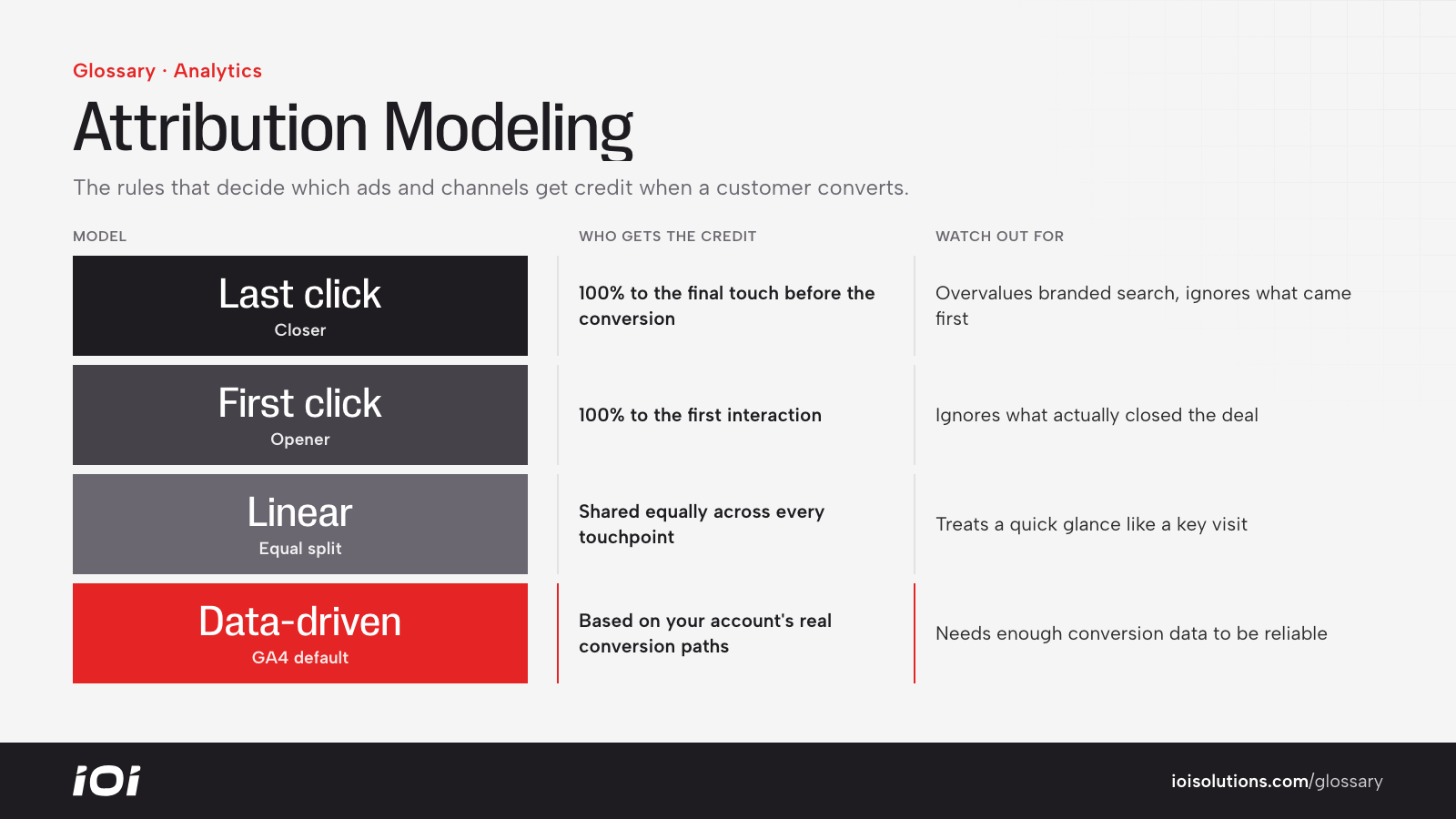
- Last click: All credit goes to the final touchpoint before conversion. Simple, but blind to everything earlier.
- First click: All credit goes to the first interaction. Useful for understanding discovery, but ignores what closed the deal.
- Linear: Credit is split equally across every touchpoint.
- Time decay: Touchpoints closer to the conversion get more credit.
- Position-based (U-shaped): Most credit goes to the first and last touches, with the remainder shared among the middle.
- Data-driven: Uses your account’s actual conversion paths and statistical modeling to assign credit. Google Ads and Google Analytics 4 now use data-driven attribution as the default, and Google has retired most of the older rule-based options in those tools.
Beyond these models, many advertisers use marketing mix modeling, which estimates channel impact from aggregate spend and sales over time, and incrementality testing, which uses holdout groups to measure lift. These approaches help where user-level tracking is limited by privacy changes and cross-device behavior.
Attribution Modeling in Automotive Marketing
Automotive buying journeys are long and messy, which makes attribution both difficult and valuable.
- Dealerships: A shopper may browse third-party marketplaces, watch a walkaround video, click a vehicle listing ad and finally walk in without filling out a form. Matching sold customers from the DMS back to marketing touchpoints gives a far truer picture than counting form leads.
- Collision shops: Many jobs come from phone calls and insurance referrals. Call tracking with unique numbers per channel helps separate search, maps and referral volume.
- Repair shops: Repeat customers often book directly, so tying repair orders back to the first campaign that acquired them shows real lifetime value by channel.
- Parts brands: Ecommerce stores can track online journeys more fully, but platform-reported results often overlap. Comparing ad platform claims to actual store revenue keeps reporting honest.
Best Practices
- Track every conversion type. Calls, forms, chats, bookings and purchases should all be measured before you debate models.
- Connect offline sales. Import CRM or DMS outcomes so attribution reflects revenue, not just leads.
- Use consistent tagging. Apply UTM codes to every non-Google link so traffic sources stay clean.
- Don’t trust one view. Compare platform data, analytics and back-end sales to find the realistic range.
- Test incrementality. When budget allows, run geographic or audience holdouts to see what truly adds sales.
- Keep the model consistent. Switching models often makes trend comparisons meaningless.