
What Is a North Star Metric (NSM)?
A North Star Metric (NSM) is the one metric a company chooses as its primary indicator of success. It’s meant to capture the core value customers get from your product or service, on the theory that if that value keeps growing, revenue and long-term growth will follow. Like the North Star for navigation, it gives every team a fixed point to steer toward.
The concept became popular among software and product-led companies, but it applies to any business that wants to focus its teams on a shared outcome.
Why a North Star Metric Matters
Most businesses track dozens of metrics and KPIs. Without a central focus, teams can optimize their own numbers in ways that don’t help the business as a whole. Marketing might chase lead volume while sales complains about quality. Operations might cut costs in ways that hurt customer experience.
A good North Star Metric:
- Aligns marketing, sales, operations, and leadership around one shared goal.
- Helps teams prioritize projects based on what moves the needle.
- Reflects customer value, not just short-term revenue.
- Serves as a leading indicator of future growth.
How a North Star Metric Works
Choosing an NSM usually involves a few steps:
- Define your core value. What does a customer get from you that keeps them coming back?
- Find a measurable expression of that value. Look for a number that rises when customers get more value.
- Check that it leads to revenue. The metric should predict future revenue and profit, not just activity.
- Break it into input metrics. Identify the smaller drivers each team can influence, such as new customer acquisition, frequency, or retention.
- Set goals and review progress. Many teams connect the NSM to OKRs so each team’s objectives ladder up to it.
Revenue itself is usually not a good North Star. It’s a lagging result rather than a direct measure of customer value, and chasing it alone can encourage short-term thinking.
North Star Metric in Automotive Marketing
A North Star Metric depends on the business model. Some hypothetical examples:
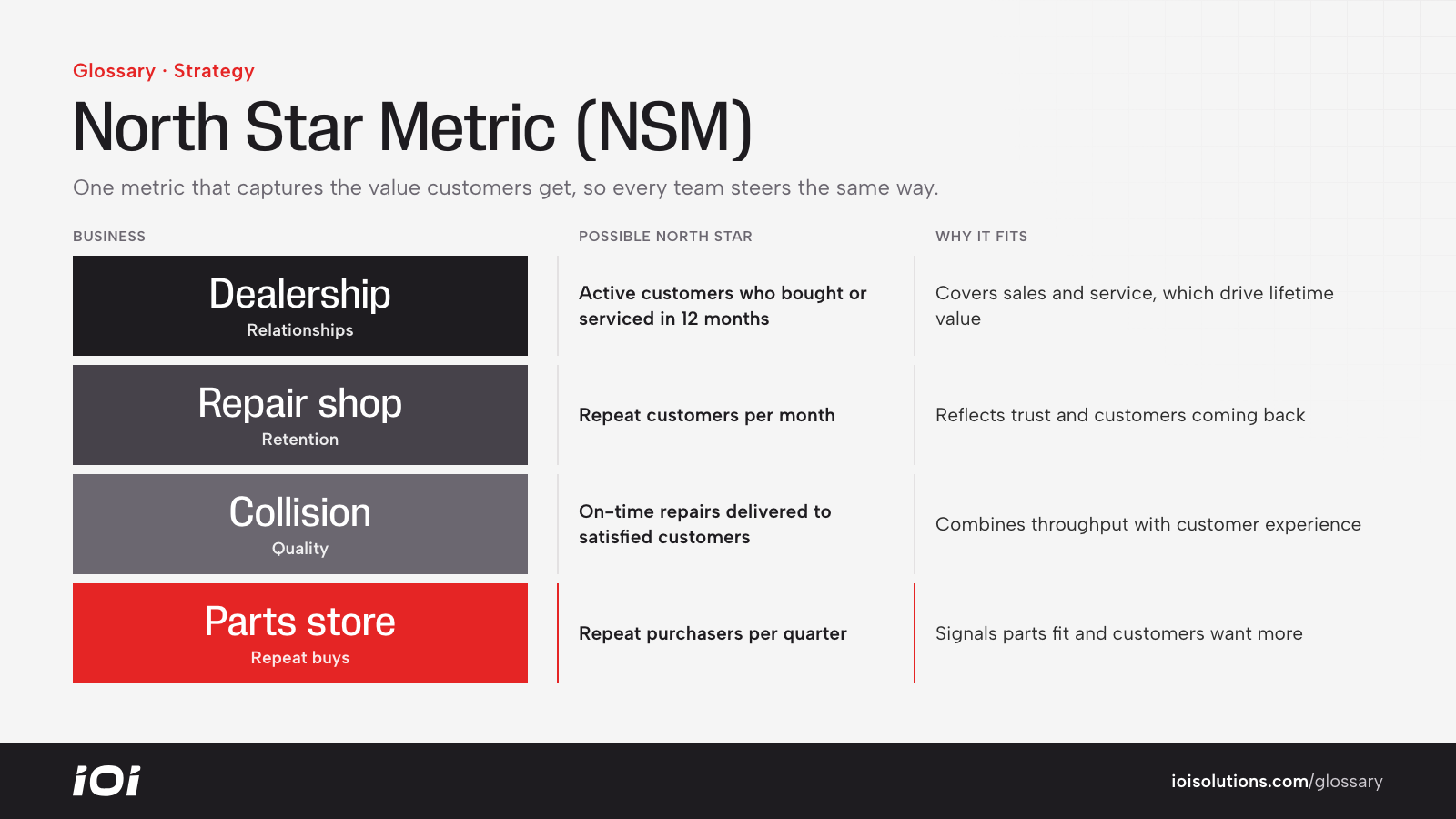
- Dealership: Active customers who bought or serviced a vehicle in the past 12 months. This reflects both sales and service relationships, which drive lifetime value.
- Repair shop: Repeat customers per month, or vehicles serviced per month among returning customers, reflecting trust and retention.
- Collision shop: Completed repairs delivered on time with satisfied customers, combining volume and quality.
- Parts and accessories ecommerce: Repeat purchasers per quarter, signaling that customers found parts that fit and want more.
- Automotive SaaS: Weekly active rooftops or shops using the product’s core feature, since active usage tends to predict renewals.
Marketing supports the NSM by bringing in the right customers, not just more customers, and by contributing to retention through reminders, loyalty programs, and relevant communication.
Best Practices
- Choose one metric. A North Star loses its power if you have five of them.
- Tie it to customer value. The metric should rise only when customers are genuinely better off.
- Make it understandable. Everyone, from technicians to executives, should know what it means and how they affect it.
- Support it with input metrics. Give each team a few drivers it can directly influence.
- Revisit it as you grow. A new business model, product line, or market may call for a different North Star.
- Watch for gaming. Pair the NSM with guardrail metrics, like profitability or customer satisfaction, so it isn’t improved at the expense of the business.