
What Is Lifetime Value (LTV)?
Lifetime value (LTV), also called customer lifetime value (CLV or CLTV), is an estimate of how much a customer is worth to your business over the full time they buy from you. Instead of looking only at the first purchase, LTV considers repeat purchases, renewals, and ongoing services.
LTV can be calculated using revenue or, more usefully, gross profit. A revenue-based LTV tells you how much a customer spends. A profit-based LTV tells you how much you actually keep, which is what matters when deciding how much you can afford to spend acquiring them.
Why Lifetime Value Matters
LTV changes how you think about marketing spend. If you only look at the first sale, many acquisition costs look too high. But if a customer comes back for years, you can justify spending more to win them, and outbid competitors who only see the first transaction.
LTV is most powerful when paired with customer acquisition cost (CAC). The LTV-to-CAC ratio shows whether your growth is profitable. It also helps you:
- Identify which customer segments and channels are most valuable.
- Set smarter bidding targets in paid media.
- Justify investment in retention, loyalty, and customer experience.
How to Calculate Lifetime Value
A simple, common version of the formula is:
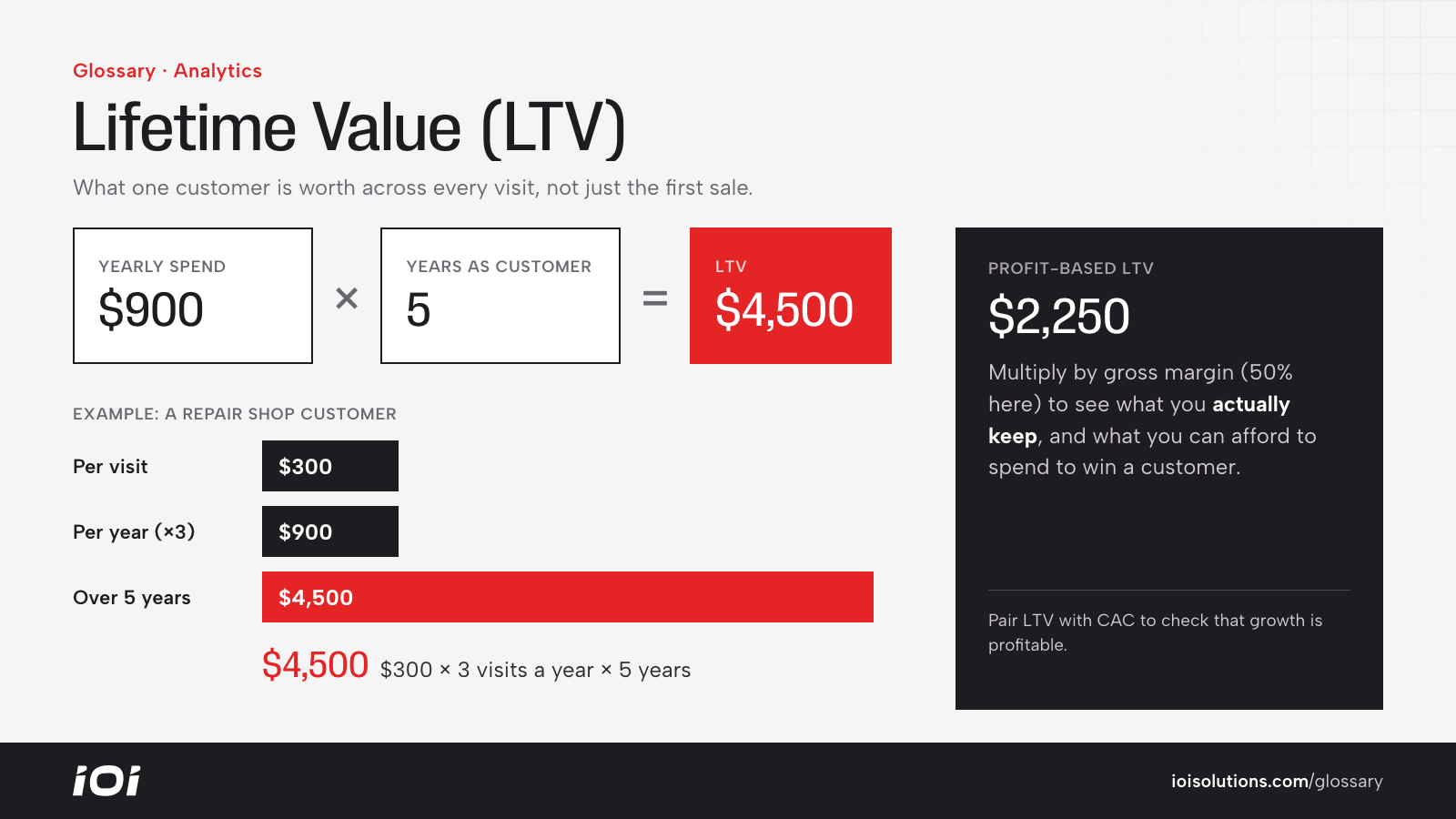
LTV = Average purchase value x Purchase frequency per year x Average customer lifespan (years)
To make it profit-based, multiply by your gross margin:
Profit LTV = Average purchase value x Purchase frequency x Lifespan x Gross margin %
For subscription businesses, a common shortcut is average revenue per account per month divided by the monthly churn rate, then multiplied by gross margin.
For example, imagine a repair shop whose average customer spends $300 per visit, visits three times a year, and stays for five years. That customer’s revenue LTV is $4,500. If the shop’s gross margin is 50 percent, the profit LTV is $2,250. Knowing that, paying $100 or more to acquire a new customer may look very reasonable.
Lifetime Value in Automotive Marketing
- Dealerships: A car buyer’s value extends far beyond the first deal. Service visits, F&I products, future trade-ins, and repeat purchases all add to LTV, which is why service retention is so important to dealer profitability.
- Repair shops: Routine maintenance creates recurring visits. Winning a customer with an oil change special can make sense if they stay for years of maintenance and repairs.
- Collision shops: Individual drivers may need collision repair rarely, so LTV often comes from referral sources like insurance agents, fleets, and dealerships that send repeat work.
- Parts and accessories ecommerce: Enthusiasts who modify their vehicles often make many purchases over time. Combining average order value with repeat purchase rate shows how much you can spend on first-time buyers.
- Automotive SaaS: Monthly subscriptions, add-on modules, and multi-rooftop expansions drive LTV, while churn reduces it.
Best Practices
- Use profit, not just revenue. Profit-based LTV gives you a realistic ceiling for acquisition spend.
- Segment LTV. Calculate it by channel, service type, vehicle type, or customer group. Some segments are far more valuable than others.
- Be conservative with lifespan. Use actual retention data where possible instead of optimistic assumptions.
- Track LTV-to-CAC. A ratio well above one is generally considered healthy, though the right target depends on your margins and cash flow.
- Invest in retention. Follow-up reminders, loyalty programs, and great service experiences raise LTV directly.
- Feed LTV into bidding. Where platforms allow value-based bidding, pass conversion values that reflect long-term worth, not just the first transaction.