
What Is Guest Posting?
Guest posting, also called guest blogging, is the practice of writing content that is published on someone else’s website. In exchange for providing useful content, the author usually gets a byline, a short bio and often a link back to their own site.
Done well, guest posting is a relationship-based way to reach new audiences and build authority. Done poorly, as mass-produced articles placed purely for links, it can violate search engine guidelines and provide little value.
Why Guest Posting Matters
Guest posting serves several marketing goals at once:
- Audience reach. You get in front of readers who already trust the host publication.
- Credibility. Being published by respected sites positions you as an expert.
- Referral traffic. Interested readers may click through to your site.
- Link building. Relevant, editorially earned backlinks from quality sites can support SEO.
- Relationships. Working with editors and site owners can lead to partnerships, interviews and future opportunities.
How Guest Posting Works
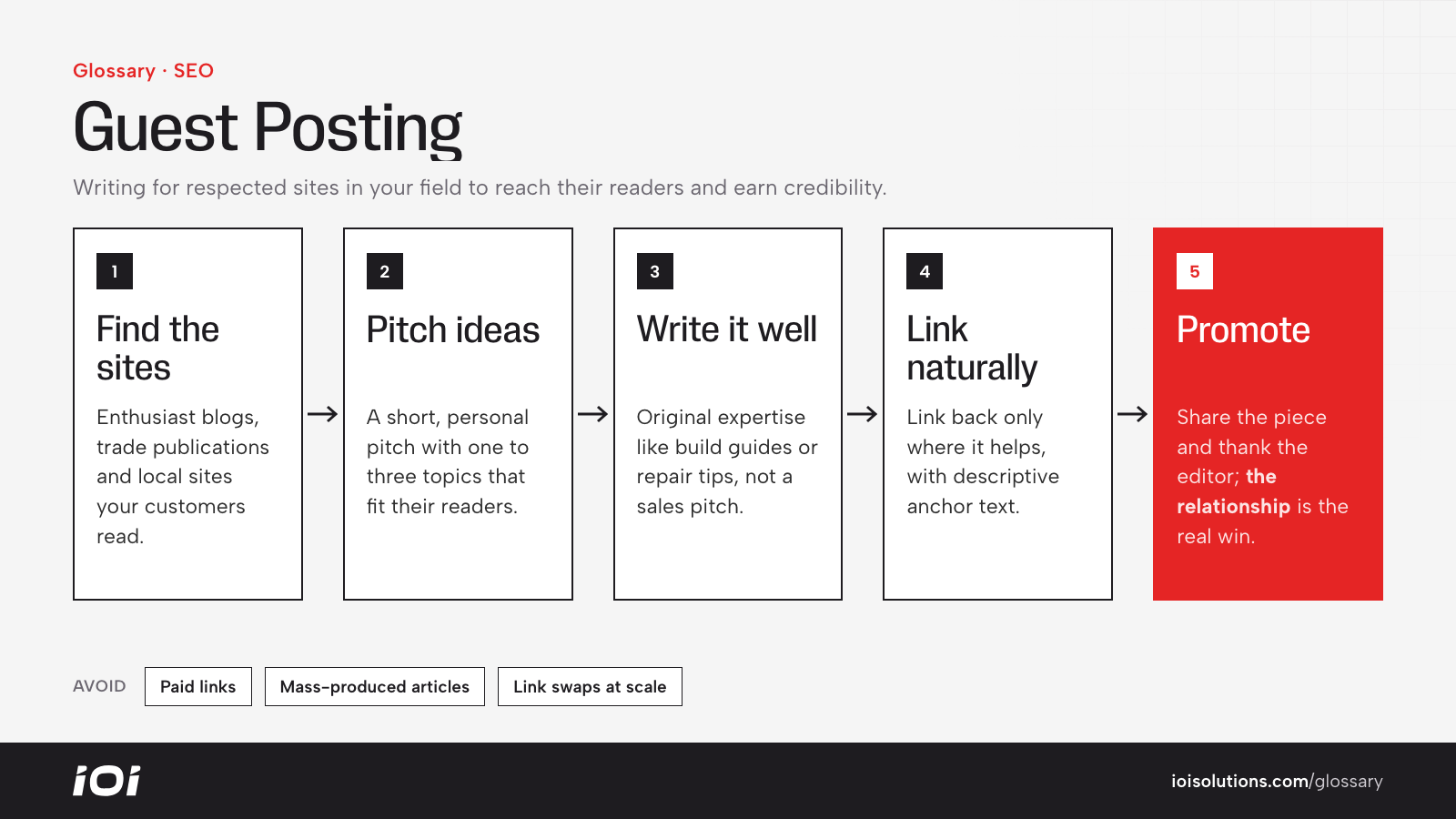
- Find relevant publications. Look for industry blogs, trade publications, local news sites, partner companies and community sites your customers actually read.
- Study the site. Review their audience, tone, topics and contributor guidelines.
- Pitch specific ideas. Send a short, personalized pitch with one to three topic ideas that fit their readers.
- Write genuinely useful content. Provide original insight, examples and expertise, not a disguised sales pitch.
- Link naturally. Include a link to your site only where it adds value, with descriptive, natural anchor text.
- Promote and follow up. Share the published piece and thank the editor.
Search engine guidelines matter here. Google treats links that are bought, exchanged at scale or placed in low-quality guest articles primarily to manipulate rankings as link spam. Links in guest content may be expected to carry rel=”nofollow” or rel=”sponsored” attributes when they are not editorially given. The safest approach is to pursue guest posting for audience and credibility, treating any SEO benefit as a bonus, in line with white hat SEO principles.
Guest Posting in Automotive Marketing
The automotive world has many niche publications, blogs and communities where guest content fits naturally:
- Aftermarket parts brands can contribute build guides, technical explanations or product comparisons to enthusiast blogs and club websites.
- Collision and repair shop owners can write for local news sites, community blogs or insurance agency newsletters about accident steps, seasonal maintenance or vehicle safety technology.
- Detailers and PPF installers can share care guides with car clubs, local lifestyle publications or partner dealerships.
- Automotive software companies can contribute to trade publications and industry association blogs on topics like shop efficiency or dealership operations.
For example, a ceramic coating shop might write a practical guide on caring for a new vehicle’s paint for a local dealership’s blog. The dealer gets helpful content for its buyers, and the shop gets exposure to new car owners and a relevant local link.
Best Practices
- Prioritize relevance over metrics. A smaller site your customers read beats a large unrelated one.
- Write your best work. Guest content represents your brand, so make it genuinely helpful.
- Avoid paid link schemes. Do not buy guest posts on networks that exist only to sell links.
- Keep links natural. One or two relevant links with descriptive anchor text are enough.
- Build ongoing relationships. Become a regular contributor where it makes sense.
- Track outcomes. Measure referral traffic, leads and mentions from each placement.