
What Is Collision Estimating Software?
Collision estimating software is the specialized program body shops, insurance appraisers and adjusters use to write repair estimates for damaged vehicles. It contains databases of vehicle parts, part prices, labor times for removal and installation, refinish times and other repair operations, organized by year, make and model. Estimators select damaged parts and operations, and the system calculates labor hours, parts costs, paint materials and totals.
A small number of major estimating platforms dominate the North American collision market, and many insurers specify which system they use for claims. Shops often license one or more of them to work with different carriers.
Why Collision Estimating Software Matters
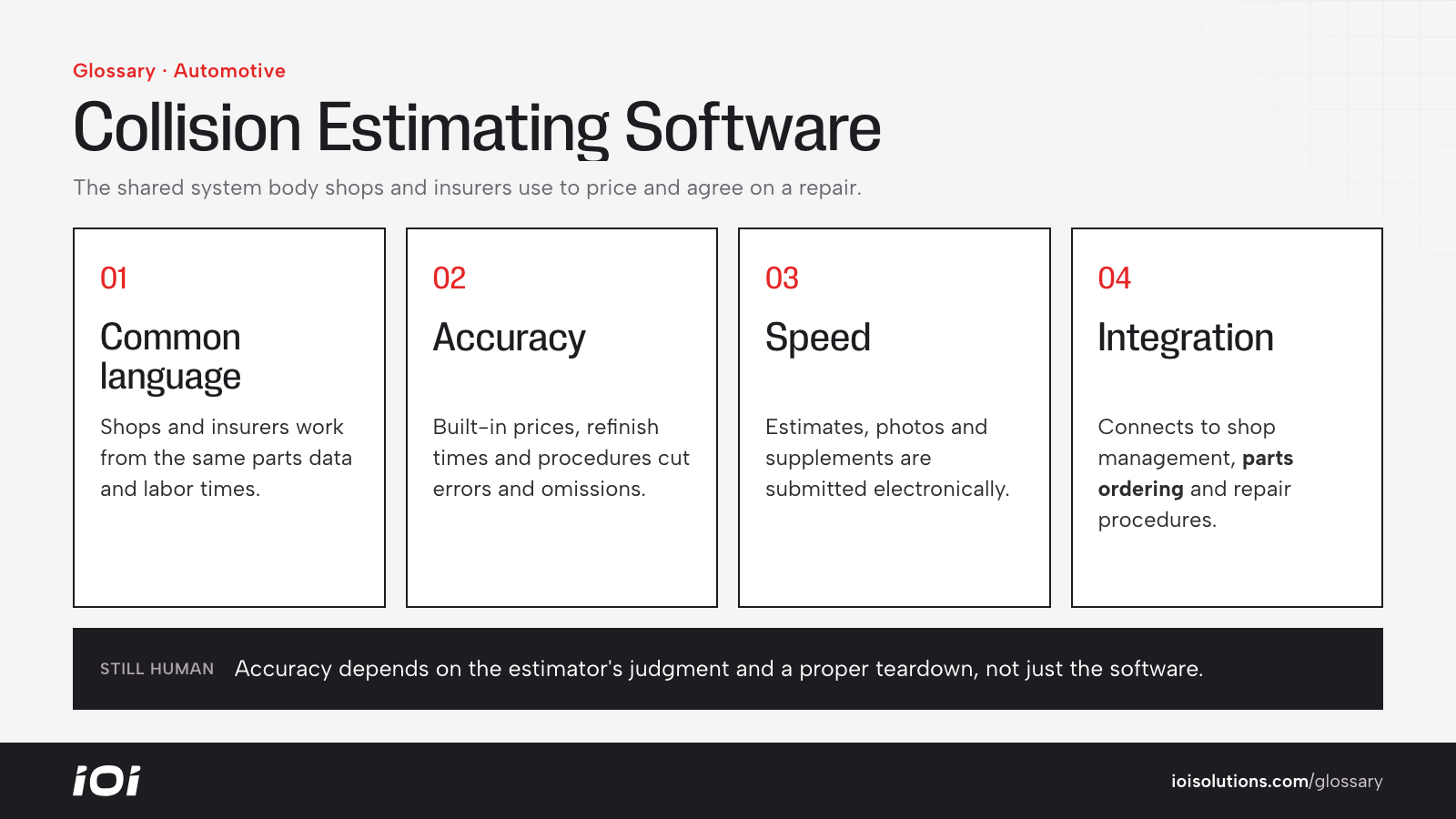
- Common language: shops and insurers need a shared format to agree on what the repair should cost.
- Accuracy: built-in parts data and labor times reduce errors and omissions compared with manual estimates.
- Speed: estimates, photos and supplements can be submitted electronically for faster approval.
- Integration: most systems connect with shop management systems, parts ordering, and repair procedure databases.
- Data and reporting: estimating data feeds metrics such as repair severity and repair mix.
How Collision Estimating Software Works
- Vehicle identification: the estimator enters or decodes the VIN to load the correct vehicle configuration.
- Damage selection: the estimator chooses damaged parts from graphical views, specifying repair, replace or refinish.
- Labor and materials: the system applies published labor times, refinish times and paint materials calculations, which the estimator can adjust with notes.
- Parts sourcing: options for OEM, aftermarket, used or reconditioned parts may be included depending on insurer guidelines.
- Required procedures: estimators add items such as pre- and post-repair scans and ADAS calibration.
- Submission: the estimate is shared with the insurer and updated through supplements as needed.
Many platforms now include photo-based estimating features and connections to OEM repair information, though accuracy still depends on the estimator’s judgment and a proper teardown.
How Collision Estimating Software Affects Marketing
For body shops, estimating systems are back-office tools, but they influence how leads are handled and what a marketer can measure.
- Online estimate requests. Many shops let customers upload damage photos through a website form. Those photos feed the estimator’s first look and speed up the process.
- Lead quality and severity data. Estimating and shop management data reveal which campaigns bring in larger repairs.
- Clear messaging. Shops can explain that photo estimates are preliminary and that final estimates follow inspection, which sets fair expectations.
For software companies, collision estimating is itself a B2B market. Vendors marketing estimating platforms or add-on tools to shops and insurers rely on trade shows, industry associations, demos and content explaining integrations, accuracy and workflow benefits. Their buyers are shop owners, estimators and insurance claims leaders, so messaging should focus on cycle time, accuracy and administrative time saved.
For example, a collision center might add a photo upload step to its estimate request landing page. Fewer people may complete the form, but the leads that do are more serious and easier for estimators to qualify.
Best Practices
- Offer an easy photo upload option for online estimate requests, while stating that final estimates require inspection.
- Connect lead sources to your estimating or shop management data so you can measure revenue by campaign.
- Explain the estimate process clearly on your website to reduce customer confusion.
- Make sure estimators respond quickly to online requests, since speed to response affects conversion.
- For software vendors, show real workflows in demos and content rather than vague feature claims.