
What Is a Total Loss?
A total loss is a vehicle that an insurance company decides to pay out rather than repair. Instead of funding a repair, the insurer pays the owner the vehicle’s actual cash value (ACV) before the loss, minus any deductible, and usually takes possession of the damaged car to sell as salvage.
The decision depends on cost. If estimated repairs plus the expected salvage value come close to or exceed what the car was worth, repairing it no longer makes financial sense. Many states also set a total loss threshold: if repair costs reach a set percentage of ACV, the vehicle must be declared a total loss and branded on its title. That percentage differs from state to state, and some states use a formula instead.
Flood, fire, theft that is never recovered, and severe structural damage are common causes.
Why Total Loss Matters
Total losses affect several parts of the automotive industry at once:
- Collision shops lose the repair when a car is totaled, though they may still bill teardown, estimating, and storage. As vehicles with sensors and complex materials become more expensive to repair, more borderline cars are totaled.
- Towing and storage operators handle total loss vehicles, and the movement to salvage yards and auctions is a steady business line.
- Dealers gain buyers. Every total loss creates a customer who needs a replacement vehicle, often quickly and with an insurance check in hand.
- Vehicle owners may have negative equity if they owe more than the payout, which is where gap coverage comes in.
How a Total Loss Works
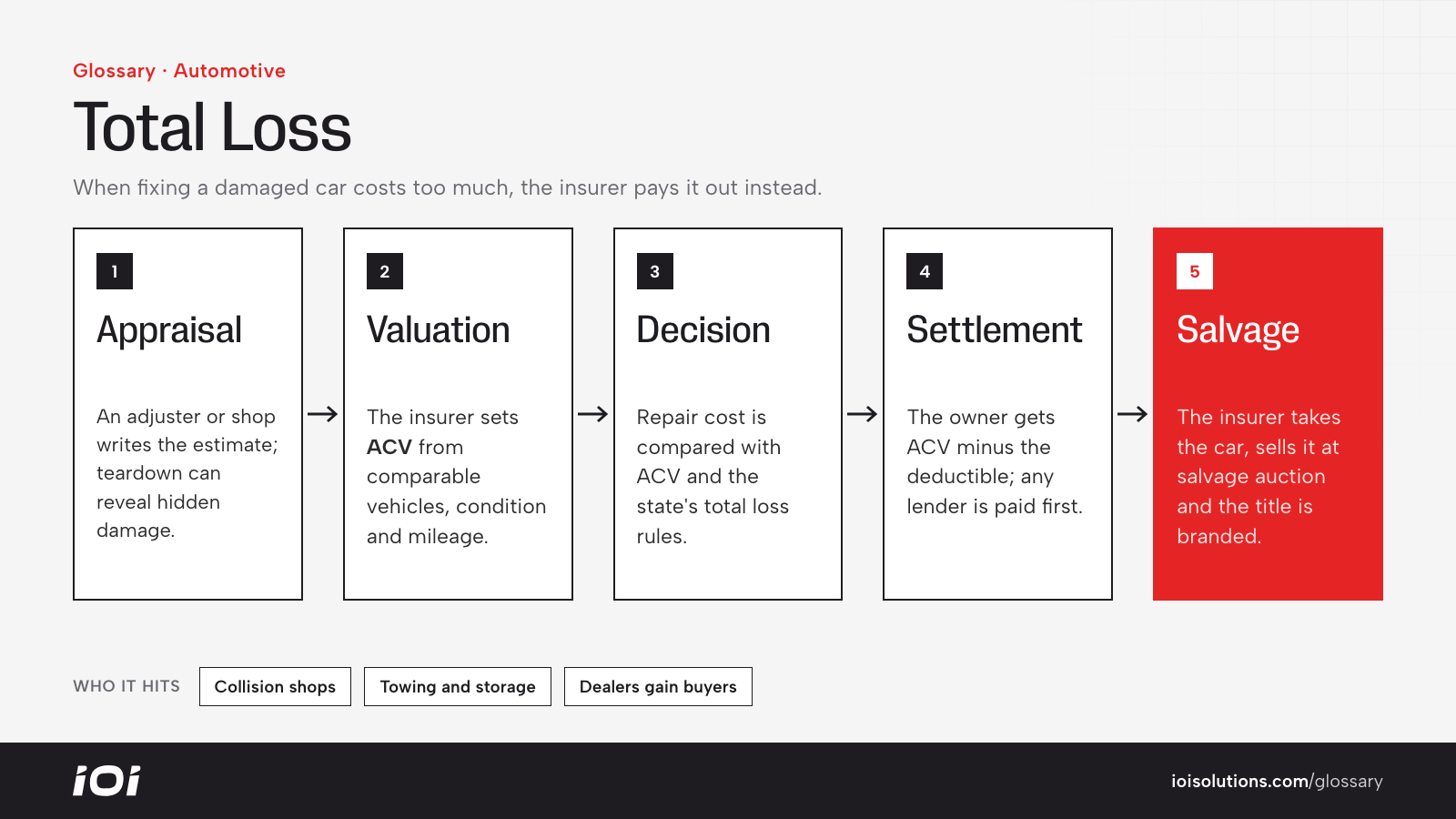
The usual sequence looks like this:
- Damage appraisal. An adjuster or shop writes an estimate. Hidden damage found during teardown can push a repairable car into total loss territory, sometimes through a supplement.
- Valuation. The insurer determines ACV using comparable vehicles, condition, mileage, and options, often with a third-party valuation service.
- Decision. The insurer compares repair cost to ACV and state rules and declares the car a total loss.
- Settlement. The owner is paid ACV minus the deductible. If there is a loan, the lender is paid first.
- Salvage. The car is transferred to the insurer and typically sold through a salvage auction, and the title is branded according to state law.
Owners can sometimes dispute the valuation or keep the vehicle in exchange for a reduced payout.
How Total Loss Affects Marketing
Total losses create both lost revenue and new demand, and good marketers plan for both.
For a collision shop, a rising share of total losses can quietly shrink revenue even when car counts look steady. Tracking repair severity and total loss ratios helps a shop understand whether it needs more volume to hit its numbers. Marketing can also explain the process to customers, who often do not understand why their car was totaled or what happens next. Helpful content builds trust and keeps the shop in the conversation for the next claim.
For dealers, total loss shoppers are a valuable audience. They have a deadline, often a rental that is about to run out, and frequently a settlement check. For example, a dealer could build a landing page and search campaign around “car was totaled, what now” topics, explaining gap coverage, settlement timing, and how to shop for a replacement. Partnerships with local body shops can also send these customers to the store.
For towing companies, relationships with insurers, salvage auctions, and shops determine total loss volume more than consumer advertising does, so B2B outreach often matters more than ads.
Best Practices
- Educate, do not alarm. Create plain-English content explaining total loss decisions, valuation, and owner rights.
- Track total loss rates. Shops should monitor what share of estimates end as total losses and how that trend affects revenue.
- Build referral partnerships. Body shops and dealers can refer total loss customers to each other.
- Respect the situation. These customers just had an accident. Messaging should be helpful and calm, not pushy.
- Stay accurate. Avoid promising specific payouts or outcomes, which are set by insurers and state rules.