
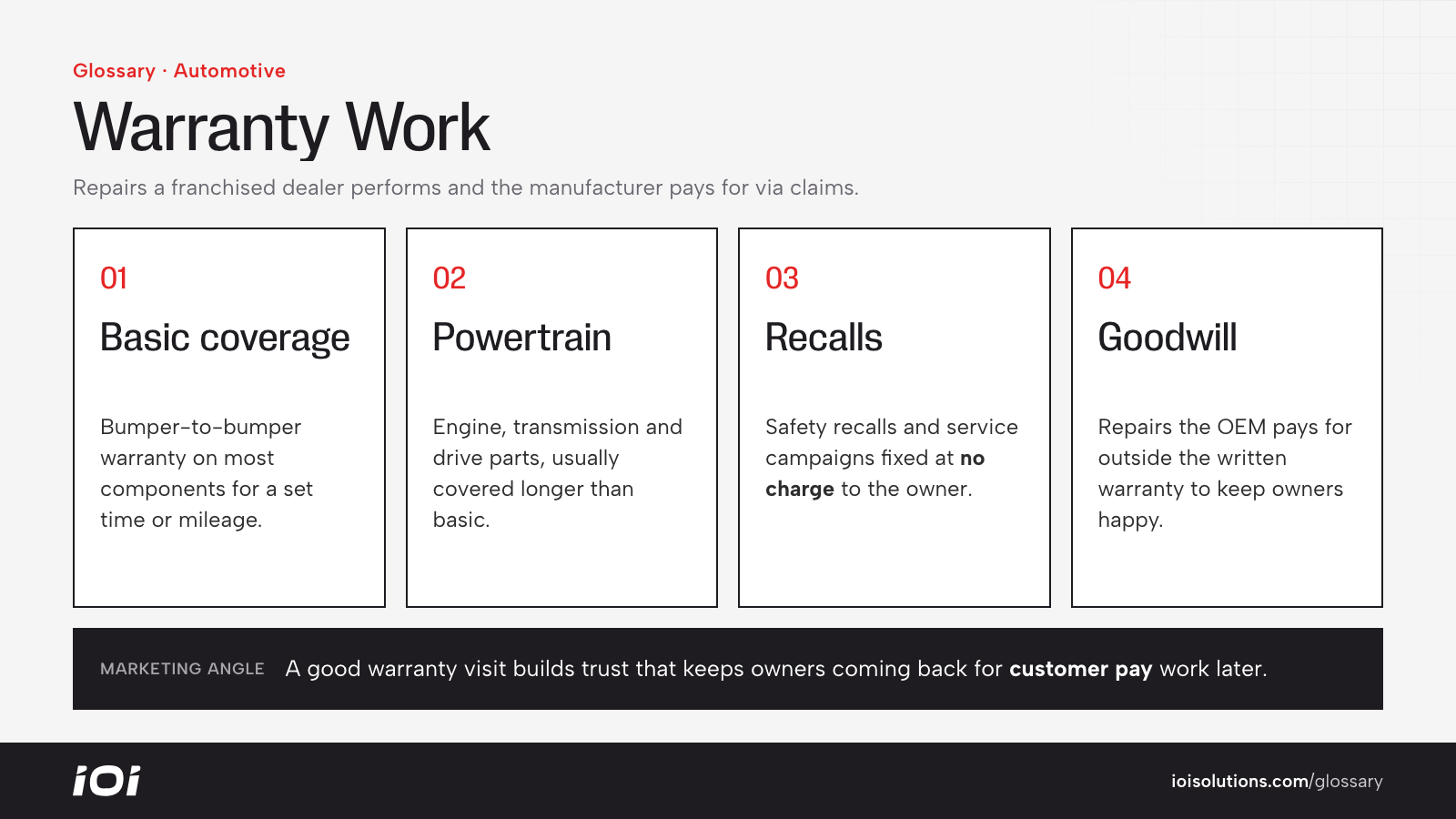
What Is Warranty Work?
Warranty work is repair or replacement performed on a vehicle under a manufacturer’s warranty, where the OEM rather than the owner pays the bill. Franchised dealers perform the repair, submit a claim to the manufacturer and are reimbursed for labor and parts according to the OEM’s policies. Recall campaigns and some goodwill repairs are handled through the same claim system.
On a repair order, warranty lines are coded separately from customer pay and internal work so the department can track each pay type’s volume and profitability.
Why Warranty Work Matters
Warranty is a significant source of service volume for franchised dealers, particularly for newer vehicles. It also matters for reasons beyond direct revenue.
- Steady traffic: warranty and recall visits bring owners into the service lane regularly during the first years of ownership.
- Relationship building: a good warranty experience encourages owners to keep using the dealer for paid maintenance later.
- Upsell opportunities: during a warranty visit, technicians can inspect the vehicle and advisors can recommend needed customer pay services.
- Reimbursement rules: many US states have laws addressing how manufacturers must reimburse dealers for warranty parts and labor, which affects how profitable warranty is.
The downside is that warranty labor is reimbursed using manufacturer time standards that can feel tight to technicians, and claims can be denied or charged back if paperwork is incomplete.
Types of Warranty Work
- Bumper-to-bumper or basic warranty: covers most components for a set time or mileage period.
- Powertrain warranty: covers engine, transmission and drive components, usually for longer than basic coverage.
- Emissions and federal-mandated coverage: certain emissions components carry legally required coverage periods.
- Recalls and campaigns: safety recalls and manufacturer service campaigns fixed at no charge to the owner.
- Certified pre-owned coverage: extended factory coverage on CPO vehicles.
- Goodwill or policy repairs: repairs the OEM pays for outside the written warranty as a customer satisfaction gesture.
Extended service contracts sold in F&I are often tracked separately, since they are usually administered by a third party or a manufacturer-backed program with different rules.
How Warranty Work Affects Marketing
Marketers rarely need to advertise warranty repairs directly, since owners come in when something breaks. But warranty is an important part of the service lifecycle and influences how you plan campaigns.
- Use warranty visits as retention moments. Follow-up surveys, maintenance reminders and loyalty offers after a warranty visit help convert free repairs into paid maintenance later.
- Promote recall completion. Recall marketing brings in owners who may not have visited the dealer before, including those who bought elsewhere.
- Plan for the warranty cliff. As vehicles age past coverage, owners often drift to independent shops. Campaigns should start before that point.
- Do not credit marketing for warranty volume. Report service campaign results on customer pay so warranty spikes from a recall do not inflate perceived ROI.
For example, a dealer could build an automated sequence for owners whose powertrain or basic warranty is about to expire: a reminder of what coverage is ending, an invitation for an inspection before it does and a competitive menu of common out-of-warranty services.
Best Practices
- Separate warranty, customer pay and internal results in every service marketing report.
- Capture accurate contact information during warranty and recall visits to grow your marketable database.
- Run warranty-expiration campaigns timed to each vehicle’s coverage end date.
- Follow up on inspection findings from warranty visits that were not covered and were declined.
- Keep claims documentation accurate on the operations side, since chargebacks erode the value of warranty traffic.