
What Is a Repair Order (RO)?
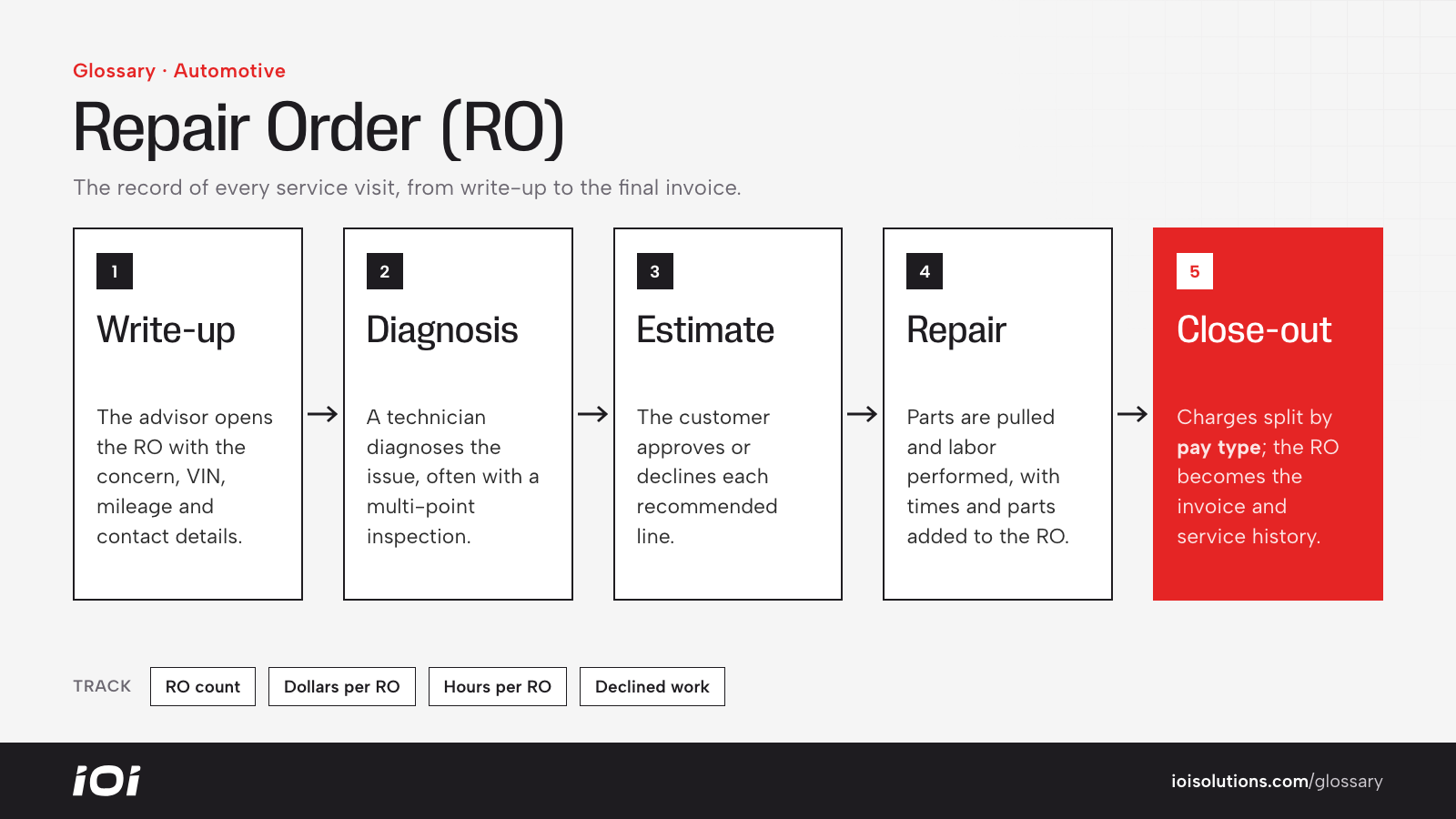
A repair order (RO) is the document a service department or repair shop creates for each vehicle visit. It records the customer and vehicle details, the customer’s concern, the technician’s diagnosis, the labor and parts used and the final charges. Once the work is done and the vehicle delivered, the RO is closed and becomes the invoice and service history record.
ROs are the basic unit of measurement in fixed operations. Dealers and shops talk about RO count, dollars per RO and hours per RO the way sales departments talk about units and gross.
Why the Repair Order (RO) Matters
Almost every service metric starts with the RO.
- Volume: RO count shows how many vehicles the shop is servicing.
- Revenue per visit: average dollars per RO, often split by labor and parts, show how much each visit is worth.
- Pay type mix: each RO line is labeled customer pay, warranty or internal, which drives profitability analysis.
- Technician productivity: labor hours on ROs feed measures like hours per RO and the effective labor rate.
- Customer history: closed ROs tell you what was done, what was declined and when the customer last visited.
How a Repair Order (RO) Works
- Write-up: a service advisor opens the RO, capturing the customer’s concern, VIN, mileage and contact details.
- Inspection and diagnosis: a technician performs diagnostics, often along with a multi-point inspection.
- Estimate and approval: the advisor presents recommended work and price, and the customer approves or declines each item.
- Repair: parts are pulled and labor is performed, with times and parts added to the RO.
- Close-out: the RO is finalized, charges are split by pay type and the customer pays and picks up the vehicle.
Each RO usually contains multiple lines, sometimes called jobs or operation codes. Declined lines are especially valuable for follow-up.
How the Repair Order (RO) Affects Marketing
RO data is a goldmine for marketers because it reflects real behavior rather than estimates.
- Measure campaign impact with ROs, not just calls. A service campaign should be judged on booked appointments that turn into closed ROs and the revenue on them.
- Grow dollars per RO. Promoting services that commonly attach to visits, such as tires, alignments or brake work, can lift average RO value.
- Follow up on declined work. Customers who declined recommended repairs are already informed and often return when reminded with a helpful message.
- Build audiences from RO history. Segment customers by last service date, mileage or vehicle age for timely reminders.
- Find lapsed customers. A customer whose last RO is more than a year old is a win-back target.
For example, an independent repair shop running a brake special could tie each call to the resulting RO in its shop management system. If brake-special ROs average higher than the shop’s overall average because customers also approve fluid flushes and tires, the campaign is worth more than its call count suggests.
Best Practices
- Capture accurate email and mobile numbers on every RO so marketing can reach customers later.
- Track average RO value by lead source to see which channels bring in valuable work.
- Build an automated declined-service follow-up sequence based on RO data.
- Count ROs by pay type so marketing is credited for customer pay growth, not warranty work it did not drive.
- Respect customer privacy and consent rules when using RO data for outreach.