
What Is Days’ Supply?
Days’ supply is a dealership inventory metric that estimates how many days the vehicles currently in stock would last if sales continued at their recent pace and no new units arrived. It translates a raw unit count into a time measure, which makes it far easier to compare stores, brands, models and points in the year.
Fifty units on the lot means nothing on its own. Fifty units at a store that retails five cars a day is roughly ten days of supply and probably too thin. Fifty units at a store that sells one a day is about fifty days, which may be perfectly healthy or slightly heavy depending on the segment. Days’ supply is usually tracked separately for new and used inventory and often broken down by make, model, trim and price band.
Why Days’ Supply Matters
Inventory is the largest asset most dealers carry, and nearly all of it is financed. Every extra day a car sits adds floor plan interest, reconditioning risk and depreciation, particularly on used units. Too little supply hurts too: shoppers cannot find the trim or color they want, and sales go to the competitor down the road.
- Cash flow: high supply ties up credit lines and cash that could buy faster-moving units.
- Gross profit: older stock typically gets discounted, eroding front-end gross.
- Manufacturer relations: OEMs watch supply when allocating new vehicles and setting incentives.
- Marketing focus: supply tells you which models need a push and which can be left alone.
How to Calculate Days’ Supply
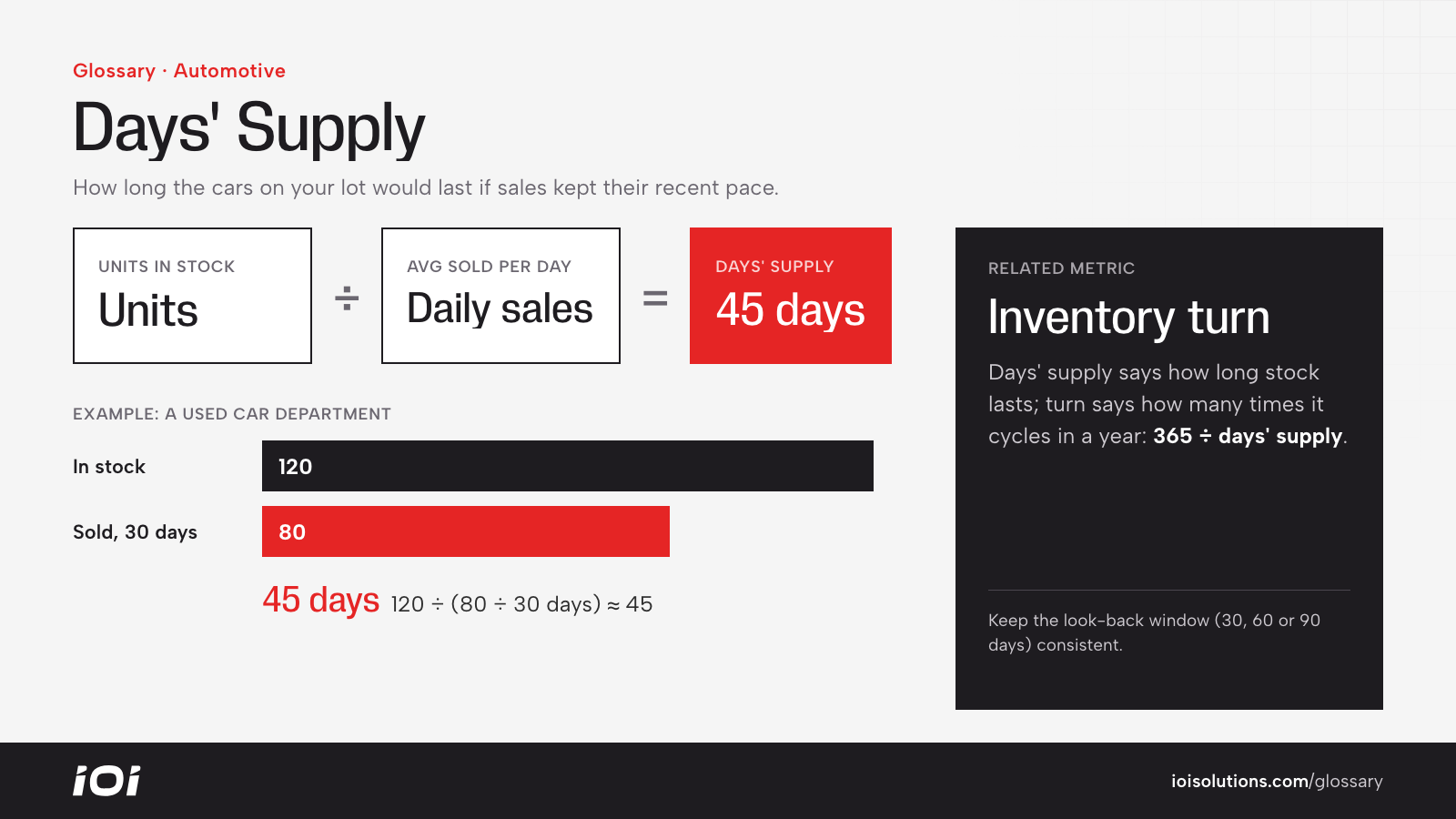
Days’ Supply = Units in Stock / Average Units Sold per Day
Average daily sales is commonly based on the trailing 30 days, so the formula is often written as units in stock divided by last month’s sales, multiplied by 30. For example, a used car department with 120 units that retailed 80 vehicles in the past 30 days has about 2.7 units sold per day, or roughly 45 days’ supply.
Some groups use a longer look-back, such as 60 or 90 days, to smooth out a single strong or weak month. Whatever window you choose, keep it consistent so the trend line means something. Days’ supply is closely related to inventory turn: one describes how long stock lasts, the other how many times it cycles in a year.
How Days’ Supply Affects Marketing
For a dealer’s marketing team or agency, days’ supply should directly steer budget and messaging. Advertising should follow the inventory, not the other way around.
- Heavy models get the spend. If a store is sitting on 110 days of a particular SUV, that model deserves its own campaigns, dedicated landing pages and a larger share of vehicle listing ads budget.
- Thin models get throttled. Paying for clicks on a truck you have four of, all spoken for, wastes money and frustrates shoppers.
- Used inventory needs speed. Used units lose value daily, so a rising used supply often calls for price-focused creative and remarketing to recent VDP viewers.
- Feeds should update automatically. Inventory-driven ads that pull from the live feed pause sold units and shift spend without manual work.
For example, a Toyota store might see sedan supply climbing past 80 days while hybrids sit under 15. The smart move is to pull hybrid search spend back to brand and conquest terms and push sedans with payment-focused offers across search, social and listing ads until the supply normalizes.
Best Practices
- Track days’ supply by model and price band, not just in total, so problem pockets do not hide inside a healthy average.
- Review new and used supply weekly and set target ranges for each with your sales managers.
- Connect ad budgets to supply rules, such as raising spend when a model exceeds its target and pausing when it drops below a floor.
- Pair days’ supply with aged inventory reports, since a normal average can still include units well past 60 days.
- Use the same look-back window every time so comparisons over months stay valid.
- Remember that targets vary widely by brand, market and season, so benchmark against your own history and OEM guidance rather than a universal number.