
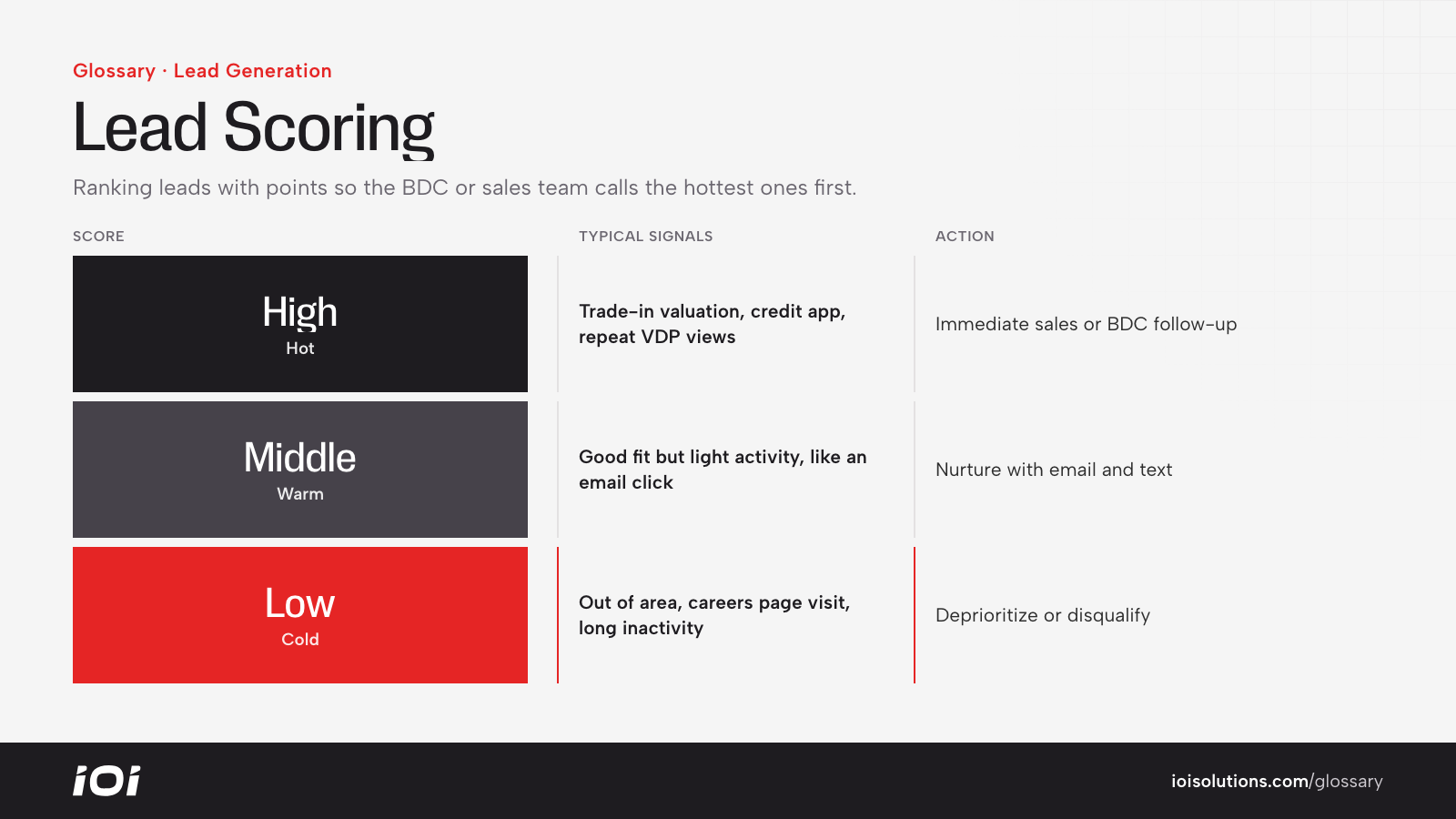
What Is Lead Scoring?
Lead scoring is a system for ranking leads by how likely they are to become customers. Each lead receives points based on who they are and what they do, and the total score helps marketing and sales decide which leads to prioritize, which to nurture, and which to set aside.
Scores can be built manually with rules, such as adding points for a pricing page visit, or generated by predictive models that analyze historical data to find patterns linked to closed deals. Many CRMs and marketing automation platforms include lead scoring features.
Why Lead Scoring Matters
Not all leads are equal, and sales teams have limited time. Without scoring, reps may work leads in the order they arrive or by gut feel, missing the best opportunities.
- It helps sales contact high-intent leads first, while interest is fresh.
- It defines a clear threshold for when a lead becomes a marketing qualified lead.
- It routes lower-scoring leads into nurture campaigns instead of wasting rep time.
- It shows marketing which sources and campaigns produce high-quality leads.
How Lead Scoring Works
Most scoring models combine two types of data:
- Fit (explicit) data: How closely the lead matches your ideal customer profile. Examples include location, company size, job title, vehicle owned or budget.
- Behavior (implicit) data: What the lead does. Examples include pages viewed, email clicks, repeat visits, tool usage, form submissions and responses to calls or texts.
Negative scores matter too. Points can be subtracted for an out-of-area address, a competitor’s email domain, a careers page visit, or long periods of inactivity.
- Review past customers and lost leads to identify signals that predicted sales.
- Assign point values to each signal, weighting the strongest ones most heavily.
- Set thresholds for actions, such as immediate sales follow-up, nurture or disqualification.
- Apply decay so scores drop over time if a lead goes quiet.
- Compare scores with actual outcomes and adjust regularly.
Lead Scoring in Automotive Marketing
Lead scoring originated in B2B, but automotive businesses can use the same logic, often within their CRM.
- Dealerships: A shopper who views several vehicle detail pages for the same model, uses the payment calculator, submits a trade-in valuation and starts a credit application is far more likely to buy soon than someone who downloaded a brochure. Scoring these behaviors helps the BDC call the hottest leads first. Owners with high equity or approaching lease end can also be scored for outreach.
- Collision shops: Estimate requests with uploaded photos, a claim number and a nearby address deserve faster follow-up than vague inquiries.
- Repair shops: Customers with declined recommended services and vehicles hitting major mileage milestones can be scored for service follow-up campaigns.
- Automotive SaaS: Vendors can score dealer groups and multi-location shop operators by number of rooftops, role of the contact, demo requests and pricing page visits.
For example, a dealer might give extra points to leads who return to the site within 48 hours and view the same vehicle again. That simple rule can surface ready-to-buy shoppers buried in a busy inbox.
Best Practices
- Build the model with sales input, based on real closed deals, not assumptions.
- Keep the first version simple, with a handful of strong signals, and add complexity later.
- Include negative scoring and score decay to keep rankings accurate.
- Define clear actions for each score range so scores actually change what people do.
- Review score accuracy every quarter by comparing scores with sales results.
- Do not let scoring slow response to direct requests; a lead asking to buy today should get a call right away regardless of score.