
What Is a Sales Accepted Lead (SAL)?
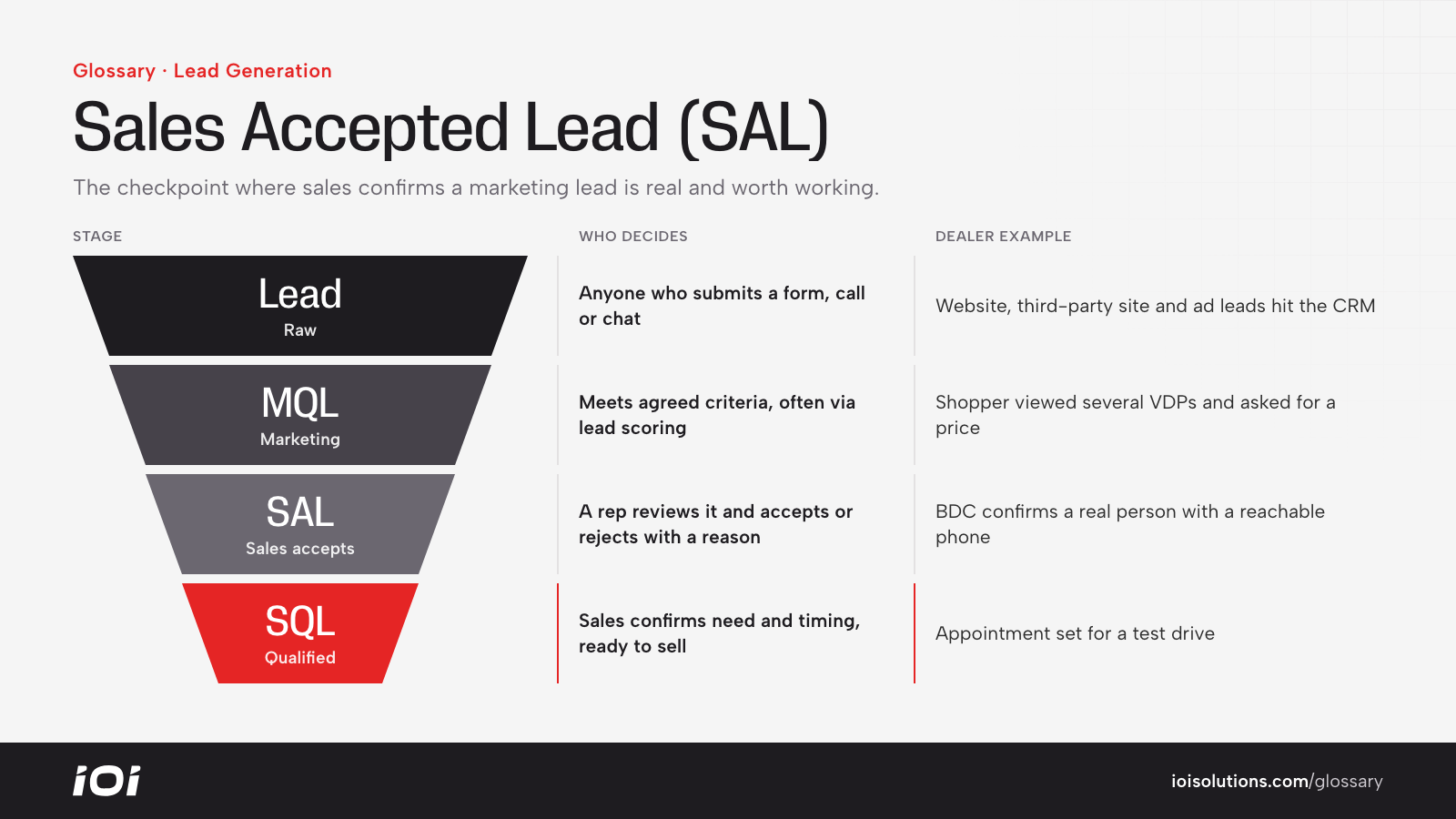
A sales accepted lead (SAL) is a lead that marketing has handed over to the sales team and that sales has formally reviewed and accepted as worth pursuing. It sits between a marketing qualified lead (MQL), which marketing believes is ready for sales, and a sales qualified lead (SQL), which sales has confirmed as a real opportunity after direct contact.
The SAL stage is essentially a handshake. Marketing says, “We think this one is good,” and sales replies, “Agreed, we will work it.” If sales rejects the lead, it goes back to marketing with a reason.
Why Sales Accepted Leads Matter
Marketing and sales often disagree about lead quality. Marketing reports lots of leads; sales complains they are junk. The SAL stage creates a checkpoint that turns that argument into data.
- It creates accountability: sales must review leads promptly instead of ignoring them.
- It gives marketing feedback on which sources and campaigns produce usable leads.
- It exposes gaps between MQL criteria and what sales actually needs.
- It improves forecasting by showing true pipeline volume at each stage.
How Sales Accepted Leads Work
- Agree on definitions. Marketing and sales write down what qualifies as an MQL and what sales will accept, such as correct contact details, a reachable decision-maker, a fit with the service area and a real need.
- Hand off. When a lead meets MQL criteria, often through lead scoring, it is routed to sales in the CRM.
- Review within an agreed time. A rep or SDR checks the lead and marks it accepted or rejected.
- Record reasons. Rejected leads get a reason code, such as wrong number, out of area, spam, or not a fit.
- Measure conversion rates. Track MQL-to-SAL and SAL-to-SQL rates by source to see where quality breaks down.
MQL-to-SAL rate = (Sales accepted leads / Marketing qualified leads) x 100
Sales Accepted Leads in Automotive Marketing
The formal MQL/SAL/SQL model comes from B2B, but the idea maps neatly onto automotive lead handling.
- Dealerships: Leads from the website, third-party sites and ads flow into the CRM. A BDC agent reviewing a lead and confirming it is a real person with a reachable phone number and genuine interest is effectively accepting it. Tracking rejection reasons by source shows which vendors or campaigns send duplicates, fake submissions or out-of-market shoppers.
- Collision shops: Estimate requests can be screened for service area, damage type and whether the shop can repair that vehicle. Accepted leads then get a call to schedule an estimate.
- Automotive SaaS and B2B suppliers: Here the full model applies directly. A demo request from a dealer group might be accepted once a rep confirms the company size, role and timeline fit.
For example, a dealer group might find that one lead provider’s leads are rejected far more often than leads from its own website. That insight supports shifting budget toward channels whose leads are actually worked and sold.
Best Practices
- Write SAL criteria jointly with sales and marketing, and keep them simple.
- Set a response time standard for accepting or rejecting leads, measured in minutes or hours, not days.
- Require a rejection reason so marketing can act on the feedback.
- Report acceptance rate by source, campaign and vendor every month.
- Recycle rejected but legitimate leads into nurture rather than deleting them.
- Review definitions quarterly as offers, markets and team capacity change.