
What Is Annual Recurring Revenue (ARR)?
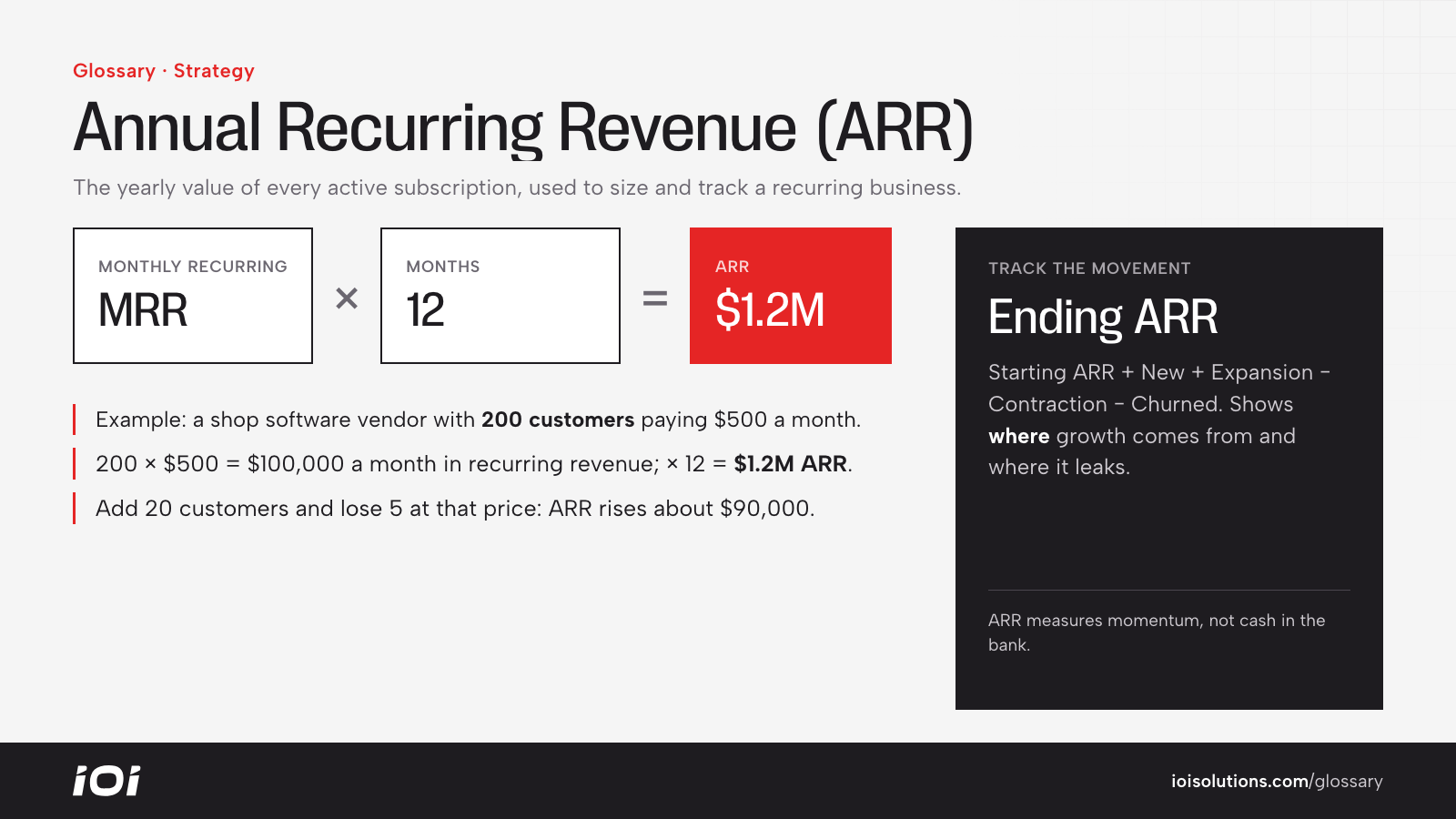
Annual recurring revenue (ARR) is the total value of recurring subscription revenue a business expects to earn over a year from its current customers, based on active contracts. It is the headline metric for subscription businesses, especially software as a service (SaaS) companies.
ARR only includes predictable, repeating revenue. One-time fees for setup, onboarding, hardware or consulting are usually excluded, because they will not repeat automatically next year. ARR is closely related to monthly recurring revenue (MRR); for simple monthly plans, ARR is often MRR multiplied by twelve.
Why Annual Recurring Revenue Matters
ARR shows how much stable revenue a business has locked in and how fast that base is growing. Investors, lenders and leadership teams use it to judge the health and value of a subscription business.
- It smooths out the noise of monthly billing cycles to show the big picture.
- It makes growth easy to track and compare across periods.
- It supports forecasting, hiring plans and budgets.
- It helps set marketing budgets by showing how much new recurring revenue campaigns need to produce.
ARR is a measure of momentum, not cash in the bank. A customer on an annual prepaid plan and one paying monthly can contribute the same ARR, even though the cash arrives very differently, so finance teams track both.
How to Calculate Annual Recurring Revenue
ARR = Sum of annualized value of all active recurring subscriptions
Many teams also break ARR movement into components:
Ending ARR = Starting ARR + New ARR + Expansion ARR – Contraction ARR – Churned ARR
- New ARR: Recurring revenue from new customers.
- Expansion ARR: Upgrades, added seats or locations, and add-on products from existing customers.
- Contraction ARR: Downgrades or reduced usage.
- Churned ARR: Revenue lost from customers who cancel, reflected in churn rate.
For example, a company with 200 customers paying an average of $500 per month has roughly $1.2 million in ARR. If it adds 20 customers at the same price and loses 5, its ARR rises by about $90,000.
Annual Recurring Revenue in Automotive Marketing
ARR is most relevant to automotive businesses built on subscriptions or contracts.
- Automotive software vendors: Companies selling CRMs, shop management systems, digital retailing tools, estimating platforms or review software to dealers and shops live by ARR. Expansion is often tied to rooftops or locations, so landing a dealer group can grow ARR quickly through added stores.
- Service plans and memberships: Detailers offering monthly wash or maintenance memberships, or repair shops selling prepaid maintenance plans, can track recurring revenue the same way.
- Fleet and B2B services: Towing, fleet maintenance and mobile repair companies with ongoing contracts can measure recurring contract value annually.
- Marketplaces and listing platforms: Subscription fees from dealers or shops listing on a platform contribute to ARR.
For marketing, ARR changes the math. A campaign is not judged only by first-month revenue but by the recurring value it adds and keeps. That is why subscription businesses compare acquisition cost against lifetime value.
Best Practices
- Define ARR consistently and document what is included and excluded.
- Exclude one-time fees, usage spikes and unsigned deals from ARR.
- Track new, expansion, contraction and churned ARR separately to see what is driving growth.
- Tie marketing reports to new and expansion ARR, not just leads or demos.
- Invest in onboarding and customer success, since retaining ARR is usually cheaper than replacing it.
- Review ARR by segment, such as single-rooftop versus group customers, to see where growth is most efficient.