
What Is Marketing Operations (MOPs)?
Marketing operations, often shortened to MOPs or MOps, is the behind-the-scenes function that makes marketing run smoothly. It manages the tools, data, processes, and reporting that marketers depend on. If campaigns are what customers see, marketing operations is the engine room that keeps them launching on time, tracking correctly, and producing reliable results.
In larger organizations, MOPs is a dedicated team. In smaller businesses, these responsibilities are often split between a marketing manager, an agency, and whoever handles the CRM. Either way, someone needs to own the systems, or they slowly fall apart.
Why Marketing Operations Matters
As marketing grows, complexity grows with it: more channels, more tools, more data, and more people. Without operational discipline, common problems appear:
- Tracking breaks and nobody notices for weeks.
- Leads fall through the cracks between forms, CRMs, and sales teams.
- Reports from different tools don’t agree.
- Tools overlap and costs pile up.
- Campaign launches stall because processes aren’t defined.
Strong marketing operations reduces waste, improves data quality, and lets marketers spend more time on strategy and creative instead of firefighting.
How Marketing Operations Works
Marketing operations typically covers several areas:
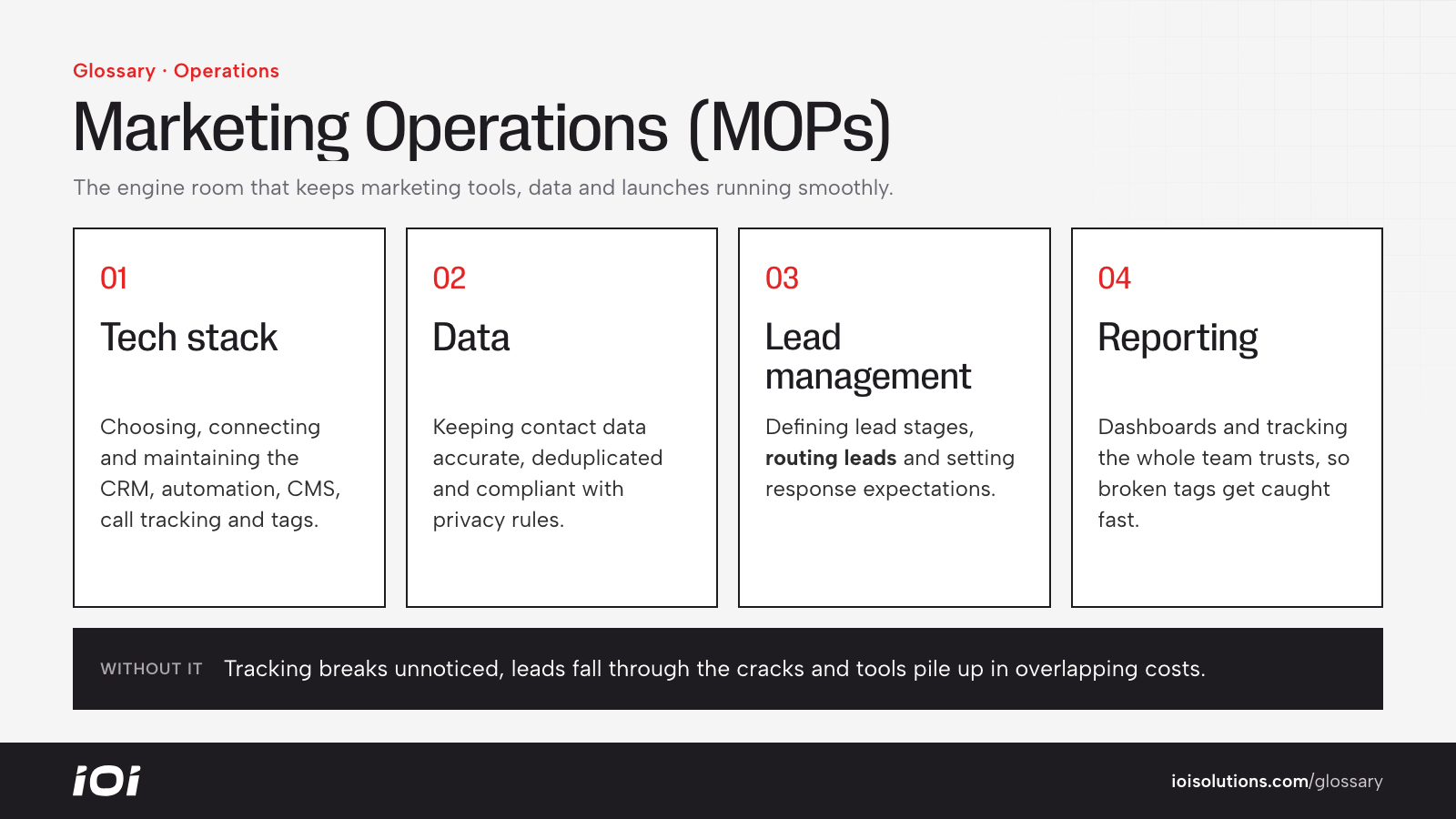
- Technology stack: Selecting, integrating, and maintaining tools like the CRM, marketing automation platform, website CMS, analytics, call tracking, and tag management.
- Data management: Keeping contact and customer data accurate, deduplicated, and compliant with privacy rules.
- Lead management: Defining lead stages, routing leads to the right people, and setting response expectations.
- Measurement and reporting: Building dashboards and maintaining tracking so performance is visible and trusted, supporting marketing analytics.
- Process and governance: Naming conventions, campaign launch checklists, approval workflows, and documentation.
- Budget and planning: Tracking spend against plans and supporting forecasting.
Marketing operations increasingly works hand in hand with sales and customer success operations, a combined approach known as revenue operations.
Marketing Operations in Automotive Marketing
- Dealerships and dealer groups: MOPs work includes making sure website leads, third-party leads, and calls flow into the CRM correctly, inventory feeds stay accurate across listing platforms, and co-op compliance requirements are documented. For multi-rooftop groups, consistent tracking and naming across stores makes performance comparable.
- Collision and repair shops: Operations might be as simple as making sure call tracking numbers are set up correctly, online booking connects to the shop management system, and review requests go out after every completed job.
- Parts and accessories ecommerce: Product feed management, fitment data accuracy, conversion tracking, and email platform integrations are core operational tasks.
- Automotive SaaS: Lead scoring, CRM hygiene, campaign attribution, and handoffs between marketing and sales development reps are central.
For example, a dealer group that adds a new rooftop needs its website forms, call tracking numbers, CRM routing rules, and ad accounts configured the same way as its other stores. Without that consistency, the group can’t tell whether the new store’s marketing is actually working or just being measured differently.
Best Practices
- Document everything. Write down processes, tracking setups, and naming conventions so knowledge doesn’t live in one person’s head.
- Audit your tech stack. Remove redundant tools and make sure the ones you keep are integrated.
- Prioritize data quality. Clean, consistent data makes automation, targeting, and reporting work.
- Use launch checklists. Confirm tracking, links, forms, and routing before every campaign goes live.
- Monitor continuously. Set alerts for sudden drops in conversions or leads, which often signal broken tracking.
- Align with sales. Agree on lead definitions, handoff rules, and shared metrics.