
What Is an Ideal Customer Profile (ICP)?
An ideal customer profile (ICP) is a description of the customer that’s the best fit for what you sell. It defines the characteristics shared by the customers who buy quickly, stay longest, spend the most, and cause the fewest headaches. In B2B, an ICP usually describes a company: its industry, size, location, budget, and the problems it’s trying to solve. In B2C, it describes the household or individual who fits your offer best.
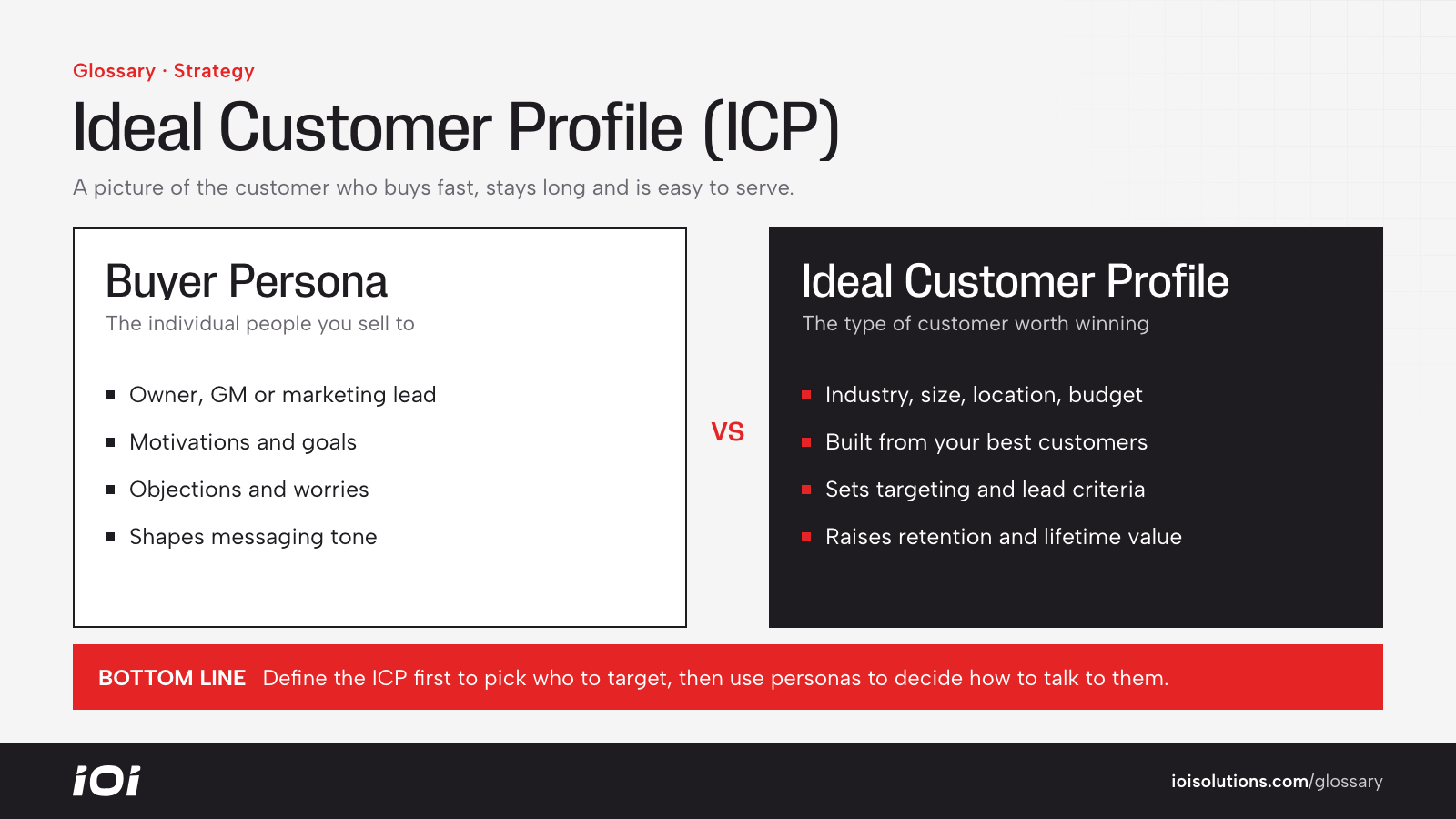
An ICP is different from a buyer persona. The ICP describes the account or customer type you want. Personas describe the individual people within that account, such as the owner, the general manager, or the marketing lead, along with their motivations and objections.
Why an Ideal Customer Profile Matters
Without an ICP, marketing tries to appeal to everyone and ends up resonating with no one. Budgets get spread across audiences that rarely convert, sales teams chase poor-fit leads, and messaging stays generic.
A clear ICP sharpens nearly every decision:
- Targeting: You know which audiences, geographies, and keywords deserve budget.
- Messaging: You can speak to specific pains instead of vague benefits.
- Lead quality: Qualification criteria become obvious, so sales spends time on accounts likely to close.
- Retention and value: Customers who fit well tend to stay longer, which raises lifetime value.
How to Build an Ideal Customer Profile
- Study your best customers. Pull a list of your most profitable, longest-tenured, easiest-to-serve customers. Ignore the ones who were a constant struggle.
- Find the common traits. For businesses, look at firmographics like industry, revenue, location count, and team size. For consumers, look at demographics, location, vehicle type, and buying behavior.
- Identify the trigger. What was happening when they bought? A new location, a bad experience with a competitor, a seasonal rush?
- Define disqualifiers. Spell out who is not a fit. This is as useful as the profile itself.
- Validate with sales and data. Check the draft against close rates and revenue, then revisit it at least once a year.
Ideal Customer Profile in Automotive Marketing
The automotive industry is broad, so ICPs vary widely by business type:
- Automotive SaaS: A dealer software company might define its ICP as franchise dealer groups with five to twenty rooftops, an in-house BDC, and a current DMS that integrates with its product.
- Collision repair: A body shop might target insured drivers within a set radius who drive late-model vehicles, plus fleet managers and local insurance agents who can send steady referrals.
- Aftermarket parts brands: A truck accessories brand might focus on owners of specific half-ton and heavy-duty pickups who already modify their vehicles and buy online.
- Detailing and protection shops: A ceramic coating or PPF installer might define its ICP as owners of new or high-value vehicles within a short drive who care about long-term appearance.
Each of these ICPs points to different channels, offers, and creative. That’s the point: once you know who you’re after, the rest of the plan gets easier.
Best Practices
- Base it on data, not assumptions. Use CRM records, sales outcomes, and revenue, not just gut feel.
- Keep it specific. “Small businesses” isn’t an ICP. “Independent repair shops with three to eight bays in metro areas” is.
- Include disqualifiers. Knowing who to avoid saves ad spend and sales time.
- Share it across teams. Marketing, sales, and customer success should all use the same definition of a good fit.
- Connect it to targeting. Translate the ICP into real audience settings, keyword lists, and account lists.
- Review it regularly. Markets shift, new products launch, and your best customers can change over time.