
What Is Account-Based Marketing (ABM)?
Account-based marketing (ABM) is a B2B approach where marketing and sales pick a specific set of target companies, called accounts, and build campaigns around each one. Instead of generating as many leads as possible and filtering them later, you start with the accounts you most want to win and focus your budget, content and outreach on the people inside them.
Think of it as flipping the traditional funnel. Classic lead generation pours a wide audience into the top and hopes good customers come out the bottom. ABM begins with a short list of ideal customers and works to engage every decision maker in those organizations.
Why Account-Based Marketing Matters
In B2B sales, a single account can be worth far more than hundreds of small deals. Buying decisions usually involve several people, such as an owner, a general manager, a finance lead and an operations manager. ABM matters because it:
- Concentrates spend on accounts that can actually move revenue.
- Aligns marketing and sales around the same target list and goals.
- Makes messaging more relevant, because it speaks to a known company’s situation.
- Gives you clearer measurement, since you track engagement and pipeline by account rather than by raw lead volume.
Types of Account-Based Marketing
ABM programs are usually grouped by how personalized they are:
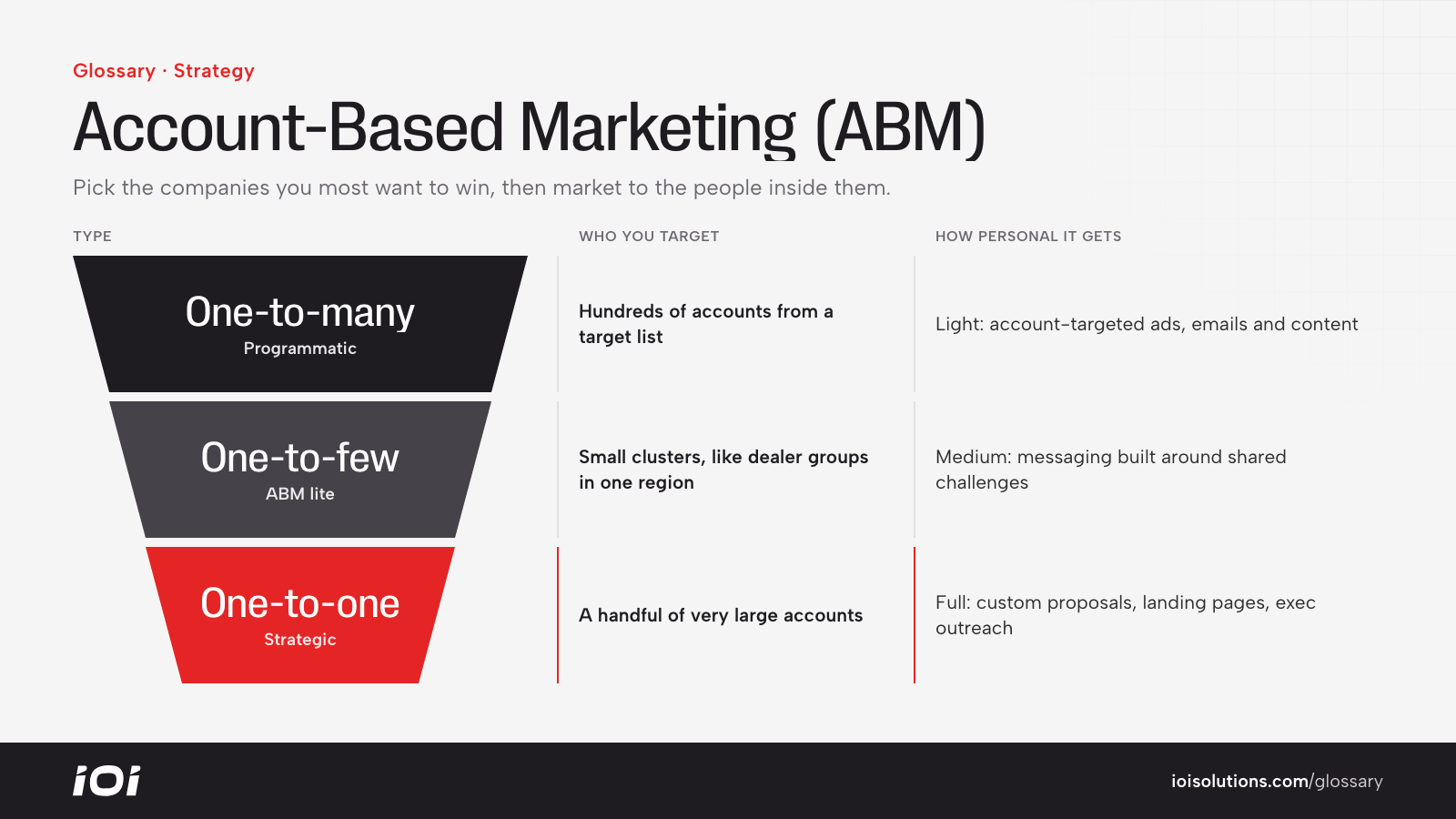
- One-to-one (strategic ABM): Fully custom campaigns for a handful of very large accounts. Think tailored proposals, custom landing pages and executive outreach.
- One-to-few (ABM lite): Campaigns built for small clusters of similar accounts, such as companies in the same segment or region with shared challenges.
- One-to-many (programmatic ABM): Lighter personalization at scale, using account lists to target ads, emails and content to hundreds of companies.
Most programs follow a similar cycle: define your ideal customer profile, build and prioritize the account list, map the buying committee, create relevant content, run coordinated outreach across channels, and measure engagement and pipeline at the account level. Firmographics such as company size, location and number of locations help build and rank the list.
Account-Based Marketing in Automotive Marketing
ABM is less common for consumer-facing shops, but it fits several corners of the automotive world well:
- Automotive software and SaaS: A company selling dealer management, CRM or collision estimating tools can target specific dealer groups or multi-store operators (MSOs), with content aimed at the dealer principal, the controller and the service director.
- Parts distributors and aftermarket brands: A brand trying to win placement with regional distributors or large repair chains can treat each distributor as an account and coordinate trade-show meetings, sales calls and targeted ads.
- Fleet and commercial services: A heavy-duty repair shop or wrap company pursuing fleet contracts can build a list of local companies with large vehicle fleets and approach the fleet manager and operations leaders directly.
- Collision shops and insurers: Relationships with insurance carriers and local agents are account-like by nature, even when they are managed informally.
For example, a calibration equipment company might pick 50 collision MSOs, run LinkedIn and display ads to their staff, send the operations leaders a short ROI guide, and have sales follow up when an account shows repeated engagement.
Best Practices
- Start small. A focused list of accounts you can genuinely personalize for beats a bloated list you treat generically.
- Agree on the list with sales. If sales doesn’t believe in the target accounts, the program stalls.
- Map the whole buying committee. Identify every role that influences the decision, not just the person who signs.
- Coordinate channels. Ads, email, direct mail, events and calls should tell one consistent story to each account.
- Measure at the account level. Track account engagement, meetings, pipeline and closed revenue rather than form fills alone.