
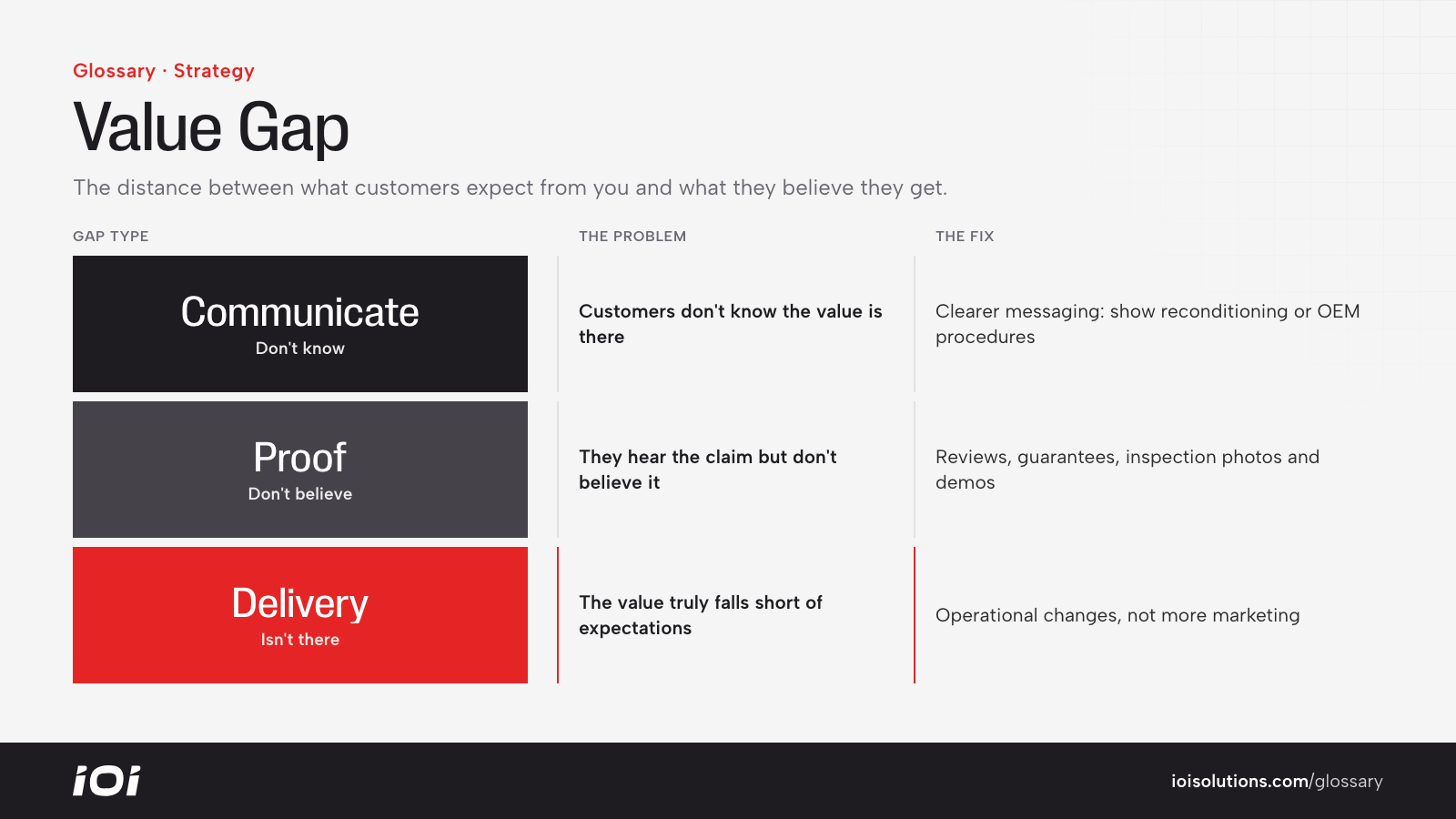
What Is a Value Gap?
A value gap is the distance between what customers expect or need and what they perceive they are getting. It can exist before a sale, when a prospect does not see enough value to justify the price, or after a sale, when the actual experience falls short of the promise.
The term is used in a few related ways. In marketing and product strategy it usually means a perception gap: the product may be good, but the customer does not understand or believe its value. In customer experience, it often means a delivery gap: the business promised more than it delivered. Both reduce sales and loyalty.
Why the Value Gap Matters
When customers see a value gap, they hesitate, negotiate harder, choose a competitor or leave after the first purchase. Closing the gap is often cheaper than finding new customers.
- Pre-sale gaps lower conversion rates and push buyers toward the cheapest option.
- Post-sale gaps drive refunds, bad reviews and higher churn.
- Persistent gaps damage reputation, making all future marketing more expensive.
Spotting value gaps also reveals opportunity. A gap competitors ignore can become the basis of a strong unique value proposition.
How to Find and Close a Value Gap
- Measure expectations. Learn what customers care about through surveys, sales calls, reviews and search queries.
- Measure perception. Use reviews, Net Promoter Score, lost-deal reasons and support tickets to see how customers rate you.
- Identify the type of gap. Is it a communication problem (they do not know the value), a proof problem (they do not believe it), or a delivery problem (the value is not there)?
- Fix the right thing. Communication gaps call for clearer messaging; proof gaps call for reviews, guarantees and demonstrations; delivery gaps require operational changes, not more marketing.
- Re-measure. Track conversion rates, reviews and retention to confirm the gap is shrinking.
Value Gap in Automotive Marketing
Automotive businesses frequently face value gaps because customers struggle to judge quality and price in complex purchases.
- Dealerships: Shoppers may not see why one store’s price is higher than another’s for a similar vehicle. Showing reconditioning work, inspection reports, included warranties or a transparent fee policy can close a perception gap.
- Collision shops: Drivers often assume all repairs are equal and may follow an insurer’s suggestion. Explaining OEM repair procedures, certifications and warranties shows the value behind choosing a qualified shop.
- Repair shops: A quote that seems high creates a gap unless the advisor explains the diagnosis and shows photos or video from the inspection.
- Detailing and PPF: Premium protection services can look overpriced next to a basic wax. Demonstrations, film warranties and care education help customers see the difference.
- Automotive software: Vendors face a gap when buyers cannot connect features to results. Framing value as time saved or revenue gained narrows it.
For example, a tire shop with lower star ratings than nearby competitors might discover through reviews that customers feel wait times were longer than promised. That is a delivery gap: better ads will not fix it, but accurate wait estimates and appointment reminders might.
Best Practices
- Listen first: read reviews, call recordings and lost-sale reasons before rewriting messaging.
- Do not overpromise in ads; inflated claims create the post-sale gaps that hurt retention.
- Show value instead of claiming it, using photos, videos, guarantees and customer stories.
- Align marketing, sales and operations so the experience matches the message.
- Track perception metrics over time, not just once.
- Treat recurring complaints as product or process feedback, not only as a marketing problem.