
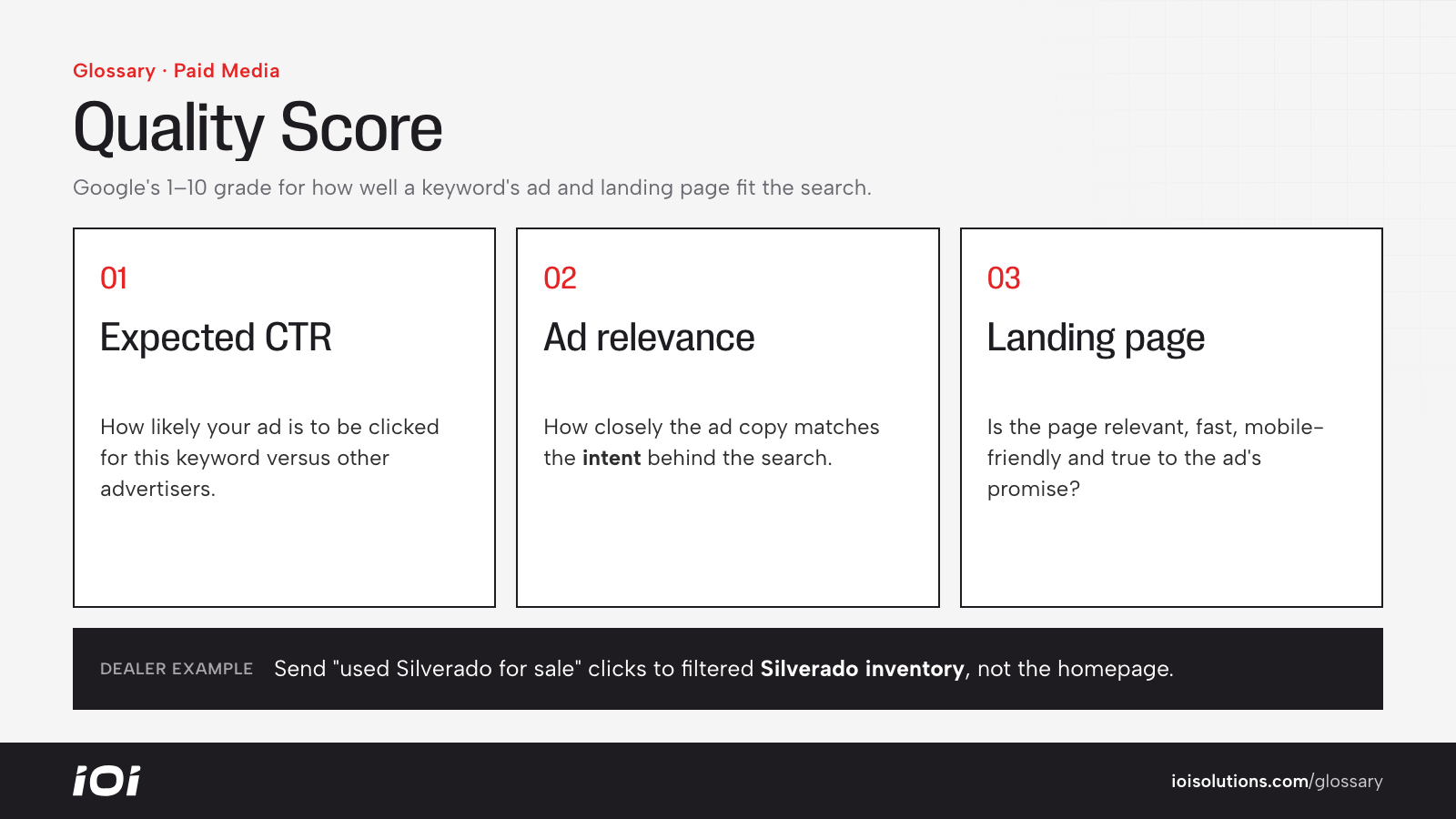
What Is Quality Score?
Quality Score is a diagnostic rating in Google Ads that estimates how relevant and useful your ads and landing pages are for the people searching a given keyword. It is reported on a scale of 1 to 10 at the keyword level, with higher scores meaning your ads are more relevant than those of other advertisers targeting the same keyword.
Microsoft Advertising uses a similar concept. It is important to know that the visible Quality Score is a summary tool; Google’s auction uses real-time quality signals calculated for every individual search, not the number you see in the interface.
Why Quality Score Matters
Google wants to show ads that searchers find useful. Ads judged more relevant tend to earn better positions and can pay less per click than less relevant competitors bidding the same or more. Over time, poor relevance means higher costs, lower visibility, or both.
- It affects your Ad Rank and therefore your position.
- It influences your actual cost per click.
- It points to specific weaknesses: the ad, the landing page or the keyword choice.
How Quality Score Works
Quality Score is built from three components, each rated “above average,” “average” or “below average”:
Expected Click-Through Rate
How likely your ad is to be clicked when shown for this keyword, compared with other advertisers, based on past performance and context.
Ad Relevance
How closely your ad copy matches the intent behind the search. An ad group mixing unrelated keywords usually scores poorly here.
Landing Page Experience
How relevant, useful and easy to use your landing page is for people who click. Load speed, mobile usability, clear content and matching the ad’s promise all factor in.
A keyword needs enough impressions before a score appears. Brand-new or very low-volume keywords may show no score at all.
Quality Score in Automotive Marketing
- Dealerships: A common problem is sending model-specific searches such as “used Silverado for sale” to the homepage. Pointing those clicks to a filtered inventory page showing that model improves landing page experience and relevance.
- Collision shops: Grouping “hail damage repair,” “bumper repair” and “frame straightening” in one ad group with generic ad copy leads to weaker ad relevance. Separate ad groups with matching ads and service pages tend to score better.
- Repair shops: A brake repair ad that mentions brakes in the headline and lands on a fast, mobile-friendly brake service page with a clear booking button covers all three components.
- Parts sellers: Part-number keywords sent to the exact product page typically show strong relevance compared with sending them to a broad category.
For example, a tire shop noticing below-average landing page experience across its campaigns might find that its booking page loads slowly on phones, a fix that can help every keyword at once.
What Is a Good Quality Score?
Generally, scores of 7 and above are considered healthy, 5 to 6 is average, and 4 or below signals a clear problem worth fixing. Expectations vary by industry and keyword type; branded keywords usually score higher than broad, competitive terms. Use these tips to improve:
- Build tightly themed ad groups. Keep keywords closely related so ads can match them precisely.
- Mirror the search in your ads. Include the core keyword theme in headlines where it reads naturally.
- Match landing pages to intent. Send each ad group to the most specific relevant page.
- Improve page speed and mobile usability. These directly shape landing page experience.
- Lift click-through rate. Test headlines, use relevant assets such as call and sitelink assets, and add negative keywords.
- Don’t obsess over the number. Focus on conversions and profit; Quality Score is a diagnostic, not a goal in itself.