
What Is N-Gram Analysis?
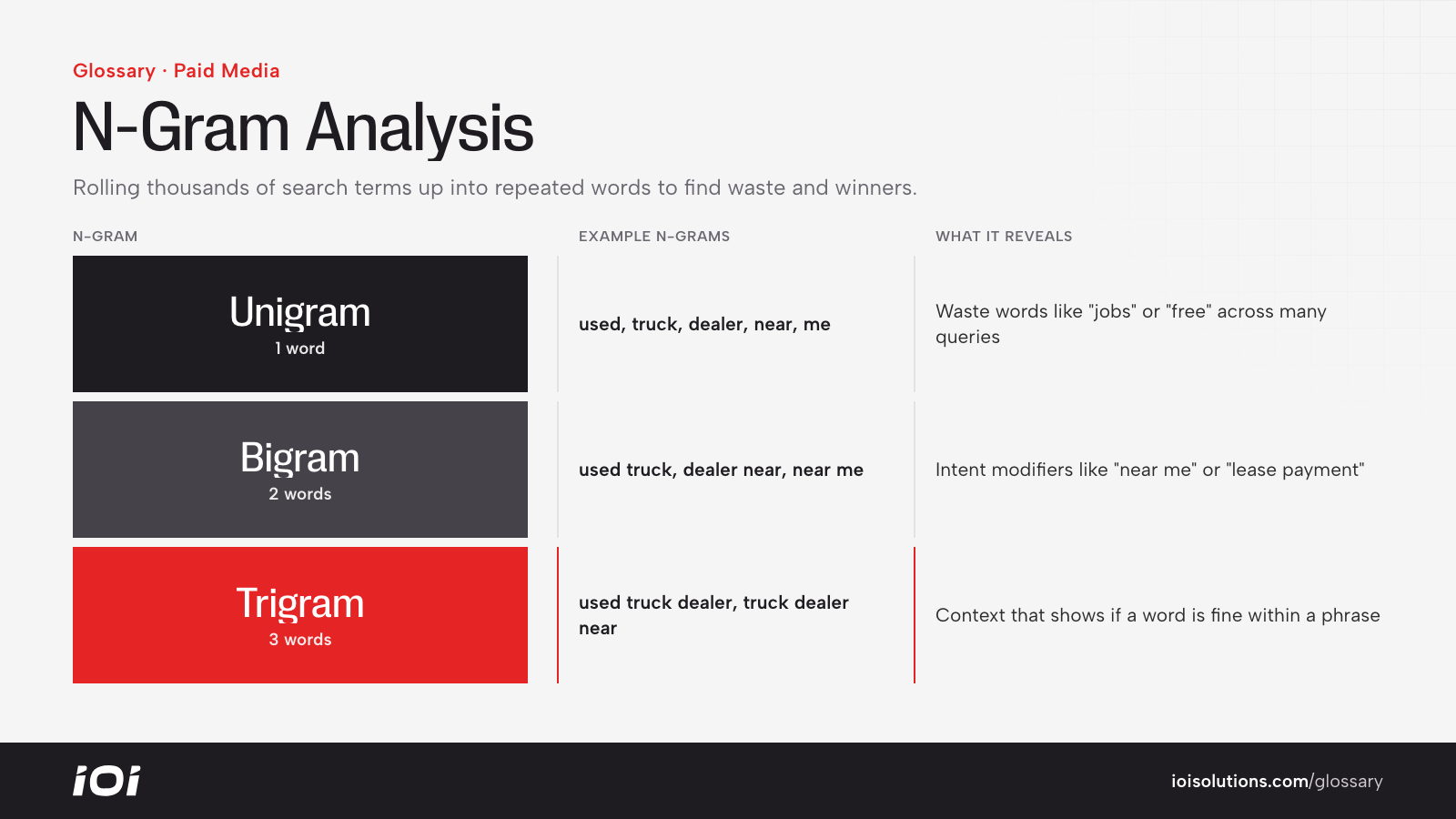
N-gram analysis is a technique that splits text into sequences of words, called n-grams, and then groups and measures them. The “n” is the number of words in each sequence. A one-word sequence is a unigram, two words is a bigram, and three words is a trigram. For example, the search term “used truck dealer near me” contains unigrams like “used” and “truck,” bigrams like “used truck” and “near me,” and trigrams like “used truck dealer.”
The idea comes from natural language processing, but in marketing it’s most commonly used to analyze paid search term reports and organic search query data.
Why N-Gram Analysis Matters
Search campaigns can generate thousands of unique search terms each month, and most of them appear only once or twice. Looking at them one by one, it’s almost impossible to spot patterns. N-gram analysis rolls those individual terms up into recurring words and phrases, then totals their impressions, clicks, cost, and conversions.
That reveals insights you’d otherwise miss:
- Wasted spend: A word like “free,” “jobs,” or “salary” might appear across hundreds of different queries that together cost real money but never convert.
- Winning themes: Words that consistently convert well can guide new keywords, ad copy, and landing pages.
- Intent signals: Modifiers like “near me,” “cost,” “best,” or “DIY” show what searchers are trying to do.
How N-Gram Analysis Works
- Export your data. Pull a search term report from Google Ads or another platform, or a query report from Search Console, covering a meaningful date range.
- Split each term into n-grams. Use a spreadsheet script, a dedicated tool, or code to break every query into one-, two-, and three-word sequences.
- Aggregate metrics. For each n-gram, sum the impressions, clicks, cost, and conversions of every query that contains it.
- Calculate efficiency. Compute cost per conversion, conversion rate, and click-through rate for each n-gram.
- Act on findings. Add poor performers as negative keywords, build new ad groups around strong themes, and adjust bids or messaging.
Be careful with context. A word that looks bad on its own might be fine within certain phrases, which is why reviewing bigrams and trigrams alongside unigrams helps.
N-Gram Analysis in Automotive Marketing
- Dealerships: N-gram analysis might show that queries containing “parts,” “manual,” or “recall” are draining a sales campaign budget, while “lease” or “payment” terms convert strongly and deserve their own ad groups.
- Collision shops: A shop could find that “insurance,” “estimate,” and specific vehicle brands convert well, while “paint supplies” or “school” terms waste money.
- Repair shops: Terms with “how to” or “DIY” may attract do-it-yourselfers rather than customers, and can be excluded or targeted with content instead.
- Parts and accessories ecommerce: Grouping by vehicle model or part type shows which fitment categories deliver the best return and where product feed titles need improvement.
Because automotive searches include so many long-tail combinations of year, make, model, and part, n-gram analysis is one of the most practical ways to make sense of them.
Best Practices
- Use enough data. Analyze at least several weeks of search terms, more for low-volume accounts.
- Look at multiple n-gram lengths. Unigrams show broad themes. Bigrams and trigrams add context.
- Set minimum thresholds. Only act on n-grams with meaningful spend or clicks to avoid reacting to noise.
- Check before adding negatives. Make sure a word isn’t part of valuable queries before excluding it.
- Repeat regularly. Search behavior and match types change. Monthly or quarterly reviews keep accounts clean.
- Feed insights into creative. Use top-converting phrases in ad copy, landing pages, and SEO content.