
What Is a Go-to-Market Strategy?
A go-to-market (GTM) strategy is a plan for bringing a product or service to customers. It explains who you are selling to, what problem you solve, why customers should choose you, how you will price the offer, which channels you will use to reach buyers and how sales and support will work.
GTM strategies are most often associated with new product launches, but they also apply when a business enters a new market, targets a new customer segment, opens a new location or relaunches an existing offer.
Why a Go-to-Market Strategy Matters
Launches fail more often from poor market fit, unclear messaging or the wrong channels than from a bad product. A GTM strategy reduces that risk.
- Clarity. Everyone, from marketing to sales to operations, works from the same understanding of the customer and the offer.
- Focus. Limited resources go to the segments and channels most likely to succeed.
- Speed. A planned launch reaches revenue faster than one that improvises.
- Learning. Clear assumptions and metrics let you see quickly what is working.
How a Go-to-Market Strategy Works
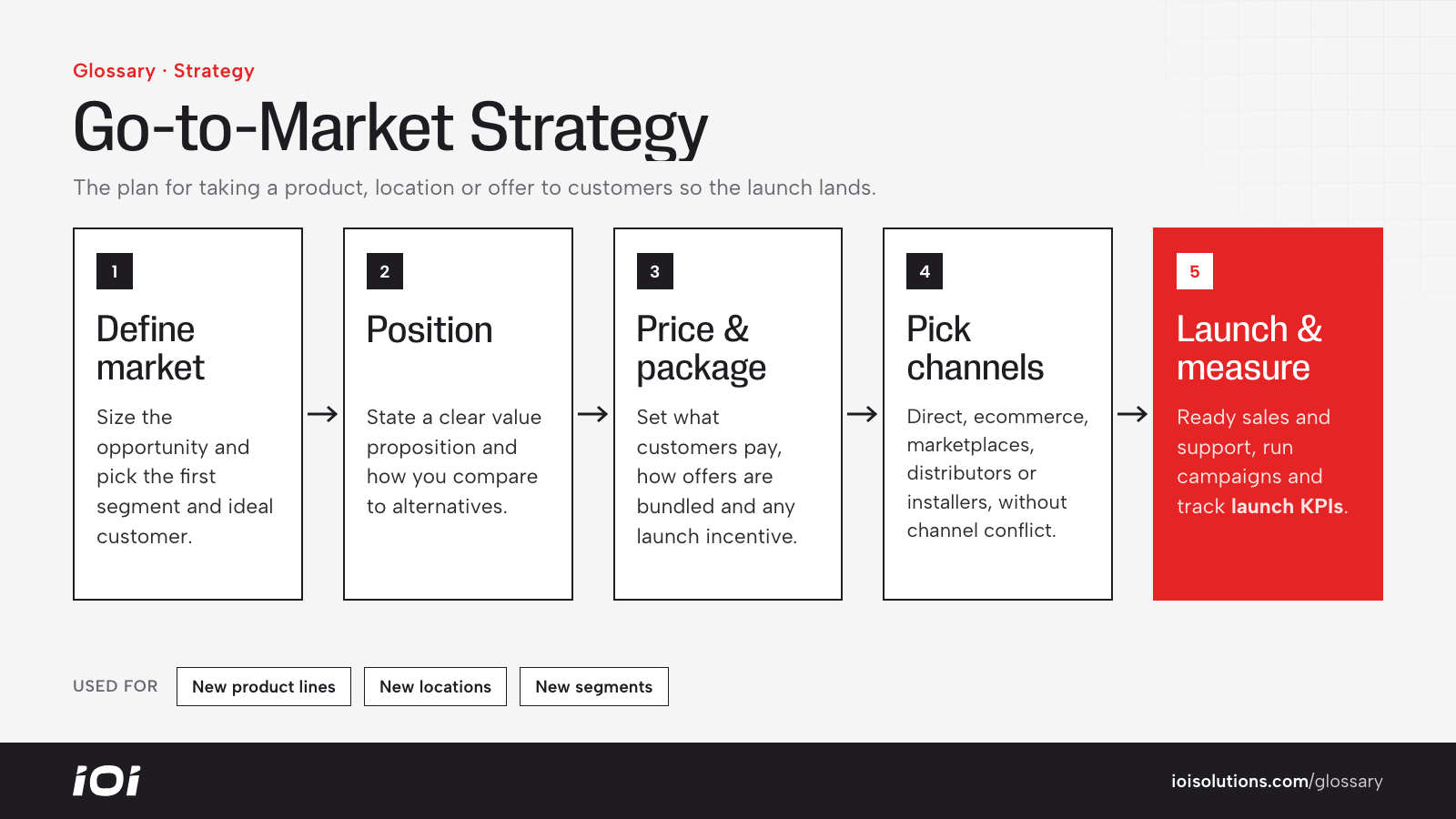
A typical GTM strategy covers:
- Market definition. The size of the opportunity and the specific segment you will target first.
- Customer profile. An ideal customer profile for B2B or detailed buyer personas for consumers, including pain points and buying triggers.
- Value proposition and positioning. A clear unique value proposition and how you compare to alternatives.
- Pricing and packaging. What customers pay, how offers are bundled and any launch incentives.
- Channels. Direct sales, ecommerce, marketplaces, dealers, distributors, partners or a mix.
- Marketing plan. Messaging, content, campaigns and launch timeline.
- Sales and support readiness. Training, sales materials, follow-up processes and customer service.
- Success metrics. The KPIs that will show whether the launch is on track.
GTM work is typically led by product marketing in larger companies, but in smaller businesses it often falls to the owner or marketing lead.
Go-to-Market Strategy in Automotive Marketing
Automotive businesses use GTM thinking in many situations:
- An aftermarket parts brand launching a new product line must decide whether to sell direct online, through marketplaces, through distributors and installers, or all three, and how to avoid channel conflict on pricing.
- A dealership adding a new franchise or opening a used-car satellite store needs a plan for market awareness, inventory marketing and staffing.
- A detail shop adding PPF or ceramic coating must position the premium service, price it, train staff and build demand among existing customers.
- A collision shop earning new OEM certifications can build a GTM plan around reaching owners of those brands and informing insurers and dealers.
- An automotive software startup must choose whether to target independent shops, franchise dealers or large groups first, and how to sell to them.
For example, a company launching a new line of truck bed covers might start with one or two popular truck platforms, sell through its own site and a small group of installer partners, and use creator videos and Shopping ads to build demand before expanding to more vehicles.
Best Practices
- Start narrow. Win one well-defined segment before expanding.
- Validate demand early. Use customer conversations, pre-orders, waitlists or small test campaigns.
- Align teams before launch. Make sure sales, service and support know the offer and messaging.
- Choose channels your buyers already use. Meet customers where they shop rather than forcing new habits.
- Set clear metrics and checkpoints. Decide in advance what results will trigger scaling or a change of course.
- Plan the post-launch phase. Momentum fades without ongoing marketing after launch day.