
What Is Lead-to-Sale Close Rate?
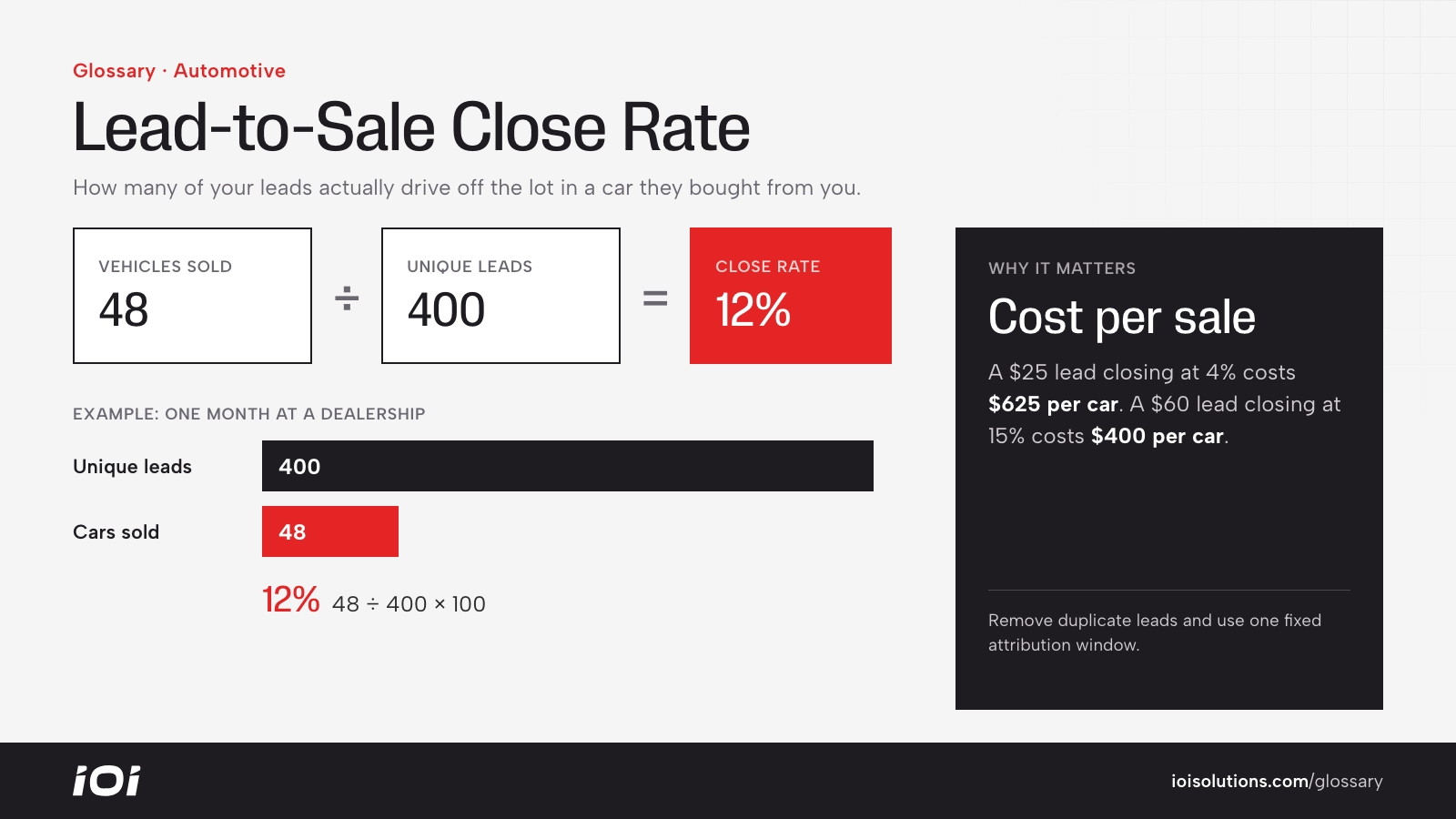
Lead-to-sale close rate is the percentage of leads that end in a delivered vehicle. A lead might be an internet form, a chat, a phone call, a text, or a walk-in that was logged in the CRM. If a store receives 400 leads in a month and 48 of them buy, its lead-to-sale close rate is 12%.
It is the bottom-line number that connects marketing to the sales floor. Click and form metrics tell you whether ads are generating interest. Close rate tells you whether that interest is turning into cars leaving the lot.
Why Lead-to-Sale Close Rate Matters
Dealers and agencies can argue all day about lead volume and cost per lead. Close rate settles the argument, because it exposes both lead quality and process quality at the same time.
- A low close rate on a specific source is a warning that the source is sending tire-kickers, duplicates, or shoppers outside your market.
- A low close rate across every source usually points to the store: slow response, weak follow-up, or a BDC that sets appointments that never show.
- Close rate turns cost per lead into cost per sale. A $25 lead that closes at 4% costs more per car than a $60 lead that closes at 15%.
That last point is why sophisticated stores judge every channel by cost per sold unit rather than raw lead count.
How to Calculate Lead-to-Sale Close Rate
Lead-to-sale close rate = (vehicles sold from leads ÷ total unique leads) × 100
The math is simple. The definitions are where stores go wrong. Decide up front:
- What counts as a lead. Remove duplicates, so a shopper who submits three forms counts once.
- The attribution window. Car shoppers often take weeks to buy. Measuring a lead against sales within 30, 60, or 90 days gives very different numbers, so pick one and stick with it.
- Source matching. Sales need to be matched back to the original lead source in the CRM, not credited to whoever touched the deal last.
Track the rate by lead source, by lead type (new, used, service-to-sales), and by salesperson so you can see where deals are leaking. Pair it with appointment show rate to see whether the breakdown happens before or after the customer arrives.
How Lead-to-Sale Close Rate Affects Marketing
For a marketer, close rate is the feedback loop that makes budget decisions honest. Without it, campaigns get optimized toward whatever produces the cheapest form fills, which is often the lowest-intent traffic.
For example, a dealer running paid search, Meta lead ads, and a third-party lead provider might see Meta producing the cheapest leads. Once sales are matched back, the store may find those leads close at a fraction of the rate of search leads, which changes where the next dollar should go.
Close rate also shapes creative and targeting. Ads that show real price, payment, and inventory tend to attract shoppers who are further along, which usually lowers volume but raises the share that buy. Agencies that feed sold data back into ad platforms as offline conversions give bidding algorithms a much better signal than form submissions alone.
The same logic applies outside dealerships. A body shop can track estimate requests to repair orders, and a repair shop can track calls to booked jobs.
What Is a Good Lead-to-Sale Close Rate?
There is no universal benchmark. Internet lead close rates at franchise dealers are commonly discussed in the high single digits to mid-teens, while phone-ups and walk-ins usually close higher. Results vary widely by brand, market, lead source, and how the store defines a lead. The more useful comparison is your own trend over time and the gap between sources.
- Respond fast. Speed to lead is one of the biggest controllable factors. Aim for minutes, not hours, with a real answer rather than an auto-reply.
- Clean your data. Deduplicate leads and enforce source tracking in the CRM, or the number means nothing.
- Report by source. Review close rate and cost per sale for every source monthly and move budget accordingly.
- Send sales back to the ad platforms. Offline conversion uploads help campaigns find more people who actually buy.
- Audit the follow-up cadence. Many leads buy after the third or fourth touch. A process that stops after one call leaves sales on the table.
- Look at the full funnel. Pair close rate with conversion rate on your site and show rate in the store so you fix the right stage.