
What Is a Dealer Management System (DMS)?
A Dealer Management System (DMS) is the central software platform that a car dealership uses to run its day-to-day business. It typically handles vehicle sales and deal structuring, F&I contracts, vehicle inventory, service scheduling and repair orders, parts inventory and sales, payroll and accounting, and customer records.
Because it connects every department, the DMS is often described as the dealership’s system of record. Well-known DMS providers in North America include CDK Global, Reynolds and Reynolds, Dealertrack and Tekion, among others. Many dealers connect the DMS to other tools such as a CRM, website platform, inventory management software and digital retailing tools.
Why a DMS Matters
The DMS holds the most reliable data a dealership has:
- Sold vehicles and buyers: who actually purchased, when, which vehicle and for how much.
- Service history: every repair order, mileage reading, declined service and visit date.
- Financial results: gross profit by vehicle, department and deal.
- Inventory status: what is in stock, in transit or sold.
Because it sits at the center of operations, switching DMS providers is a major project, and data access rules set by the provider can affect which third-party tools a dealer can use.
How a DMS Works
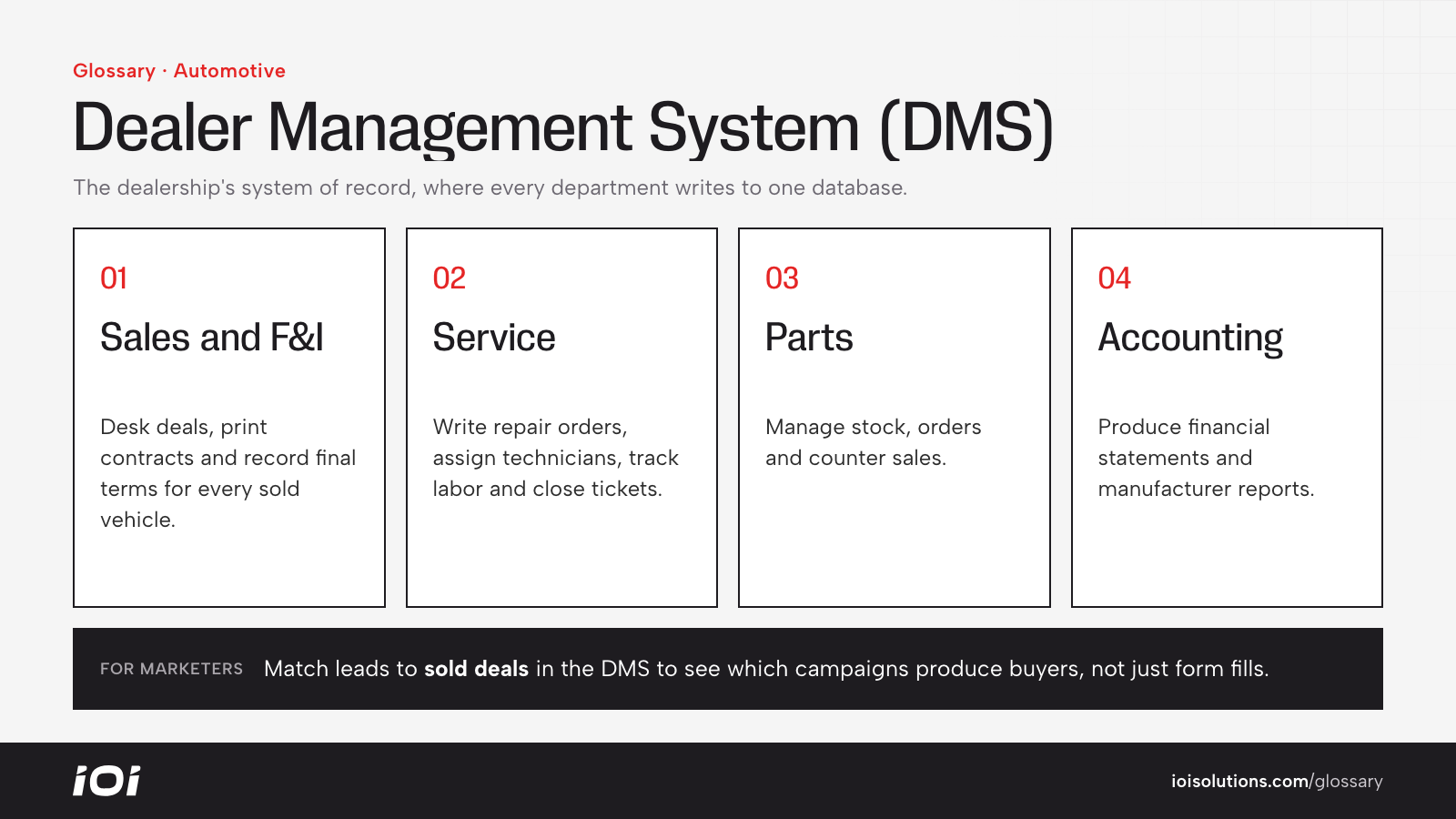
Each department uses the DMS for its own tasks, all writing to a shared database:
- Sales and F&I desk deals, print contracts and record final terms.
- Service writes repair orders, assigns technicians, tracks labor and closes tickets.
- Parts manages stock, orders and counter sales.
- Accounting produces financial statements and manufacturer reports.
Other systems connect through integrations, either approved programs run by the DMS provider or third-party data extraction services. A CRM, for example, may pull sold and service data from the DMS to update customer records automatically.
How a DMS Affects Marketing
For marketers, the DMS is the key to measuring real results and targeting existing customers:
- Closed-loop attribution: matching leads and ad interactions to sold deals in the DMS shows which campaigns produce buyers. This is the foundation of closed-loop marketing for dealers.
- Offline conversion uploads: sold-vehicle data can be fed back into ad platforms so automated bidding optimizes toward actual sales, where permitted by privacy rules and platform policies.
- Customer targeting: service history, purchase date, lease end and loan details support service reminders, equity mining, lease-end and loyalty campaigns.
- Suppression lists: recent buyers can be excluded from conquest ads, avoiding wasted impressions and awkward messages.
- Reporting accuracy: DMS data fills the gap between web marketing analytics and what actually happened in the store.
Data protection matters here. The DMS contains sensitive personal and financial information. In the US, dealers that arrange financing are generally covered by the FTC’s Safeguards Rule, which requires security programs for customer information. Share only what each marketing tool needs, through secure, approved methods.
For example, a dealer that matches DMS sales against CRM leads might find that one marketplace produces many leads but few sales, while search campaigns produce fewer leads with a much higher close rate.
Best Practices
- Keep DMS data clean, with consistent customer names, emails, phone numbers and lead sources.
- Use approved integrations to move data securely between the DMS and marketing tools.
- Match sales to marketing regularly, ideally monthly or more often.
- Limit access to sensitive data and follow privacy and security requirements.
- Use service data for retention, not just sales data for conquest.
- Document lead source rules so staff record sources consistently.