
What Is a Sales Development Rep (SDR)?
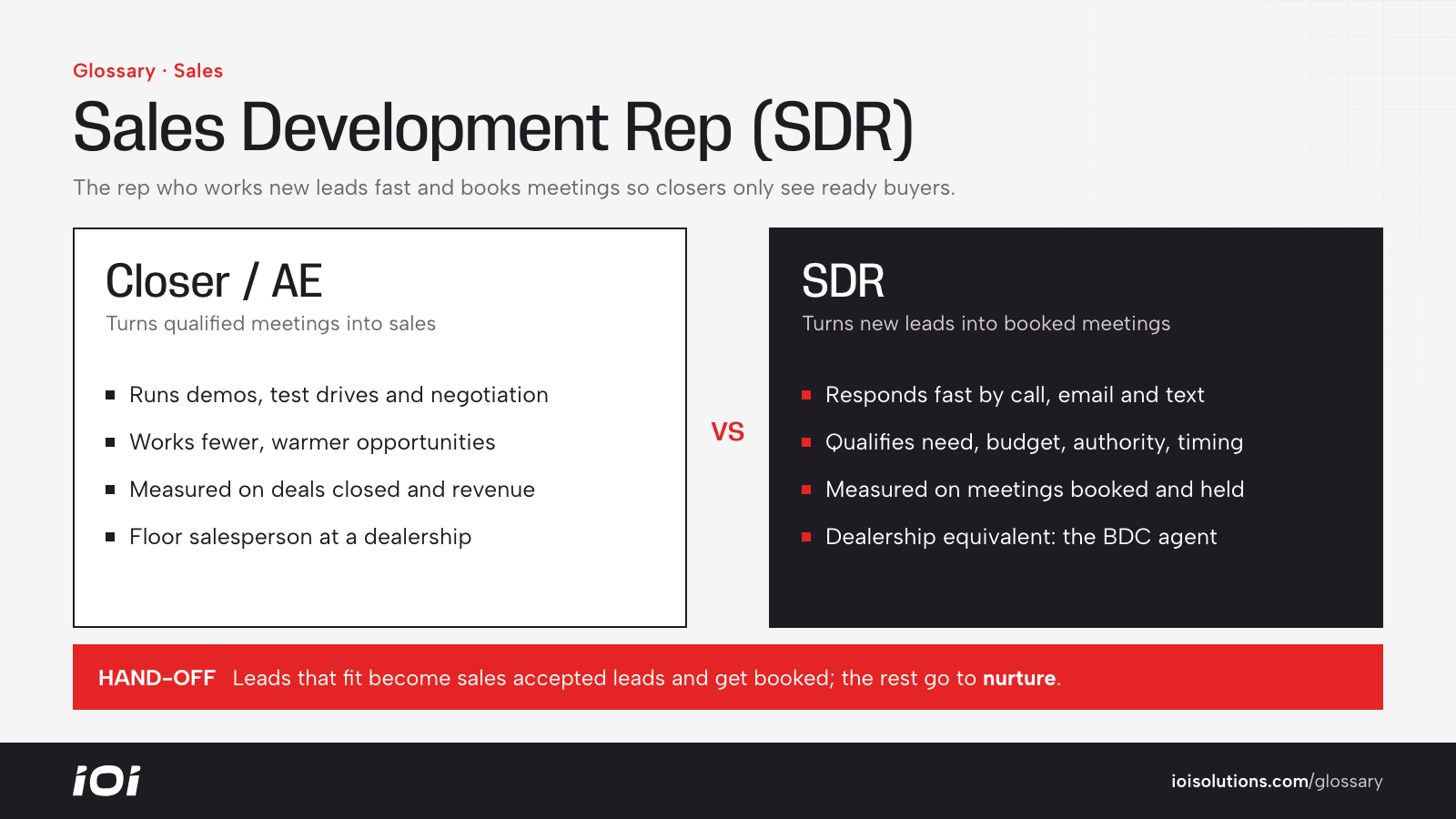
A sales development rep (SDR) is a member of the sales team who focuses on the early stages of the sales process. SDRs respond to inbound leads, reach out to prospects, ask qualifying questions and book meetings or appointments. They usually do not close deals; they hand qualified opportunities to account executives or other closers.
Some companies split the role: SDRs handle inbound leads, while business development reps (BDRs) focus on outbound prospecting. In practice, the titles are often used interchangeably.
Why Sales Development Reps Matter
Closers are expensive, and their time is best spent with buyers who are ready to talk seriously. SDRs protect that time while making sure no lead goes unanswered.
- Speed to lead: A dedicated team can respond to new inquiries within minutes, which is often critical to winning the conversation.
- Consistent qualification: SDRs apply the same criteria to every lead, which improves pipeline quality.
- Feedback loop: Because they talk to every lead, SDRs learn which campaigns and messages attract the right people.
- Scalable pipeline: Adding SDRs is often the fastest way to increase booked meetings.
For marketers, the SDR team is also where lead generation becomes revenue or gets wasted. A well-run campaign can look like a failure if leads sit untouched for a day, so marketing and sales development need shared goals and shared reporting.
How the Sales Development Rep Role Works
- Receive or find leads. Inbound leads arrive from forms, calls and chat; outbound lists come from targeted research.
- Reach out quickly. SDRs use calls, emails, texts and social messages in planned sequences.
- Qualify. They confirm need, budget, authority and timing, or the company’s own criteria, often supported by lead scores.
- Accept or recycle. Leads that fit become sales accepted leads; others go to nurture.
- Book and hand off. SDRs schedule meetings, demos or appointments and pass context to the closer.
SDRs are usually measured on activities (calls, emails), conversations, meetings booked, meetings held and the pipeline those meetings create.
Sales Development Reps in Automotive Marketing
In car retail, the closest equivalent to an SDR team is the dealership business development center (BDC). BDC agents answer internet leads and phone calls, confirm interest, set showroom appointments and run follow-up and equity campaigns, while salespeople on the floor close deals.
- Dealerships: BDC agents are typically measured on appointments set, appointment show rate and the sales that result.
- Service departments: Service BDCs book maintenance and recall appointments and follow up on declined repairs.
- Collision and large repair operations: A dedicated intake coordinator can handle estimate requests and insurance questions, acting much like an SDR.
- Automotive SaaS vendors and suppliers: Classic SDR teams prospect dealer groups, collision MSOs and shop owners, booking demos for account executives.
For example, a software company selling to collision shops might give SDRs a list of multi-location operators, a sequence of calls and emails about cycle time and customer updates, and a goal of booked demos per week.
Best Practices
- Respond to inbound leads as fast as possible, ideally within minutes during business hours.
- Give SDRs clear qualification criteria and simple scripts or talk tracks, but let them sound human.
- Use a CRM with sequences and reminders so follow-up is consistent.
- Measure meetings held and pipeline created, not just activity volume.
- Hold regular feedback sessions between SDRs and marketing on lead quality and messaging.
- Build a clear career path, since many SDRs aim to become closers or managers.