
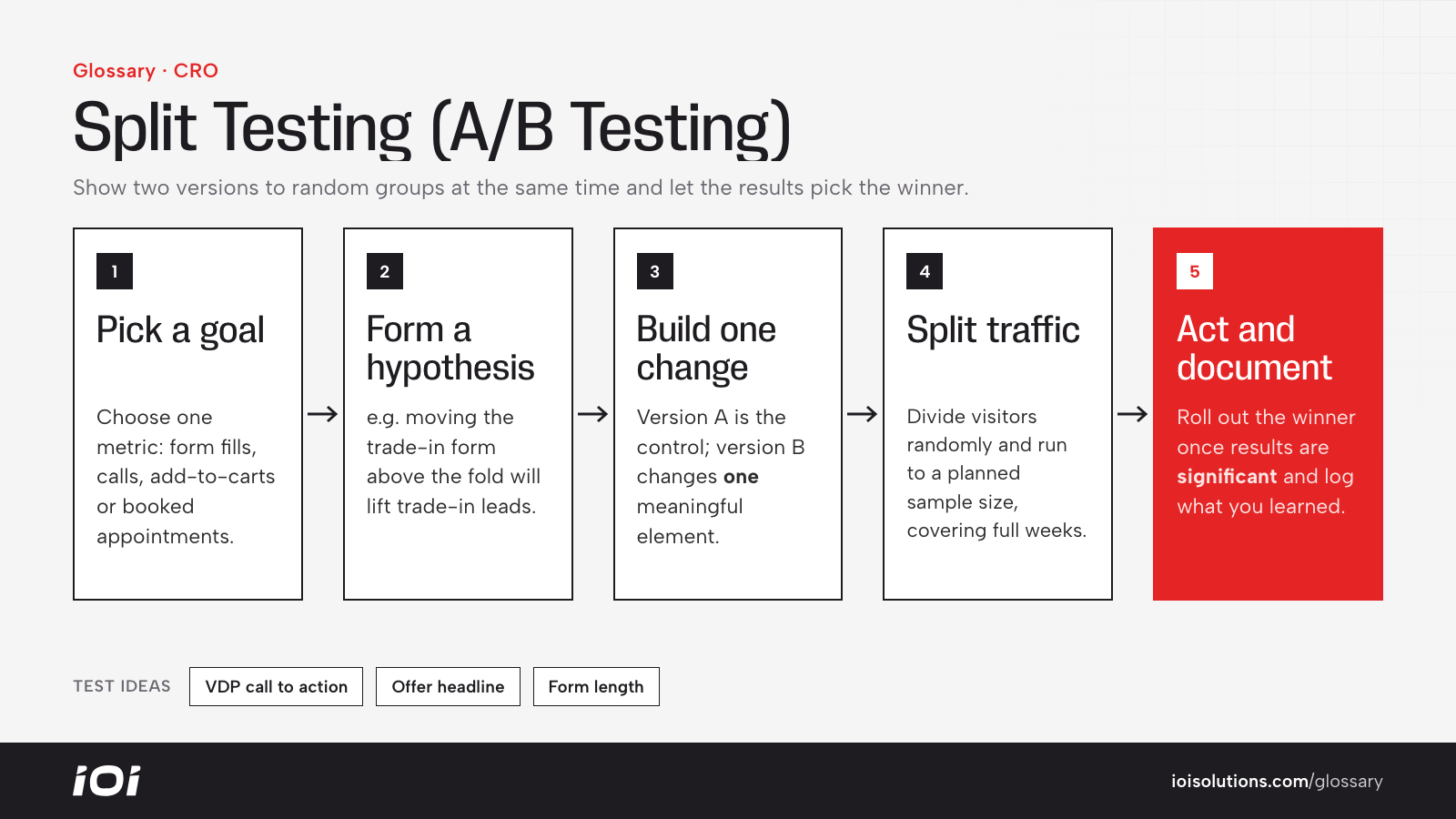
What Is Split Testing (A/B Testing)?
Split testing, also called A/B testing, is a controlled experiment in which you show two versions of something to comparable groups of people at the same time and measure which version produces better results. Version A is usually the current page, ad or email (the control), and version B contains one deliberate change (the variant).
Because traffic is split randomly, differences in outcome can be credited to the change rather than to timing, seasonality or audience mix. That makes split testing one of the most reliable ways to improve marketing performance with evidence instead of opinion.
Why Split Testing Matters
Most marketing decisions start as guesses: which headline is clearer, which offer is stronger, which form is less intimidating. Split testing turns those guesses into measured answers. Small wins compound, too. A page that converts better makes every dollar of ad spend more productive, which lowers cost per lead without raising budgets.
Testing also protects you from bad redesigns. Many site launches lower conversion rate because nobody checked the new version against the old one before rolling it out.
How Split Testing Works
- Pick a goal metric. Decide what success means: form submissions, calls, add-to-carts, purchases or booked appointments.
- Form a hypothesis. For example: “Moving the trade-in form above the fold will increase trade-in leads because visitors will not need to scroll to find it.”
- Build one change. Change one meaningful element so the result is easy to interpret. Testing many elements at once is multivariate testing, which needs far more traffic.
- Split traffic randomly. Use a testing tool or the ad platform’s built-in experiments to divide visitors evenly.
- Run to a planned sample size. Decide in advance how long the test will run and stop only once you have enough data to reach statistical significance, ideally covering full weekly cycles.
- Act and document. Roll out the winner, record what you learned, and use it to shape the next test.
Split Testing in Automotive Marketing
There is plenty to test across the automotive funnel:
- Dealerships: Test the primary call to action on vehicle detail pages (“Check Availability” versus “Get Today’s Price”), the placement of payment calculators, or whether showing an all-in price affects lead volume and quality.
- Collision shops: Compare a landing page that leads with “Free estimate in 24 hours” against one that leads with “We work with all insurance companies.”
- Repair shops: Test online booking against a call-first layout to see which produces more booked appointments that actually show up.
- Parts ecommerce: Test fitment lookup placement, shipping threshold messaging or product image order on high-traffic product pages.
- Ads: Test offer framing in Meta creative, such as a dollar discount versus a percentage off, or a video walkaround versus a static image.
For example, a dealer group might find that a shorter lead form produces more leads but weaker appointment rates. That is why the test metric should connect to sales outcomes where possible, not only top-line form fills.
Best Practices
- Test changes big enough to matter. Button color tweaks rarely move results on low-traffic sites.
- Decide sample size and duration before launching, and avoid stopping the moment one version pulls ahead.
- Run tests for at least one to two full weeks to smooth out weekday and weekend behavior.
- Track downstream quality, such as appointments or sales, alongside conversion rate.
- Keep a test log so lessons carry over across stores, rooftops or campaigns.
- Prioritize high-traffic, high-value pages first, where wins pay off fastest.