
What Is a Call to Action (CTA)?
A call to action (CTA) is a clear instruction that encourages someone to take a specific next step. It can be a button, a link, a line of ad copy, a spoken line in a video or an instruction in an email. Examples include “Book Your Service,” “Get a Free Estimate,” “View Inventory” and “Shop Now.”
Every marketing asset should have a purpose, and the CTA is where that purpose becomes an action the audience can take. In paid search, platforms also offer built-in CTA elements, such as call buttons in ads and preset button labels on social ads like “Learn More” or “Book Now,” and choosing the right one matters just as much as the copy on your website.
Why a Call to Action Matters
People rarely take action unless the next step is obvious and easy. A strong CTA:
- Removes guesswork about what to do next.
- Turns attention into measurable results like calls, leads and sales.
- Improves conversion rate and click-through rate when it’s specific and relevant.
- Helps you track performance, since each CTA represents a defined conversion.
Weak or missing CTAs leave money on the table even when the rest of the page or ad is excellent.
How a Call to Action Works
Effective CTAs share a few traits:
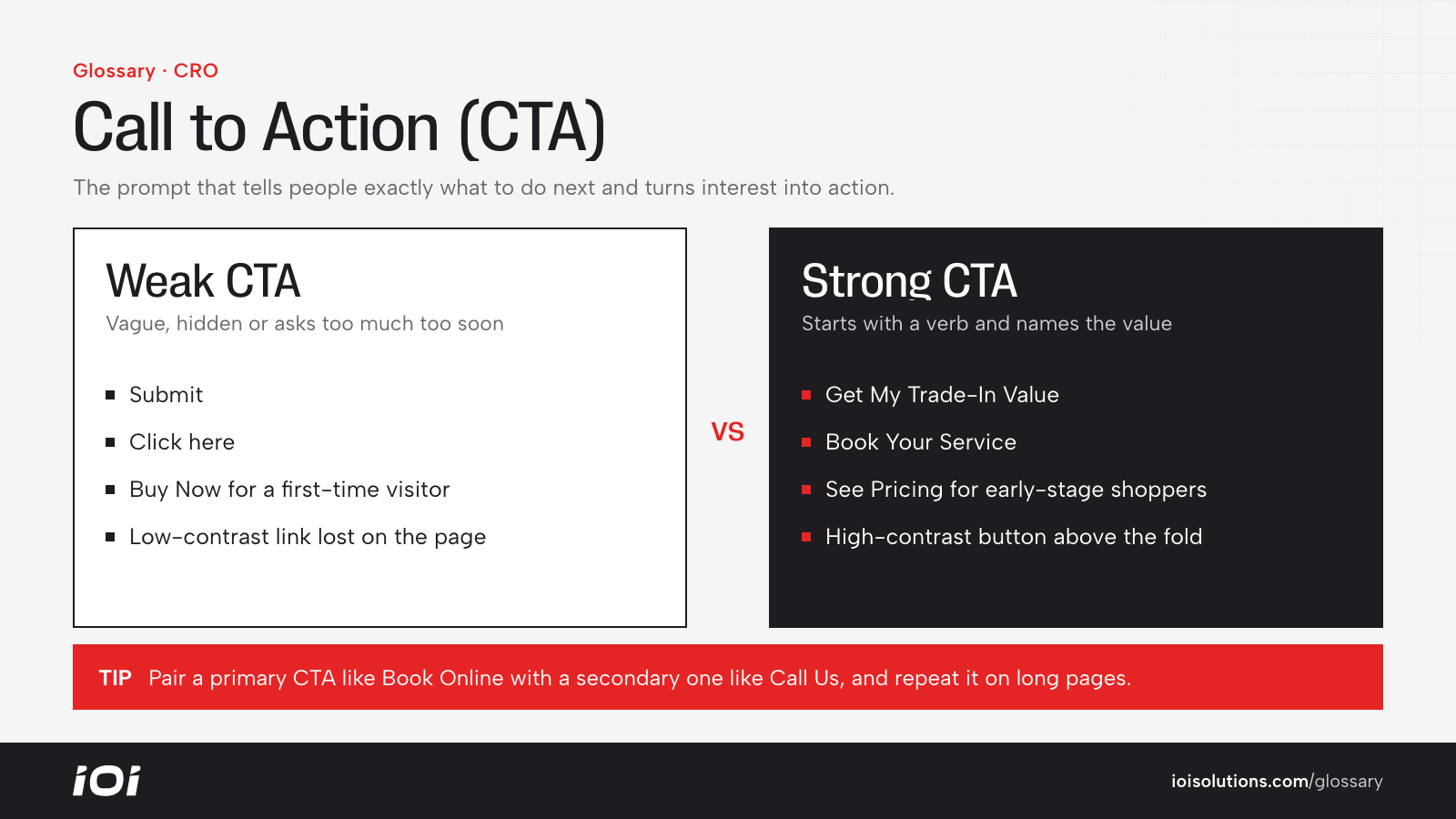
- Action-oriented language: Start with a verb, like “Schedule,” “Get,” “Compare” or “Claim.”
- Specific value: “Get My Trade-In Value” says more than “Submit.”
- Right commitment level: Match the ask to the audience’s readiness. A first-time visitor may prefer “See Pricing” to “Buy Now.”
- Visual prominence: Buttons should stand out through contrast, size and placement.
- Low friction: What happens after the click should be fast and simple.
Pages often have a primary CTA and a secondary one. For example, a primary “Book Online” button and a secondary “Call Us” link for people who prefer the phone. Place the primary CTA above the fold and repeat it further down long pages.
Call to Action in Automotive Marketing
The best CTA depends on the business and the shopper’s stage:
- Dealerships: “View Inventory,” “Check Availability,” “Value Your Trade,” “Get Pre-Qualified” and “Schedule a Test Drive” each fit different buyers. Vehicle pages often include several, so test which order works best.
- Collision shops: “Get a Free Estimate,” “Upload Photos” and “Call Now” work well because customers want quick answers after an accident.
- Repair and tire shops: “Book Service Online” and “Call for Same-Day Service” match urgent needs. Showing open time slots right after the click helps.
- Detailing, wrap and PPF shops: “Get a Custom Quote” or “See Packages” fits a considered purchase.
- Parts brands: “Check Fitment” can come before “Add to Cart” to build confidence.
- Car shows: “Get Tickets” or “Register Your Car” with a deadline adds urgency.
For example, a body shop might find that changing its button from “Contact Us” to “Get My Free Estimate” makes the next step clearer to stressed drivers.
Best Practices
- Use one main goal per page. Too many competing CTAs dilute attention.
- Write in the customer’s words. First-person phrasing like “Get My Quote” often feels more personal.
- Make mobile CTAs thumb-friendly. Use large tap targets, and consider sticky call or booking buttons.
- Set expectations. Short notes like “Takes 60 seconds” or “No obligation” reduce hesitation.
- Test variations. Use split testing to compare wording, color and placement.
- Track every CTA. Measure clicks and completions so you know which ones drive results.