
What Is Net Promoter Score (NPS)?
Net Promoter Score (NPS) is a customer loyalty metric based on one question: “On a scale of 0 to 10, how likely are you to recommend us to a friend or colleague?” Based on their answers, customers fall into three groups. The score summarizes how many enthusiastic fans you have compared to unhappy customers.
NPS is popular because it’s simple to ask, simple to understand, and easy to track over time. Many businesses follow the main question with an open-ended one, like “What’s the main reason for your score?”, to understand the why behind the number.
Why Net Promoter Score Matters
Loyal customers buy again, spend more, and refer others. Unhappy customers leave, and some share negative experiences publicly. NPS gives you a quick read on which way your customer base is leaning.
It’s useful for:
- Tracking customer sentiment over time and after operational changes.
- Comparing locations, departments, or employees.
- Identifying happy customers who might leave reviews or provide referrals.
- Flagging unhappy customers for quick recovery before they churn or post a negative review.
NPS also connects marketing to the customer experience. Strong advertising can’t overcome a poor experience for long, and NPS helps reveal when operations are undermining acquisition efforts.
How to Calculate Net Promoter Score
Responses are grouped as:
- Promoters (9-10): Loyal enthusiasts likely to recommend you.
- Passives (7-8): Satisfied but not enthusiastic, and open to competitors.
- Detractors (0-6): Unhappy customers who may discourage others.
The formula is:
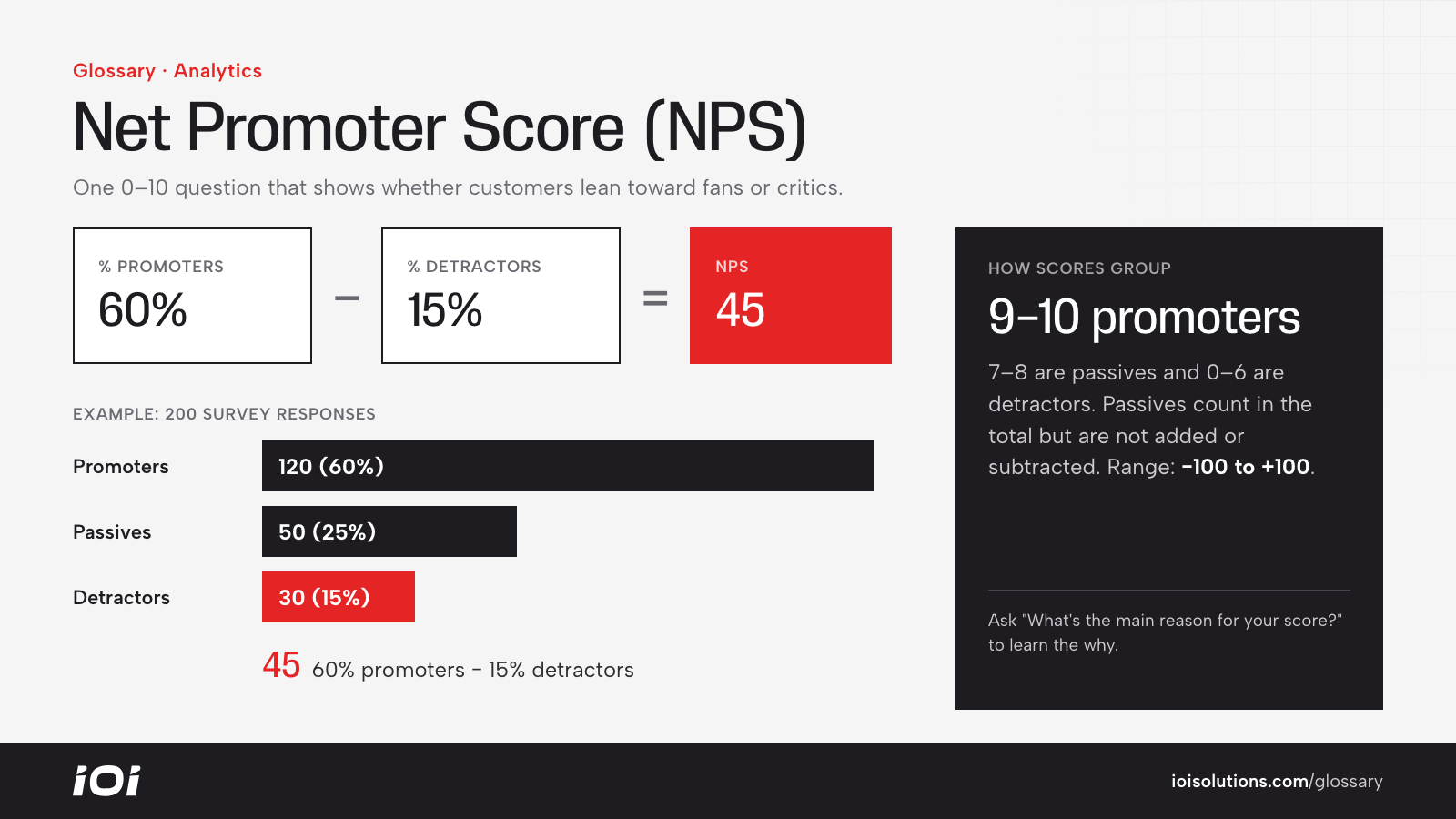
NPS = % of Promoters – % of Detractors
Passives count toward the total number of responses but aren’t added or subtracted. The result ranges from -100 (everyone is a detractor) to +100 (everyone is a promoter).
For example, if 200 customers respond and 120 are promoters (60 percent), 50 are passives (25 percent), and 30 are detractors (15 percent), the NPS is 60 – 15 = 45.
Net Promoter Score in Automotive Marketing
- Dealerships: Sales and service departments can track NPS separately. Since many manufacturers already run their own customer satisfaction surveys, dealers should coordinate so customers aren’t over-surveyed. Service NPS is especially useful because it ties closely to service retention.
- Collision shops: Repair experiences are emotional. NPS surveys sent after vehicle delivery can reveal issues with communication, timing, or repair quality, and promoters can be invited to leave online reviews.
- Repair shops: Tracking NPS by service advisor or technician team helps identify training needs and top performers.
- Parts and accessories brands: Post-purchase NPS can highlight problems with fitment accuracy, shipping, or install instructions.
- Automotive SaaS: NPS from dealers or shop owners often serves as an early warning of churn and a source of product feedback.
What Is a Good Net Promoter Score?
Any score above zero means you have more promoters than detractors. Beyond that, what counts as “good” varies widely by industry, region, and survey method, so the most useful benchmark is your own trend over time.
- Ask at the right moment. Send surveys shortly after a purchase, delivery, or service visit, while the experience is fresh.
- Keep it short. The core question plus one open-ended follow-up is usually enough.
- Close the loop. Contact detractors quickly to resolve issues, and thank promoters.
- Turn promoters into reviewers. Invite happy customers to share their experience on review platforms, following each platform’s rules on review requests.
- Segment the results. Break NPS down by location, department, service type, or employee to find specific improvements.
- Act on the comments. The written feedback is often more valuable than the score itself.