
What Are Long-Tail Keywords?
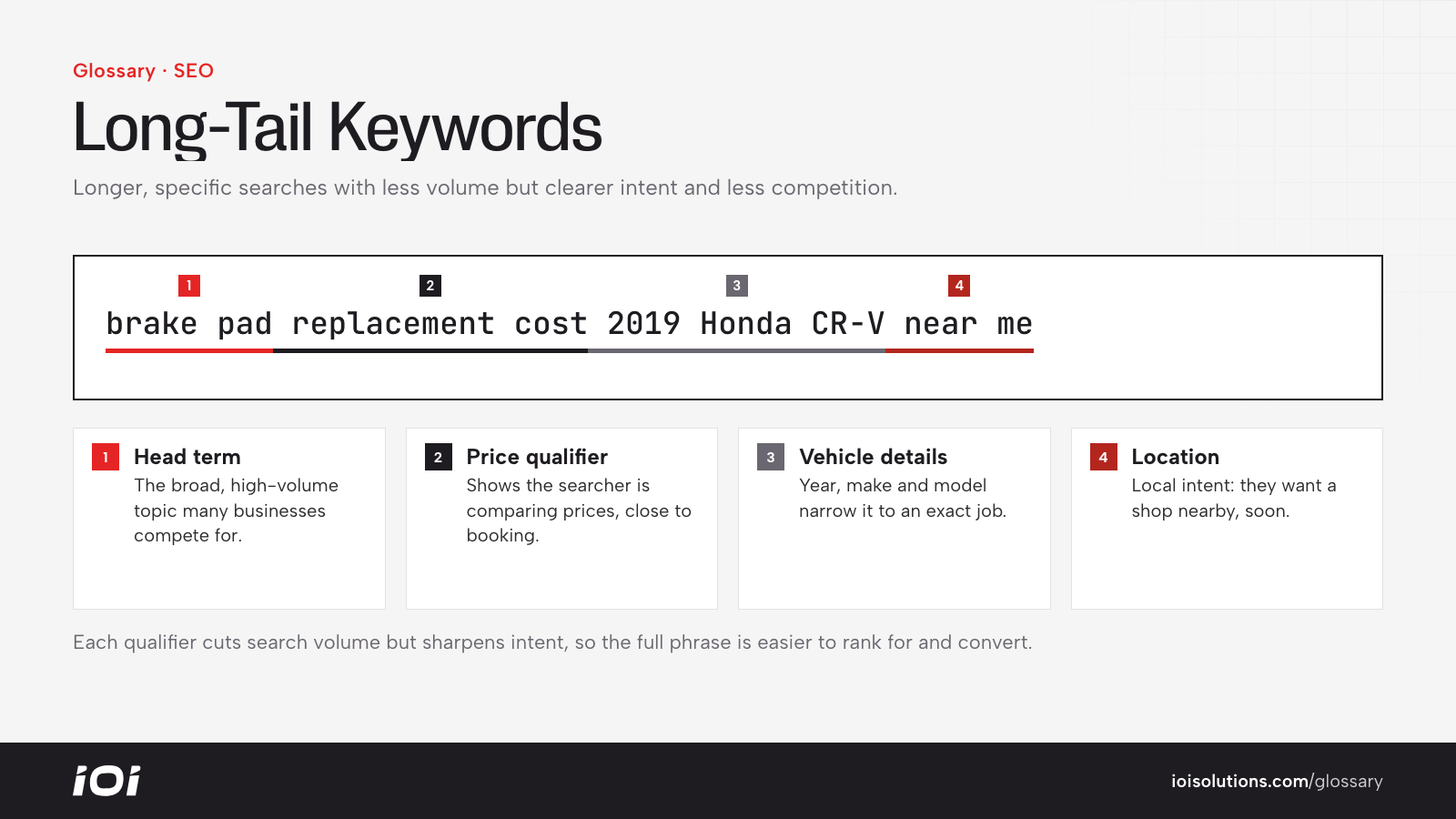
Long-tail keywords are specific, usually multi-word search phrases that individually get relatively few searches. “Brakes” is a broad, head term. “Brake pad replacement cost for a 2019 Honda CR-V” is a long-tail keyword. Each long-tail phrase may only be searched a handful of times a month, but there are enormous numbers of them, and together they make up a large share of all searches.
The name comes from the shape of a search demand curve. A small number of popular terms make up the tall “head,” while a long “tail” of niche phrases stretches out behind them.
Why Long-Tail Keywords Matter
Long-tail keywords tend to offer three advantages:
- Clearer intent: Someone searching a detailed phrase usually knows what they want. That specificity often leads to higher conversion rates.
- Less competition: Fewer businesses target narrow phrases, so it’s easier to rank organically and often cheaper to bid on them in paid search.
- Better alignment with how people search today: Voice search and AI-assisted search encourage people to type or speak full questions, which naturally creates long-tail queries.
For smaller businesses that can’t outrank national brands on broad terms, long-tail keywords are often the most realistic path to search visibility.
How Long-Tail Keywords Work
Long-tail keywords usually add one or more qualifiers to a broader term:
- Location: “transmission repair in Mesa AZ”
- Vehicle details: “2021 Jeep Wrangler 2-inch lift kit”
- Problem or symptom: “car shakes when braking at high speed”
- Price or comparison: “ceramic coating vs PPF cost”
- Purchase intent: “buy used Tacoma under 30k near me”
You can find them through keyword research tools, Google’s autocomplete and “People also ask” boxes, Search Console query data, paid search term reports, and customer conversations. Grouping search terms by recurring words, a technique called n-gram analysis, helps reveal patterns across thousands of long-tail queries.
Long-Tail Keywords in Automotive Marketing
The automotive world is naturally full of long-tail searches because of years, makes, models, trims, parts, and symptoms:
- Dealerships: Pages and ads for specific models, trims, and configurations, such as “certified pre-owned F-150 with tow package,” can capture shoppers who are close to buying.
- Repair shops: Content that answers symptom-based questions, like “grinding noise when turning,” attracts drivers who need help now and may not know what repair they need.
- Collision shops: Phrases like “Tesla certified body shop near me” or “hail damage repair cost” signal high intent and specific needs.
- Parts and accessories ecommerce: Year-make-model product and category pages naturally target long-tail searches, which is a cornerstone of ecommerce SEO for parts brands.
- Detailing and wraps: “Matte wrap cost for Model Y” or “best ceramic coating for black paint” bring in qualified shoppers comparing options.
Best Practices
- Build pages around topics, not single phrases. One strong page can rank for dozens of related long-tail keywords if it covers the topic thoroughly.
- Mine your own data. Search term reports and Search Console reveal real long-tail queries people already use to find you.
- Answer questions directly. Use clear headings and concise answers, which also helps with AI-generated search summaries.
- Use structured data for scale. For inventory and catalogs, generate pages from year, make, model, and fitment data rather than writing each one by hand, while keeping them genuinely useful.
- Balance with broader terms. Long-tail keywords complement, rather than replace, core terms in your SEO and paid search strategy.
- Watch for thin content. Avoid creating near-duplicate pages for every tiny variation. That can hurt rankings rather than help.