
What Is JavaScript Object Notation (JSON)?
JavaScript Object Notation (JSON) is a simple text format for organizing data so that computers can easily read, write, and exchange it. Despite the name, it isn’t limited to JavaScript. Nearly every programming language and platform supports it, which makes JSON the default way software systems pass data to each other.
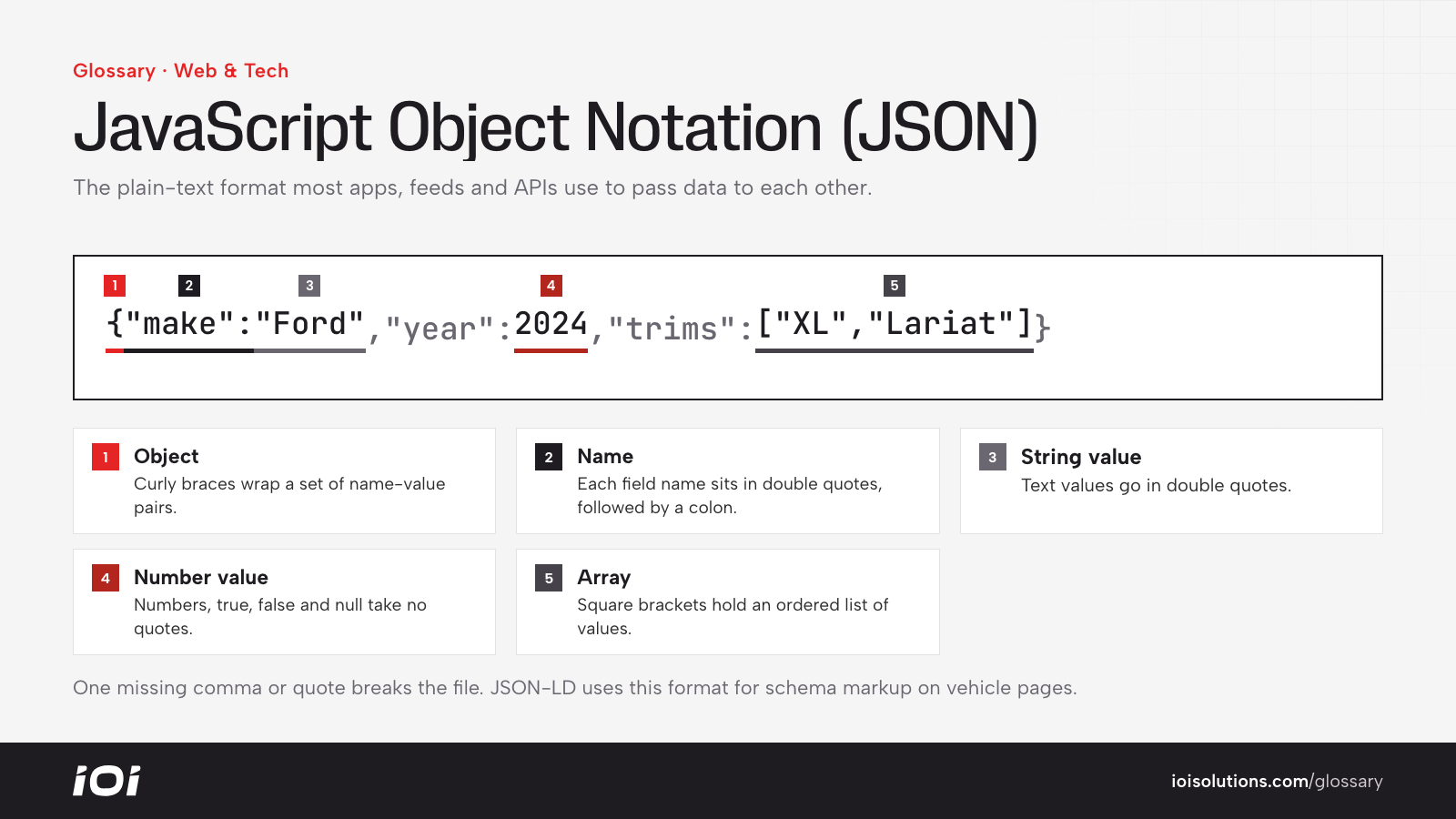
JSON organizes information as pairs of names and values, grouped inside curly braces, with lists inside square brackets. For example, a vehicle could be described with fields for “year,” “make,” “model,” and “price,” each paired with its value. It’s readable enough that a non-developer can usually look at a JSON file and understand what it contains.
Why JSON Matters
Marketers rarely write JSON from scratch, but it shows up constantly behind the scenes:
- APIs: Most APIs send and receive data as JSON. When your CRM, ad platform, or reporting tool pulls data from another system, JSON is usually the format moving it.
- Structured data for SEO: Search engines recommend JSON-LD (JSON for Linked Data) for adding schema markup to pages. That markup can make pages eligible for rich snippets such as review stars, product prices, and FAQs.
- Tracking and tags: Data layers used by tools like Google Tag Manager are built from JSON-style objects that pass details like product IDs or form types to analytics.
- Feeds and integrations: Product feeds, inventory feeds, and webhook payloads often use JSON.
Understanding the basics helps you troubleshoot integrations, review schema markup, and communicate clearly with developers.
How JSON Works
JSON is built from a few simple pieces:
- Objects: collections of name-value pairs wrapped in curly braces.
- Arrays: ordered lists of values wrapped in square brackets.
- Values: text strings in double quotes, numbers, true or false, null, or nested objects and arrays.
Because the rules are strict, a single missing comma or quotation mark can break a JSON file. That’s why validators and linters are useful when you edit it by hand. When a system receives JSON, it “parses” the text into data it can work with, then often sends JSON back in response.
JSON-LD for SEO is placed inside a script tag in a page’s HTML. It describes the page’s content using vocabulary from Schema.org, such as Organization, LocalBusiness, Product, Vehicle, or FAQPage.
JSON in Automotive Marketing
JSON quietly powers much of automotive digital marketing:
- Dealership inventory: Inventory data often moves between the dealer management system, website platform, and listing sites through feeds and APIs that use JSON. Vehicle pages can include JSON-LD describing year, make, model, mileage, VIN, and price.
- Local businesses: Repair shops, body shops, and detailers can use LocalBusiness or AutoRepair schema in JSON-LD to describe their name, address, hours, and services.
- Parts ecommerce: Product schema with price, availability, and reviews helps parts listings stand out in search. Fitment data is also frequently exchanged between systems in structured formats.
- Lead routing: When a form submission is sent to a CRM through a webhook, the lead details usually travel as JSON.
Best Practices
- Use JSON-LD for schema markup. It’s the format search engines generally recommend, and it keeps structured data separate from visible content.
- Validate before publishing. Run JSON through a validator and test schema with a rich results testing tool.
- Keep markup truthful. Structured data must match what’s on the page. Marking up reviews or prices that users can’t see can lead to penalties.
- Automate at scale. For inventory or catalogs, generate JSON-LD from your data source rather than editing pages by hand.
- Document your data layer. Keep a shared reference of field names so marketing and development stay aligned.