
What Is Duplicate Content?
Duplicate content is substantial blocks of text that are the same or very similar across multiple web pages. It can happen within one website, such as the same product description on several URLs, or across different websites, such as a manufacturer description used by hundreds of retailers.
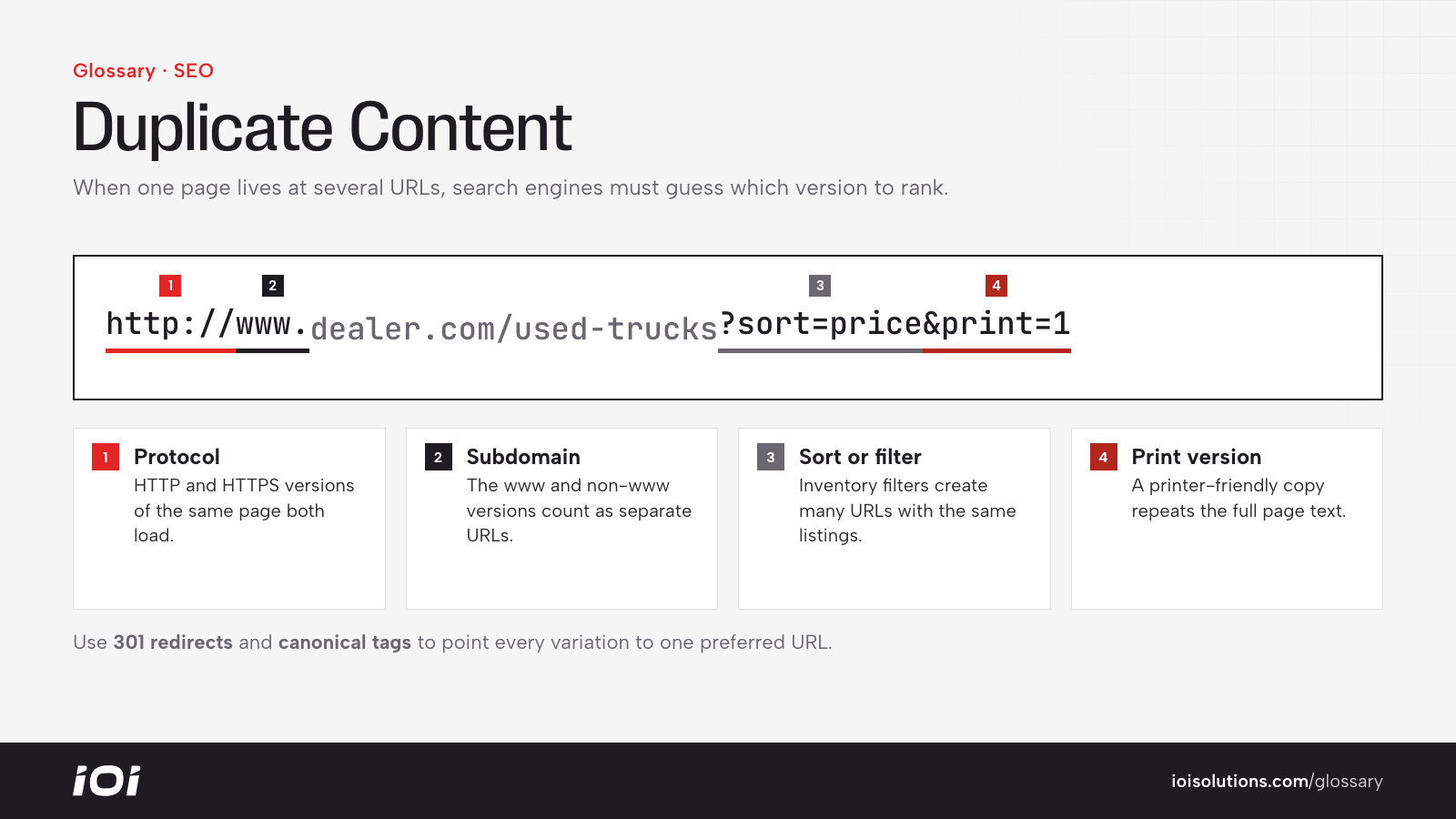
Most duplicate content is not created on purpose. It often comes from technical quirks: URL parameters for sorting and filtering, separate print versions, HTTP and HTTPS versions, “www” and non-“www” versions, or templates that generate near-empty pages.
Why Duplicate Content Matters
Google has stated that it does not generally penalize ordinary duplicate content. The bigger problem is that duplication creates confusion and wastes potential.
- Split ranking signals. Links and engagement get spread across several versions instead of strengthening one.
- Wrong page ranking. Search engines may pick a version you did not intend, such as a filtered URL instead of the main category page.
- Wasted crawling. On large sites, search engines spend time crawling duplicate URLs instead of your important pages.
- Thin differentiation. If your product or service pages read exactly like everyone else’s, you give search engines little reason to rank you above competitors.
Deliberately copying or scraping others’ content to manipulate rankings is a different matter and can lead to pages being filtered out or other action.
How Duplicate Content Works
When search engines find multiple pages with the same content, they group them and choose one to show, often called the canonical version. You can influence that choice with several tools:
- Canonical tags tell search engines which URL is the preferred version of a page.
- 301 redirects permanently send users and search engines from duplicate URLs to the main version.
- Consistent internal linking to the preferred URL reinforces it.
- Noindex directives keep low-value variations out of search results.
- Clean sitemaps that list only canonical URLs.
Duplicate Content in Automotive Marketing
Automotive websites are especially prone to duplication:
- Dealership sites generate many inventory search pages through filters for make, model, price, color and more. Vehicle detail pages often use identical manufacturer descriptions, and sold vehicles may leave behind near-duplicate pages.
- Multi-location repair or tire chains sometimes copy the same service page for every city, changing only the town name, which creates thin, near-duplicate location pages.
- Parts and accessories stores often use manufacturer-supplied descriptions shared by every retailer, and variant URLs for sizes or finishes can create internal duplicates.
For example, a parts retailer might write unique descriptions for its top-selling products, adding fitment notes, installation tips and photos, while using canonical tags to consolidate color variants. That gives search engines a reason to prefer its pages over competitors using the same stock copy. This is a core concern in ecommerce SEO.
A multi-location shop could make each location page genuinely local with staff, photos, directions, reviews from that location and the specific services offered there.
Best Practices
- Pick one preferred URL format. Redirect HTTP to HTTPS and choose “www” or non-“www” consistently.
- Use canonical tags on variations. Point filtered, sorted and parameter URLs to the main page where appropriate.
- Write original copy for key pages. Prioritize top categories, best-selling products and core service pages.
- Make location pages truly local. Add unique details for each location rather than swapping city names.
- Manage faceted navigation. Control which filter combinations can be crawled and indexed.
- Audit regularly. Use a crawler and Google Search Console to find duplicate titles, descriptions and pages.