
What Is Direct Marketing?
Direct marketing is any marketing that reaches a specific person or household directly, rather than a broad audience, and asks them to respond. Common forms include direct mail, email, SMS text messages, phone calls and personalized digital messages. The defining traits are targeting individuals and measuring the response.
Unlike brand advertising, which builds awareness over time, direct marketing usually carries a clear call to action: call this number, use this code, book by this date or visit this page.
Why Direct Marketing Matters
Direct marketing is highly measurable and controllable. You choose exactly who receives a message, track who responds and calculate the return on each campaign.
- Precise targeting. Lists can be built by location, purchase history, vehicle owned, service due dates and more.
- Personalization. Messages can include names, vehicles, past purchases or specific offers.
- Clear measurement. Unique codes, phone numbers and URLs show which pieces worked.
- Owned relationships. Email and SMS lists are assets you control, unlike rented social audiences.
Types of Direct Marketing
- Direct mail. Postcards, letters and catalogs. Still effective for local businesses and for reaching people who are not active online.
- Email marketing. Low-cost, fast and easy to automate, from newsletters to triggered reminders.
- SMS and text messaging. High visibility for time-sensitive messages, but requires explicit consent.
- Telemarketing and outbound calls. Personal but heavily regulated.
- Addressable digital. Uploading customer lists to platforms like Meta or Google to reach known people with ads.
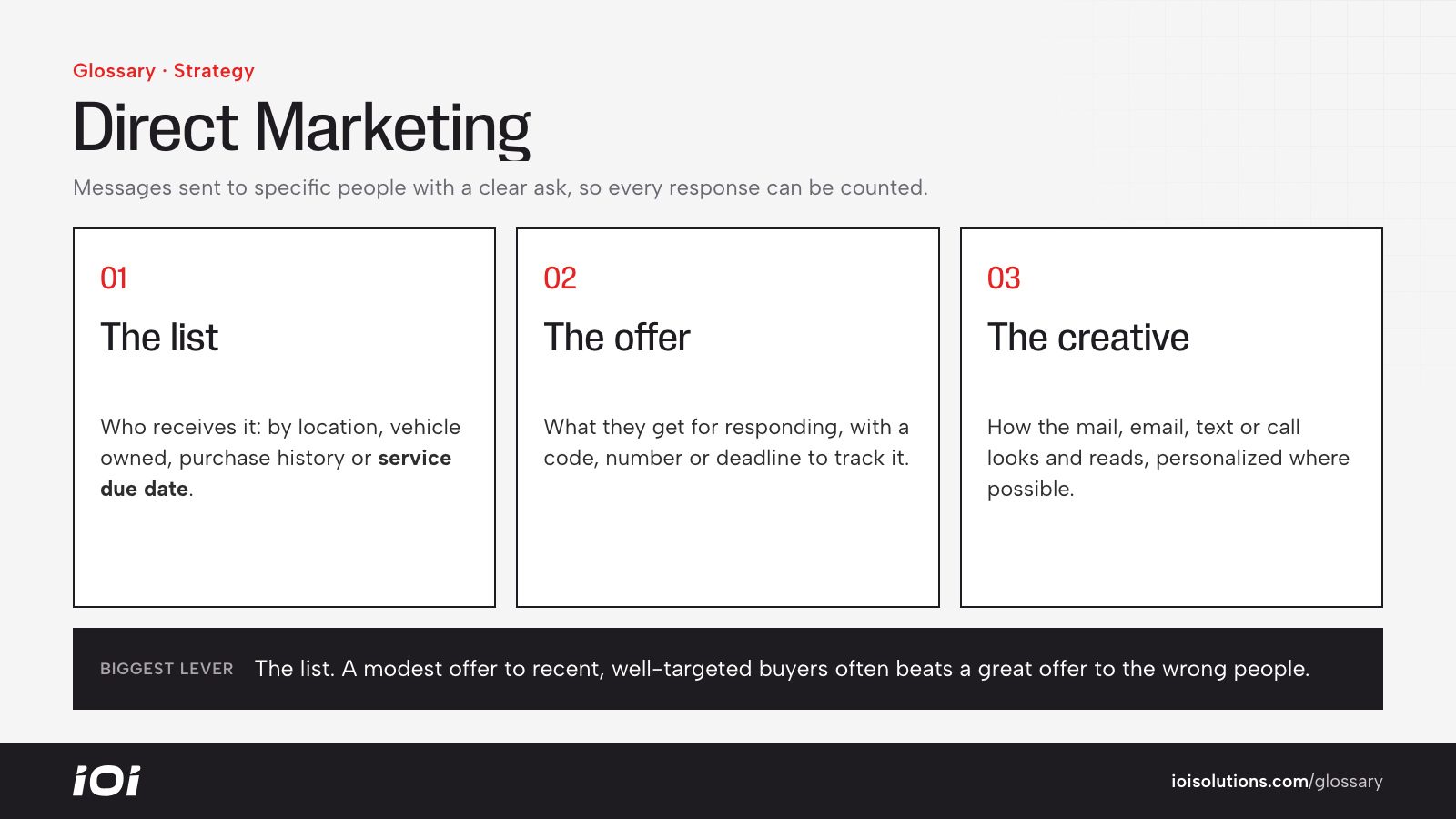
Every direct marketing campaign rests on three elements: the list (who receives it), the offer (what they get for responding) and the creative (how the message looks and reads). Of the three, the list usually has the biggest effect on results. A strong offer sent to the wrong people will still underperform, while a modest offer sent to well-targeted, recently active customers often does well. Testing one element at a time, such as two offers to matched halves of a list, shows what actually drives response.
Direct marketing is regulated. In the US, laws such as CAN-SPAM for commercial email and the Telephone Consumer Protection Act (TCPA) for calls and texts set rules on consent, opt-outs and identification. Always confirm compliance before launching.
Direct Marketing in Automotive Marketing
Automotive businesses have rich customer data, which makes direct marketing a natural fit.
- Dealerships mail or email owners whose vehicles have high trade-in value or whose leases are nearing maturity, inviting them to upgrade.
- Service departments and repair shops send maintenance reminders based on mileage or time since the last visit, along with seasonal offers like winter tire changeovers.
- Collision shops may send thank-you mail and review requests after a repair, plus referral offers.
- Parts brands use email and SMS flows for abandoned carts, restocks and replenishment of consumables.
For example, a tire shop could use geographic segmentation to mail postcards only to neighborhoods within a short drive, with a unique offer code to measure redemptions. If a few ZIP codes respond far better, the next mailing can concentrate there.
Best Practices
- Get consent and stay compliant. Follow email, text and calling rules, and honor opt-outs quickly.
- Keep lists clean. Remove duplicates, bad addresses and people who have sold their vehicles.
- Personalize meaningfully. Mention the customer’s vehicle or service history, not just their first name.
- Make one clear ask. Each piece should have a single, specific action and a reason to act now.
- Track every response. Use unique codes, URLs or call tracking numbers per campaign.
- Coordinate with digital. Pair mail with matched email or social ads to the same list for stronger results.