
What Is Customer Churn Rate?
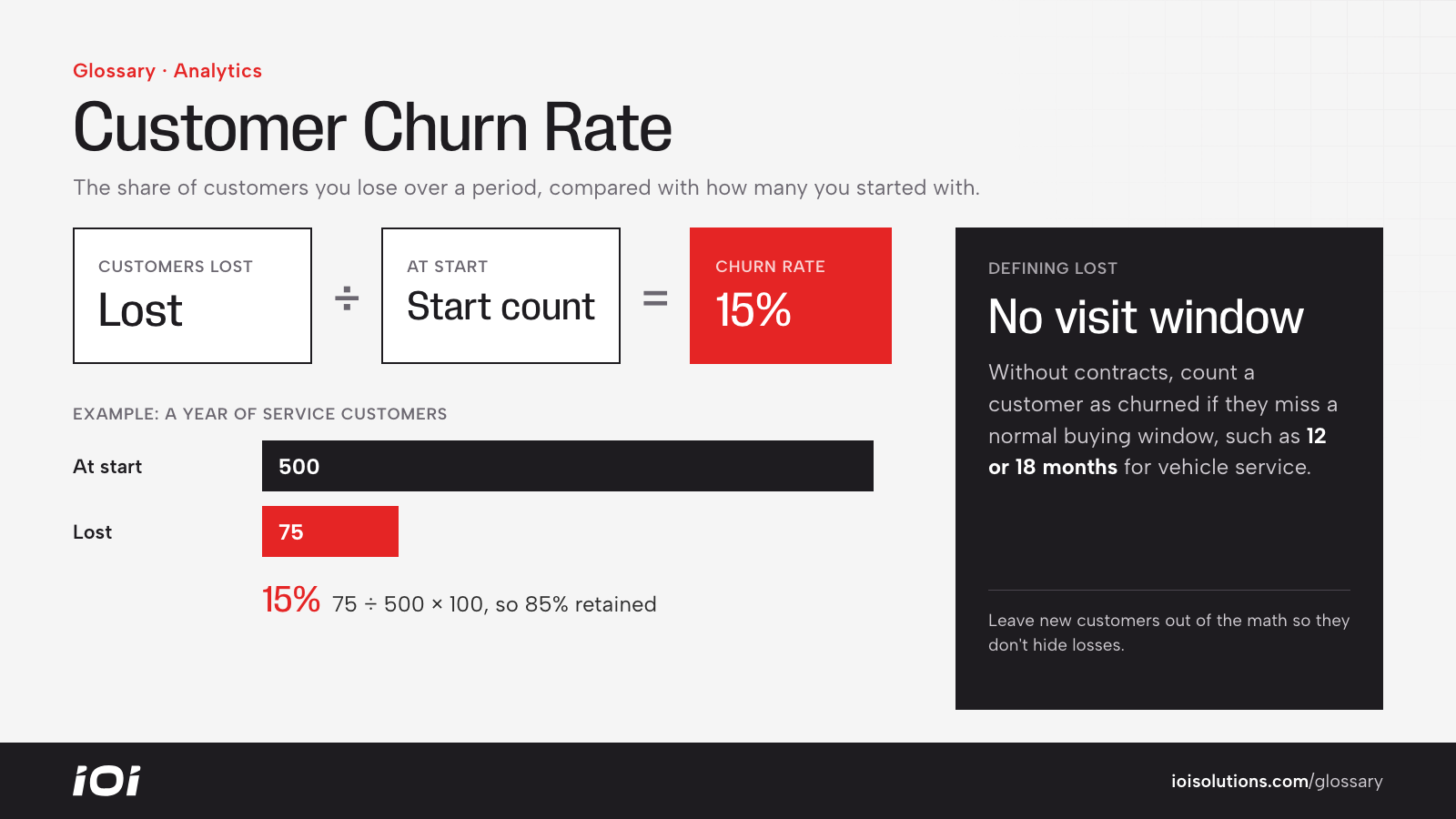
Customer churn rate measures how many customers you lose over a set period, expressed as a percentage of the customers you started with. In subscription businesses, churn means a cancellation. In businesses without contracts, churn means a customer who has stopped coming back within the time frame you would normally expect.
Churn is the mirror image of retention. If 10% of customers churn in a year, 90% were retained.
Why Customer Churn Rate Matters
Churn quietly undermines growth. If you add 100 customers a month but lose 80, you are working hard to grow by 20. Reducing churn is often cheaper than acquiring replacements, and it increases lifetime value because customers stay and spend longer.
- It reveals experience problems. Rising churn often points to service quality, pricing, communication or product issues.
- It shapes acquisition budgets. Lower churn means each new customer is worth more, so you can afford to spend more to acquire them.
- It drives recurring revenue. For SaaS companies, churn directly reduces annual recurring revenue.
How to Calculate Customer Churn Rate
Churn Rate = (Customers Lost During Period ÷ Customers at Start of Period) × 100
For example, if you begin the year with 500 active customers and 75 of them stop doing business with you by year end, your annual churn rate is 75 ÷ 500 × 100 = 15%. New customers acquired during the period are excluded from this calculation so they do not mask losses.
For non-subscription businesses, you need a working definition of “lost.” A common approach is to treat a customer as churned if they have not purchased or visited within a window that reflects normal buying behavior, such as 12 or 18 months for vehicle service.
Some companies also track revenue churn, which measures lost revenue rather than lost customers. This matters when customers differ widely in value.
Customer Churn Rate in Automotive Marketing
Automotive businesses experience churn in several forms:
- Dealership service departments lose customers when owners shift maintenance to independent shops or quick-lube chains, often once a vehicle’s warranty or included maintenance ends.
- Repair and tire shops lose customers who move, sell their vehicle or have one poor experience.
- Detailers and ceramic coating shops with maintenance plans see churn when members cancel recurring washes or coating upkeep.
- Automotive software providers track classic subscription churn when dealers or shops cancel their contracts.
For example, a repair shop could pull a list of customers who have not returned in 15 months and compare it to a year earlier. If that group is growing, targeted reminder emails, text campaigns and a service offer could win some back before they are gone for good.
Ecommerce parts brands can track repeat purchase rate as the flip side of churn, especially for consumables such as filters, fluids, detailing products and wiper blades.
What Is a Good Customer Churn Rate?
Acceptable churn varies widely by industry, business model and customer type. Contract-based B2B software usually aims for much lower churn than consumer services where people buy occasionally. Your best benchmark is your own trend: churn should be stable or falling over time.
- Define churn clearly. Pick a time window that matches your customers’ normal buying cycle and stick with it.
- Find the causes. Survey lost customers, review complaints and track Net Promoter Score to spot patterns.
- Automate reminders. Service due reminders, renewal notices and seasonal check-ins keep you top of mind.
- Win back lapsed customers. Build specific offers and messages for people who have not returned recently.
- Fix the first experience. Many customers churn after their first visit, so onboarding and follow-up matter.
- Segment by value. Focus retention effort on the customers who contribute the most revenue.