
What Is Cost per Click (CPC)?
Cost per click (CPC) is the price you pay when someone clicks your ad. It is both a pricing model, where you are charged only for clicks rather than views, and a metric, where you look at the average amount you paid per click over a period of time. CPC is the foundation of pay-per-click (PPC) advertising on platforms like Google, Microsoft and many social networks.
Most platforms use an auction to set CPC. You set a maximum bid or let automated bidding decide, and the actual price you pay is influenced by competitors’ bids and the quality of your ad.
Why Cost per Click Matters
CPC determines how much traffic your budget can buy. If clicks cost $2, a $1,000 budget buys roughly 500 visits; if they cost $10, it buys about 100. That difference shapes everything downstream, from lead volume to how quickly you can test new ideas.
- Budget planning. Estimated CPCs help you forecast traffic and leads before launching.
- Competitive insight. Rising CPCs usually signal more advertisers bidding on the same terms.
- Efficiency diagnosis. CPC is one half of cost per acquisition. The other half is conversion rate.
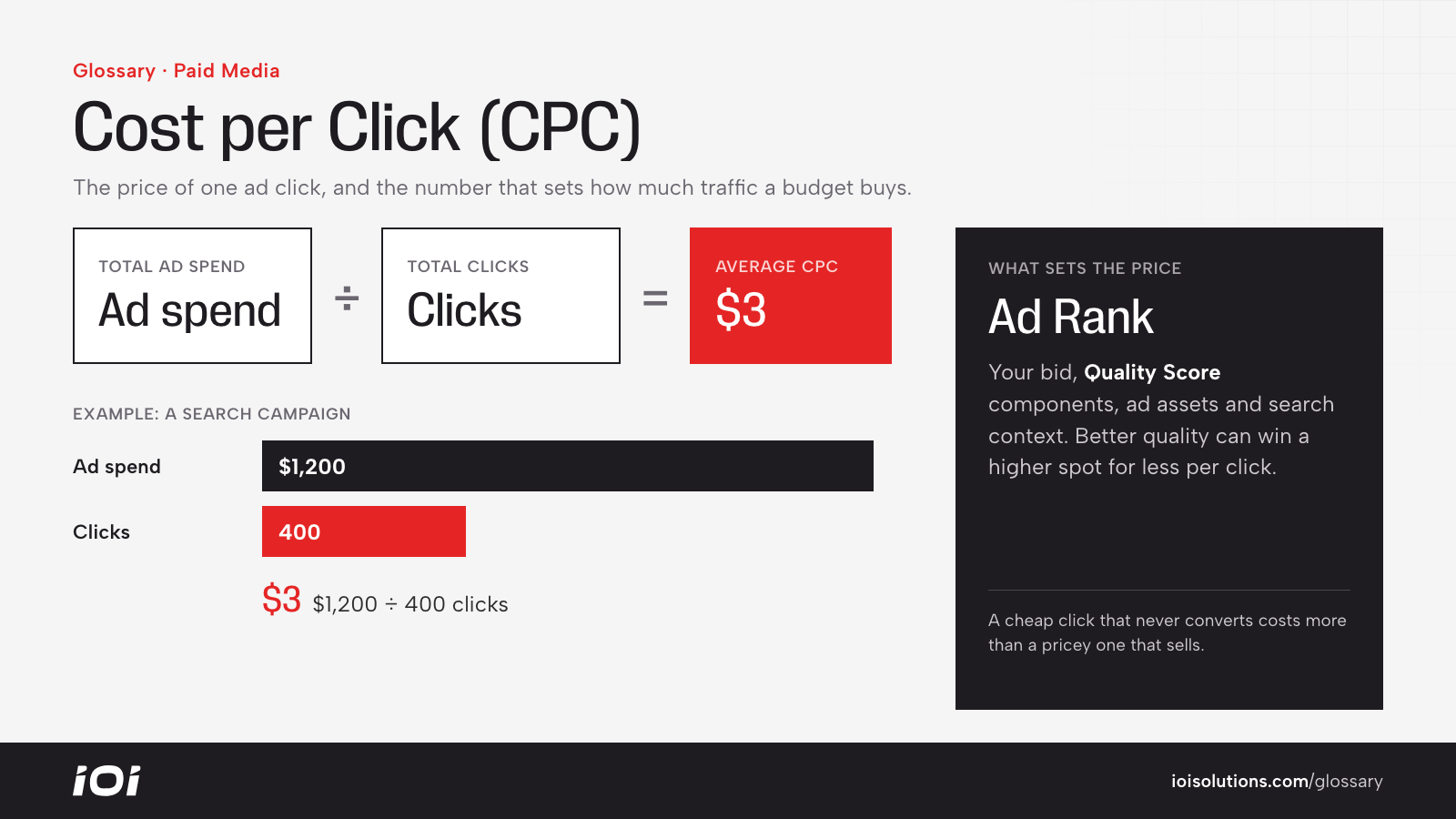
That said, CPC alone can mislead. A cheap click that never converts is more expensive than a pricey click that turns into a customer.
How to Calculate Cost per Click
Average CPC = Total Ad Spend ÷ Total Clicks
For example, if you spend $1,200 and receive 400 clicks, your average CPC is $3.
In Google Ads, the actual CPC in a given auction is driven by your Ad Rank relative to the advertiser below you. Ad Rank considers your bid, your Quality Score components (expected click-through rate, ad relevance and landing page experience), ad extensions and context such as device and location. Better quality can let you win a higher position while paying less per click.
Cost per Click in Automotive Marketing
Automotive keywords span a wide price range. High-intent searches tied to big-ticket purchases or urgent needs, such as collision repair near me, towing service or a specific new model with a dealer’s city, can be among the more expensive clicks in local advertising because many competitors want them. Informational searches, like how often to rotate tires, tend to cost less but convert less directly.
For example, a dealership might pay considerably more per click for a branded model plus “lease deals” query than for a generic used-car term. Because the lease shopper is much closer to buying, that higher CPC can still produce a better cost per sale.
Repair shops and body shops can often lower CPC by tightening geographic targeting to a realistic service radius, scheduling ads during business hours when calls can be answered, and excluding irrelevant searches such as “jobs,” “salary” or “DIY.” Parts retailers frequently find that Shopping and product-specific searches deliver more qualified clicks than broad category terms.
Vehicle listing ads and marketplace placements may use CPC or other pricing models, so compare them on cost per lead or sale rather than on CPC alone.
What Is a Good Cost per Click?
A good CPC is any price that still produces a profitable cost per acquisition. CPCs vary widely by industry, keyword, location, season and competition, so a number that looks high in one market may be cheap in another.
- Improve relevance. Tight ad groups, specific ad copy and matching landing pages raise Quality Score and can lower CPC.
- Use negative keywords. Block searches that will never convert so you stop paying for them.
- Bid on value, not vanity. Push budget toward keywords with proven conversions, even if their CPC is higher.
- Adjust by device, location and time. Bid modifiers or automated signals help you pay less where results are weaker.
- Monitor auction insights. Track who you compete against and how often, so CPC changes do not surprise you.
- Judge on downstream results. Always pair CPC with conversion rate and CPA before making cuts.