
What Is Conversion Rate?
Conversion rate is the share of people who take a specific, valuable action out of everyone who had the chance to take it. The “action” is whatever you define as a conversion: submitting a quote request, calling from an ad, booking a service appointment, starting a credit application or completing an online order. The “chance” is usually sessions, clicks or users, depending on how you measure.
It is one of the most practical numbers in marketing because it connects traffic to outcomes. Two campaigns can send the same number of visitors to your site, but if one converts twice as well, it produces twice the leads for the same spend.
Why Conversion Rate Matters
Conversion rate is the lever that multiplies everything else. When you improve it, every dollar spent on ads, SEO and social goes further, and your cost per acquisition falls without buying a single extra click.
- It exposes friction. A low rate usually points to a slow page, a confusing offer, a weak call to action or a form that asks too much.
- It separates traffic quality from page quality. Comparing conversion rate by source shows whether the problem is who you are attracting or what they see when they arrive.
- It drives bidding. Smart bidding systems in Google Ads and Meta optimize toward conversions, so clean conversion data directly improves how your budget is spent.
How to Calculate Conversion Rate
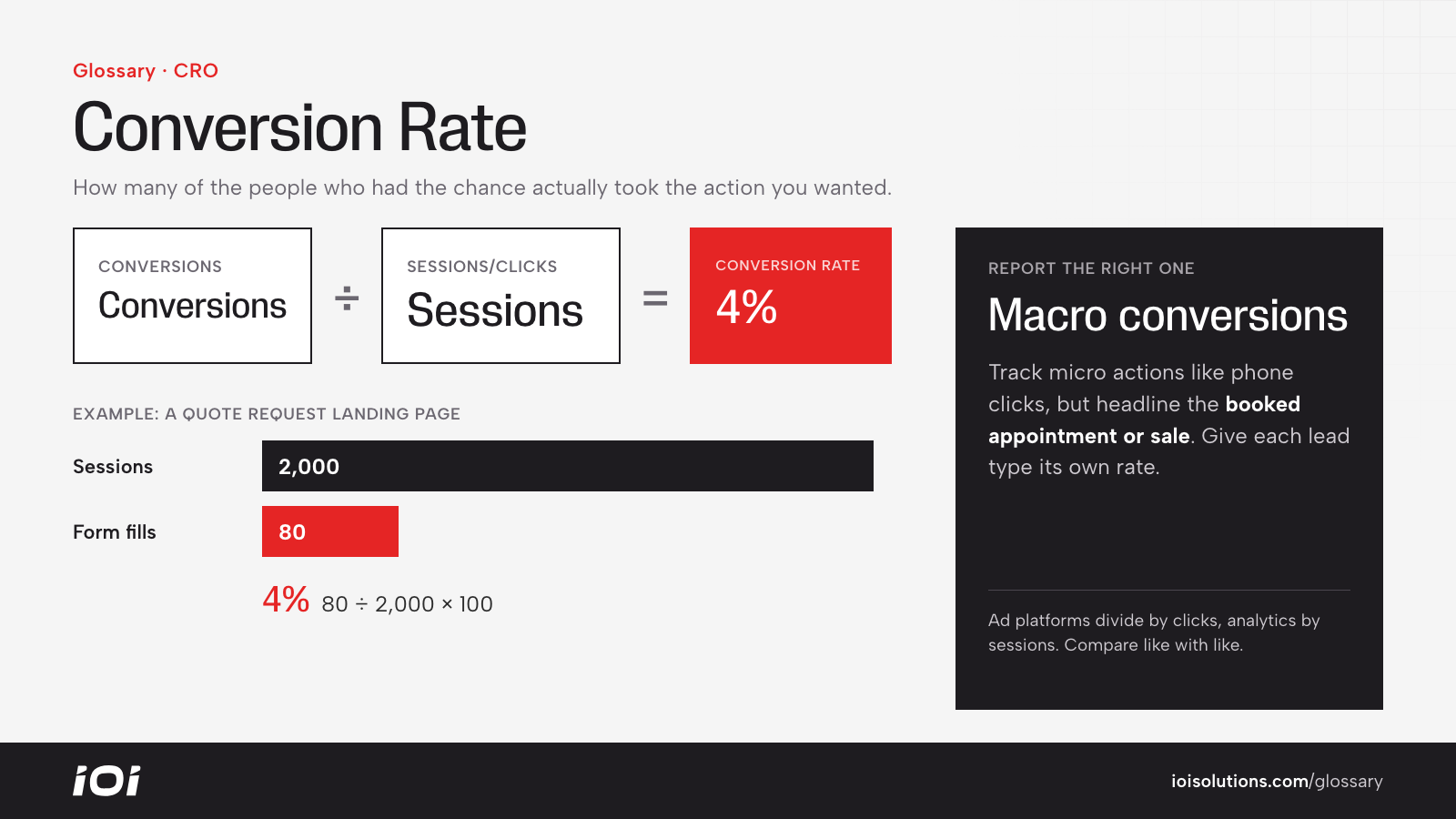
Conversion Rate = (Conversions ÷ Total Visitors, Sessions or Clicks) × 100
For example, if a landing page gets 2,000 sessions in a month and 80 people submit the form, the conversion rate is 80 ÷ 2,000 × 100 = 4%.
A few details change the number significantly:
- Denominator choice. Ad platforms usually divide by clicks; analytics tools often use sessions or users. Be consistent when you compare.
- Conversion definition. Counting every page view of a “thank you” page inflates results if people refresh. Count unique, meaningful actions.
- Micro vs. macro conversions. A click on a phone number or a video play is a micro conversion. A booked appointment or sale is a macro conversion. Track both, but report the macro one as your headline.
Conversion Rate in Automotive Marketing
Automotive businesses rarely have a single conversion. A dealership website might track lead forms, click-to-call, chat starts, trade-in valuations, credit applications and test drive requests. Each deserves its own rate, because a trade-in tool may convert well but produce lower-intent leads than a credit application.
For example, a collision shop running local search ads might find that its estimate request page converts at a healthy rate on desktop but poorly on mobile, where most accident-related searches happen. Adding a photo-upload estimate option and a sticky call button on mobile could lift the overall rate without touching the ad budget.
Parts and accessories brands selling online often see conversion rates rise sharply when shoppers can confirm fitment with a year/make/model selector on the product detail page. Uncertainty about whether a part fits is one of the most common reasons people abandon a cart.
Repair shops and detailers should treat phone calls as conversions. Many automotive customers prefer to call, and a site that tracks only forms will undercount results and make good campaigns look weak.
What Is a Good Conversion Rate?
There is no universal benchmark. Conversion rates vary widely by industry, offer, traffic source and device. Low single digits are common for ecommerce, while focused local service landing pages with strong intent often convert higher. The most useful benchmark is your own historical rate for the same page and traffic source.
- Test one change at a time. Use split testing to prove which headline, form length or offer actually wins.
- Match the page to the ad. If an ad promises a free brake inspection, the page should lead with that offer, not a generic homepage.
- Cut form fields. Ask only what you need to follow up. Every extra field adds friction.
- Speed up mobile pages. Slow load times quietly kill conversions, especially for on-the-go searches.
- Track calls and chats. Use call tracking and event tracking so offline-leaning customers are counted.
- Segment your reporting. Break conversion rate out by channel, campaign and device before drawing conclusions.