
What Is Average Contract Value (ACV)?
Average contract value (ACV) measures how much revenue a typical customer contract brings in, usually normalized to one year. It is most common in subscription, SaaS and B2B service businesses, where customers sign multi-month or multi-year agreements rather than making one-time purchases.
Some companies define ACV as the average annualized value of a contract, while others use the average total value of the contract. The two can differ a lot on multi-year deals, so always state which definition you are using. Many teams also exclude one-time fees, such as setup or onboarding charges, so ACV reflects recurring revenue only.
Why Average Contract Value Matters
ACV tells you how much each new customer is worth in the near term, which shapes almost every growth decision:
- Acquisition budgets: A higher ACV can justify a higher customer acquisition cost.
- Sales model: Low-ACV products usually need self-serve or light-touch sales. High-ACV products can support demos, account managers and longer sales cycles.
- Forecasting: Multiplying expected new contracts by ACV gives a quick revenue projection.
- Segmentation: Comparing ACV across customer types shows which segments are most valuable.
How to Calculate Average Contract Value
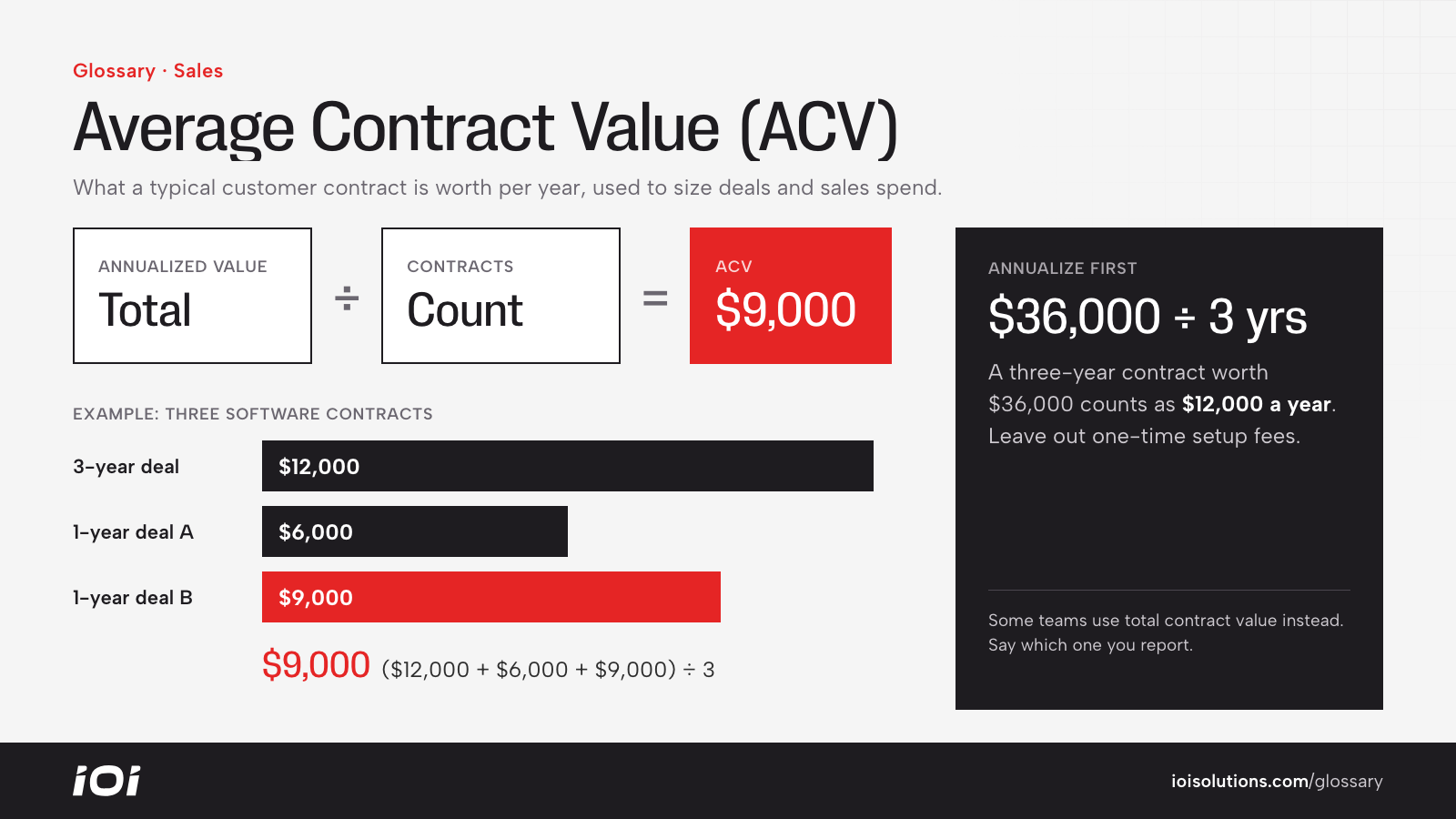
ACV = Total annualized contract value of all contracts ÷ Number of contracts
To annualize a single contract, divide its total recurring value by the number of years it covers. For example, a three-year contract worth $36,000 has an annualized value of $12,000. If a company signed that contract plus two one-year contracts worth $6,000 and $9,000, its ACV for that group would be ($12,000 + $6,000 + $9,000) ÷ 3, or $9,000.
ACV is closely related to annual recurring revenue (ARR). ARR is the total recurring revenue across all customers in a year, while ACV is the per-contract average. Compare ACV over a consistent period, such as contracts signed this quarter, so the numbers aren’t skewed by old pricing.
Average Contract Value in Automotive Marketing
ACV applies to automotive businesses that sell on contracts rather than single transactions:
- Automotive software providers: A company selling CRM, digital retailing or shop management software to dealers and repair shops uses ACV to decide whether to sell through inside sales or field reps, and how much to spend on trade shows and ads.
- Fleet services: A heavy-duty repair shop or mobile detailer with annual fleet maintenance agreements can track ACV to see whether marketing is landing bigger fleets.
- Vendors to dealers: Agencies, BDC outsourcing companies and reconditioning vendors often sell monthly retainers, so ACV helps compare deal sizes across single-rooftop dealers and larger dealer groups.
- Extended service and protection programs: Businesses selling multi-year plans can use ACV to compare plan mixes and pricing changes.
For example, if an automotive SaaS company sees that multi-location collision groups have an ACV several times higher than single shops, it might shift budget toward targeting those groups, even if each lead costs more.
What Is a Good Average Contract Value?
There is no universal benchmark. ACV depends entirely on your product, market and pricing model, and it varies widely by industry. The more useful question is whether your ACV supports your acquisition costs and sales model. A common way to check is to compare ACV and expected retention against what it costs to win a customer.
- Define ACV once and stick to it. Decide whether it includes one-time fees and multi-year totals, then report it consistently.
- Segment it. Track ACV by customer size, channel and product tier to see where value concentrates.
- Pair it with retention. A high ACV is less valuable if customers cancel after the first term.
- Use it to set CAC limits. Let ACV and margin guide how much you can afford to spend per new customer.
- Grow it carefully. Packaging, add-ons and annual prepay options can raise ACV without changing your core price.