
What Is an Application Programming Interface (API)?
An application programming interface (API) is a defined way for one piece of software to request data or actions from another. It spells out what requests are allowed, what format they must use, and what the response will look like. You never see most APIs, but they power much of what marketers use daily, from ad platforms reporting conversions to CRMs syncing with websites.
A simple analogy is a restaurant menu and server. You don’t walk into the kitchen. You order from a set menu, the server takes the request to the kitchen, and you get back a predictable dish. The API is the menu and the server.
Why APIs Matter
Modern marketing runs on many tools: ad platforms, analytics, CRMs, email systems, inventory feeds and scheduling software. APIs connect them so data moves without someone exporting spreadsheets by hand. That matters because it:
- Keeps data accurate and current across systems.
- Enables automation, such as sending a new lead straight to sales.
- Makes better measurement possible by feeding real sales data back into ad platforms.
- Saves time and reduces manual errors.
How APIs Work
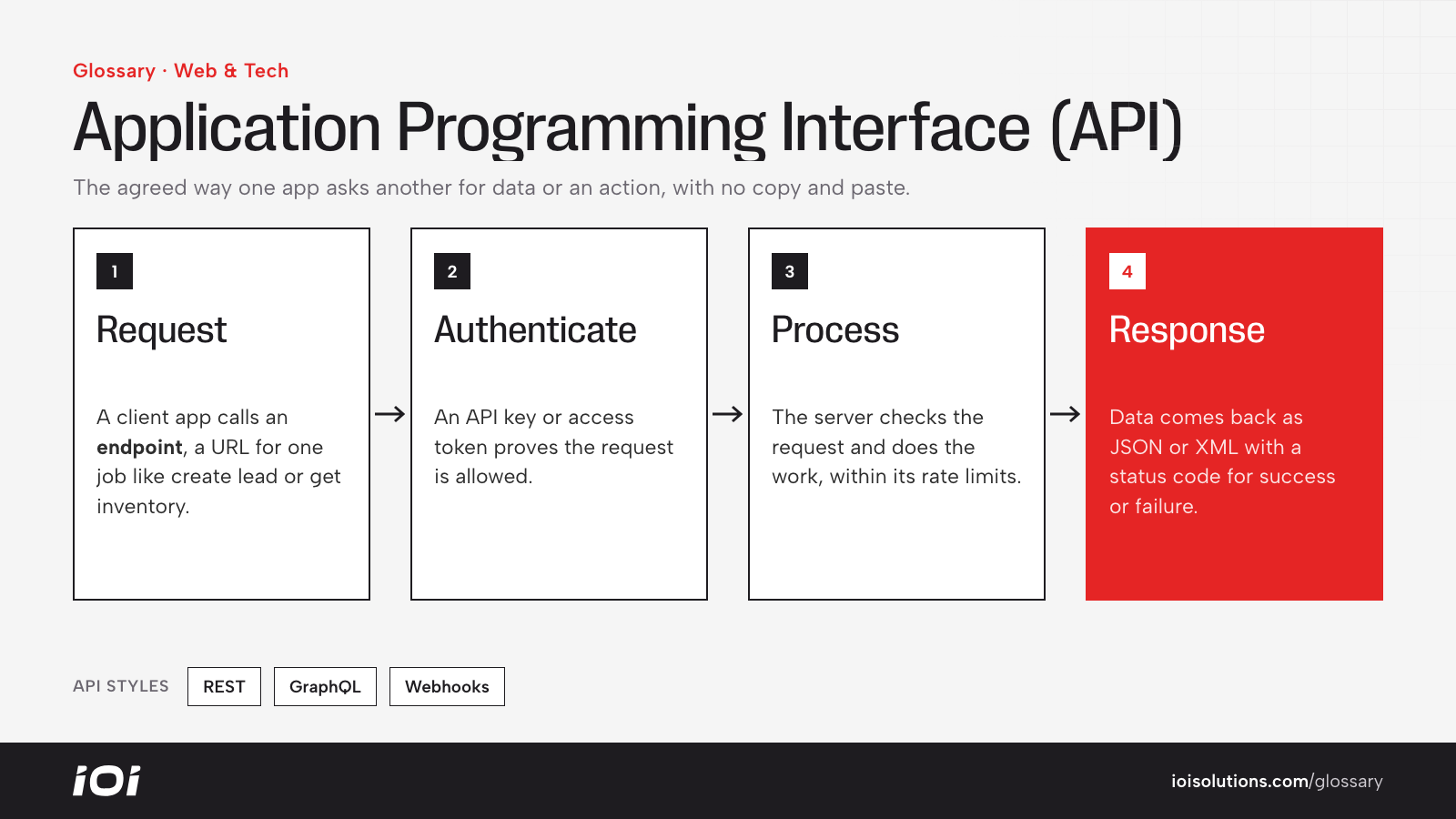
Most web APIs follow a request-and-response pattern:
- A client application sends a request to an endpoint, which is a specific URL for a specific function, such as “create a lead” or “get inventory.”
- The request includes authentication, usually an API key or access token, to prove it is allowed.
- The server processes the request and sends back a response, often formatted as JSON or XML, along with a status code that shows success or failure.
Common styles include REST, which uses standard web methods like GET and POST, and GraphQL, which lets the client ask for exactly the fields it needs. Webhooks are a related idea: rather than you asking for updates, the other system sends a message automatically when something happens.
APIs usually have rate limits on how many requests you can make, and they change over time as providers release new versions, so integrations need maintenance.
APIs in Automotive Marketing
Automotive businesses depend on APIs, often without realizing it:
- Dealerships: Inventory from the dealer management system flows to the website, listing sites and vehicle ad feeds through integrations. Leads move into the CRM, often in the industry’s ADF/XML format.
- Repair and collision shops: Online booking tools, shop management systems and review platforms connect so appointments and customer data stay in sync.
- Parts and ecommerce brands: Store platforms use APIs to manage products, fitment data, pricing and orders, and to send purchase data to ad platforms.
- Measurement: Server-side conversion APIs from Google and Meta let you send conversion events directly from your server or CRM. For example, a dealer could report which leads actually bought a vehicle so campaigns learn to find more buyers, not just form fillers.
Best Practices
- Protect your keys. Treat API keys and tokens like passwords. Never paste them into public code or shared documents.
- Use official integrations first. Native or vendor-supported connections tend to be more reliable than custom workarounds.
- Map your data flow. Document which system is the source of truth for leads, inventory and customers.
- Monitor for failures. Set alerts so a broken integration doesn’t silently stop leads or conversion data.
- Respect privacy rules. Only send the customer data you need, and follow platform policies and applicable laws.