
What Is Subprime Auto Lending?
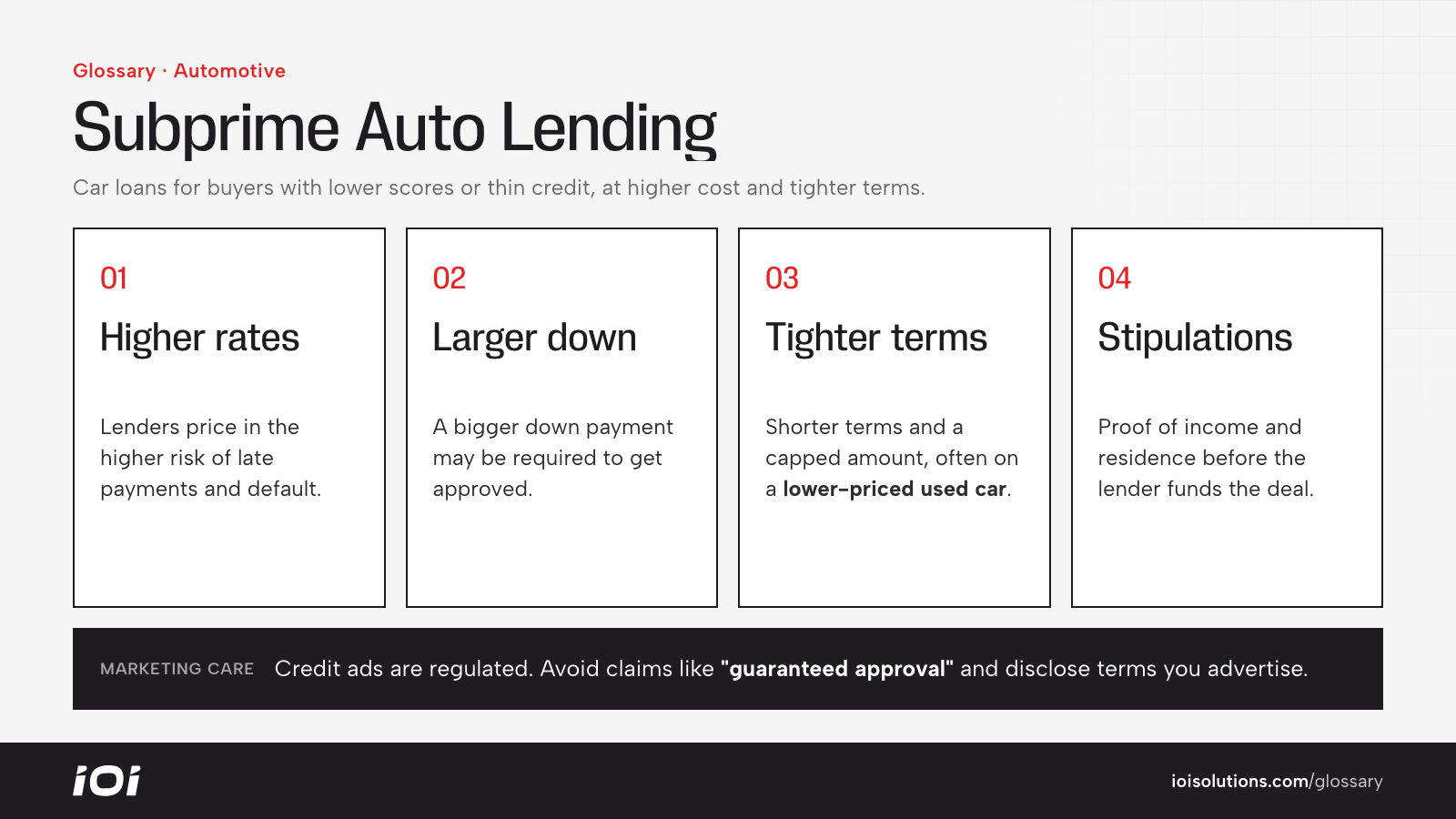
Subprime auto lending is the financing of vehicles for borrowers who have lower credit scores, limited credit history, or past credit problems such as late payments, collections, repossession, or bankruptcy. Lenders see these borrowers as higher risk, so they typically charge higher interest rates and may require larger down payments, shorter terms, or proof of income and residence.
There is no single cutoff for “subprime.” Credit bureaus and lenders define tiers differently, but subprime is generally used for scores below the near-prime range, with deep subprime at the lowest end.
Subprime financing comes from banks, credit unions, captive finance companies with special programs, and specialized subprime lenders. Buy-here-pay-here dealers go a step further by financing the vehicle themselves.
Why Subprime Auto Lending Matters
A meaningful share of car buyers have credit challenges, and they still need reliable transportation.
- Market size. Dealers that can serve credit-challenged buyers reach shoppers that many competitors turn away.
- Profit opportunity. Subprime deals can produce finance reserve and product income in the F&I office.
- Higher risk. Defaults and repossessions are more common, and lenders adjust approvals quickly when economic conditions change.
- Regulatory attention. Regulators closely watch subprime lending and marketing for unfair or deceptive practices.
How Subprime Auto Lending Works
A typical subprime deal follows these steps:
- Application. The customer submits a credit application online or in the store.
- Lender submission. The F&I team sends the application to lenders that accept the customer’s profile.
- Approval with conditions. Lenders return approvals with a rate, maximum amount, required down payment, and conditions such as proof of income.
- Vehicle matching. The store matches the customer to a vehicle that fits the approval, often a lower-priced used car.
- Funding. Once paperwork and stipulations are met, the lender funds the deal.
Many dealers have a dedicated special finance department to manage these relationships and the extra documentation.
How Subprime Auto Lending Affects Marketing
Special finance marketing can generate large lead volume, but it requires extra care.
Compliance first. Credit advertising is regulated. Truth-in-lending rules require certain disclosures when specific terms like payment or down payment are advertised, and fair lending laws prohibit discrimination. Claims such as “guaranteed approval” or “everyone is approved” are risky and often misleading. Ad platforms also restrict credit ads. Google and Meta limit how you can target audiences for credit offers, for example by restricting targeting by age, gender, or ZIP code, so campaigns must be built within those rules.
Messaging that respects the customer. Shoppers with credit challenges are often anxious or embarrassed. Clear, respectful copy such as “options for all credit situations” tends to build more trust than aggressive promises.
Lead quality. Many third-party leads in this space are sold to multiple dealers. Measuring lead-to-sale close rate by source shows which vendors and campaigns produce funded deals rather than just applications.
For example, a used car dealer could build a special finance landing page with a short pre-qualification form, clear explanations of what documents to bring, and a phone number that rings a trained special finance team, then measure success by funded deals rather than form fills.
Best Practices
- Review every ad for compliance. Check credit terms, disclosures, and claims before launch.
- Avoid guarantees. Do not promise approval or specific rates you cannot deliver.
- Respond quickly and kindly. Special finance shoppers often contact several stores, and empathy wins.
- Set expectations. Explain down payment, income, and document requirements up front.
- Measure funded deals. Judge campaigns on deals funded and kept, not applications.