
What Are Third-Party Leads?
Third-party leads are customer inquiries generated by an outside company rather than by the business’s own website, phone lines or showroom. In automotive retail, they typically come from third-party automotive marketplaces, manufacturer websites, pricing and research sites, credit application networks and dedicated lead vendors. Repair shops and body shops may receive third-party leads from directories, service-booking apps and lead-generation platforms.
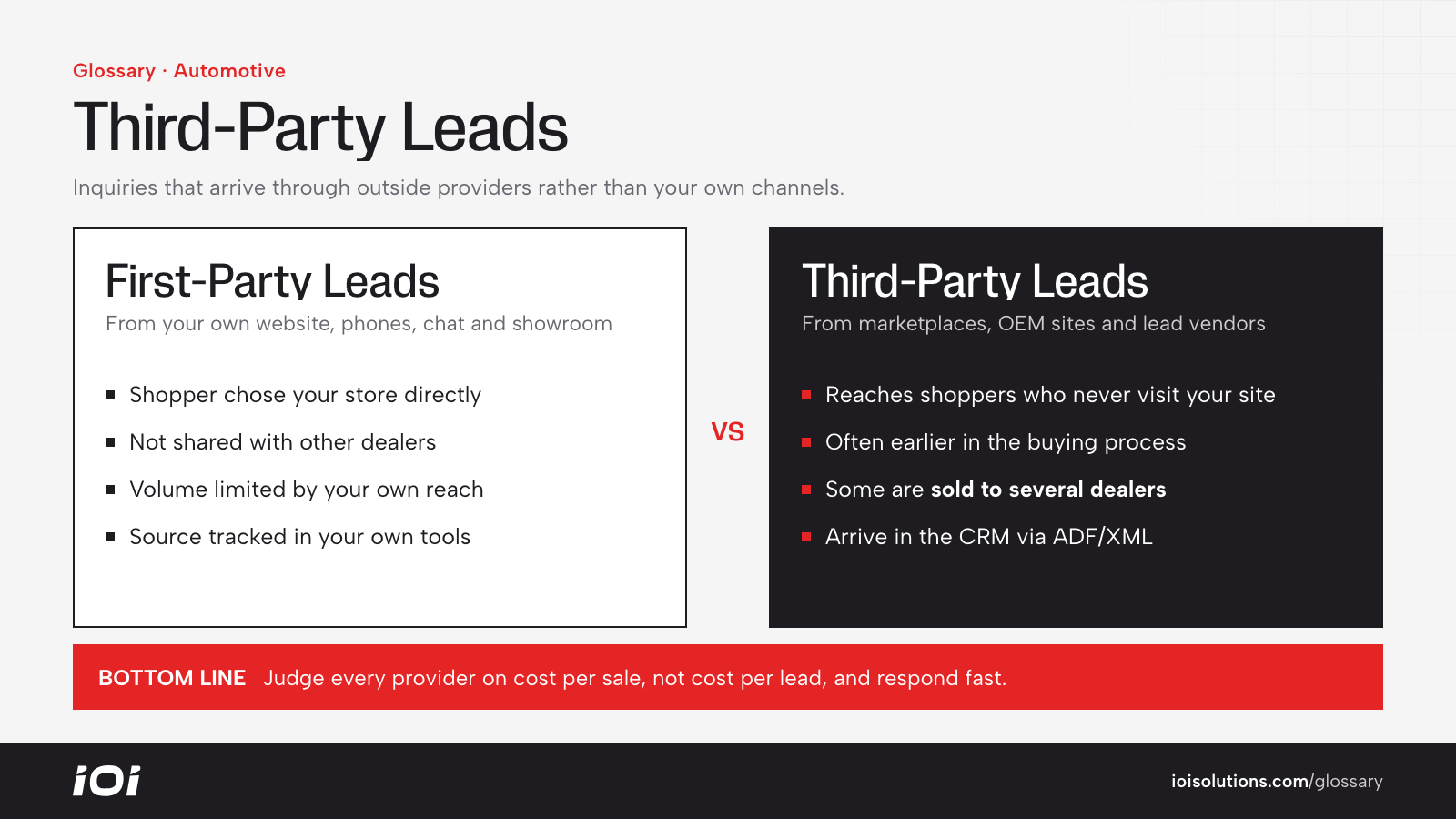
They are usually contrasted with first-party leads, which come directly from a dealer’s own website forms, calls, chats and walk-ins.
Why Third-Party Leads Matter
- Volume: outside providers can deliver a steady flow of inquiries that would be hard to generate alone.
- Market coverage: they reach shoppers who never visit the dealer’s website.
- Cost and quality vary: lead quality differs widely between providers, and some leads are sold to multiple dealers at once.
- Process demands: third-party leads are often earlier in the buying process, so they need fast, persistent follow-up.
Types of Third-Party Leads
- Marketplace leads: inquiries from shoppers on listing sites about specific vehicles.
- OEM leads: requests submitted on a manufacturer’s website and routed to a nearby dealer, often at no direct cost or under an OEM program.
- Price-quote leads: shoppers requesting pricing from research or pricing sites, frequently shared with several dealers.
- Credit leads: people who completed a financing application, often including subprime credit shoppers.
- Trade-in and instant offer leads: owners looking to sell or trade a vehicle.
- Service leads: repair or maintenance requests from booking platforms or directories.
How Third-Party Leads Affect Marketing
Third-party leads should be judged with the same rigor as any paid channel. The question is not how cheap a lead is, but what it costs to make a sale.
- Integrate cleanly. Leads should flow into the CRM automatically, usually via ADF/XML, with the correct source tag so results can be tracked.
- Respond quickly. Shoppers who submit to several dealers often engage with the first helpful response. Many dealers route these leads to a BDC for fast follow-up.
- Measure close rate by source. A low-cost lead with a poor lead-to-sale close rate can be more expensive per sale than a costlier lead that closes well.
- Watch for duplicates. The same shopper may arrive from multiple providers. De-duplication prevents double counting and wasted outreach.
- Compare to first-party. If owned channels can produce leads at a lower cost per sale, shifting budget from vendors to search, social and listing ads may pay off.
For example, a dealer buying credit leads might find they close at a low rate overall but convert reasonably well when the BDC follows a specific process tailored to credit-challenged buyers. Process improvement, not just vendor choice, changes the economics.
Repair and body shops face the same trade-offs. A shop paying a directory or booking app for leads should compare the resulting repair orders and revenue against what its own Google Business Profile, website and paid search produce. Third-party platforms can fill gaps in the schedule, but owned channels usually build more durable demand and customer relationships over time.
Best Practices
- Tag every lead by provider and track it through to sale and gross profit.
- Set response time standards and use templates tailored to each lead type.
- Ask vendors whether leads are exclusive or shared and price your expectations accordingly.
- Review providers quarterly and cut those whose cost per sale is consistently too high.
- Make sure lead vendors collect consent compliantly, since you are responsible for how you contact those leads.