
What Is an Impression?
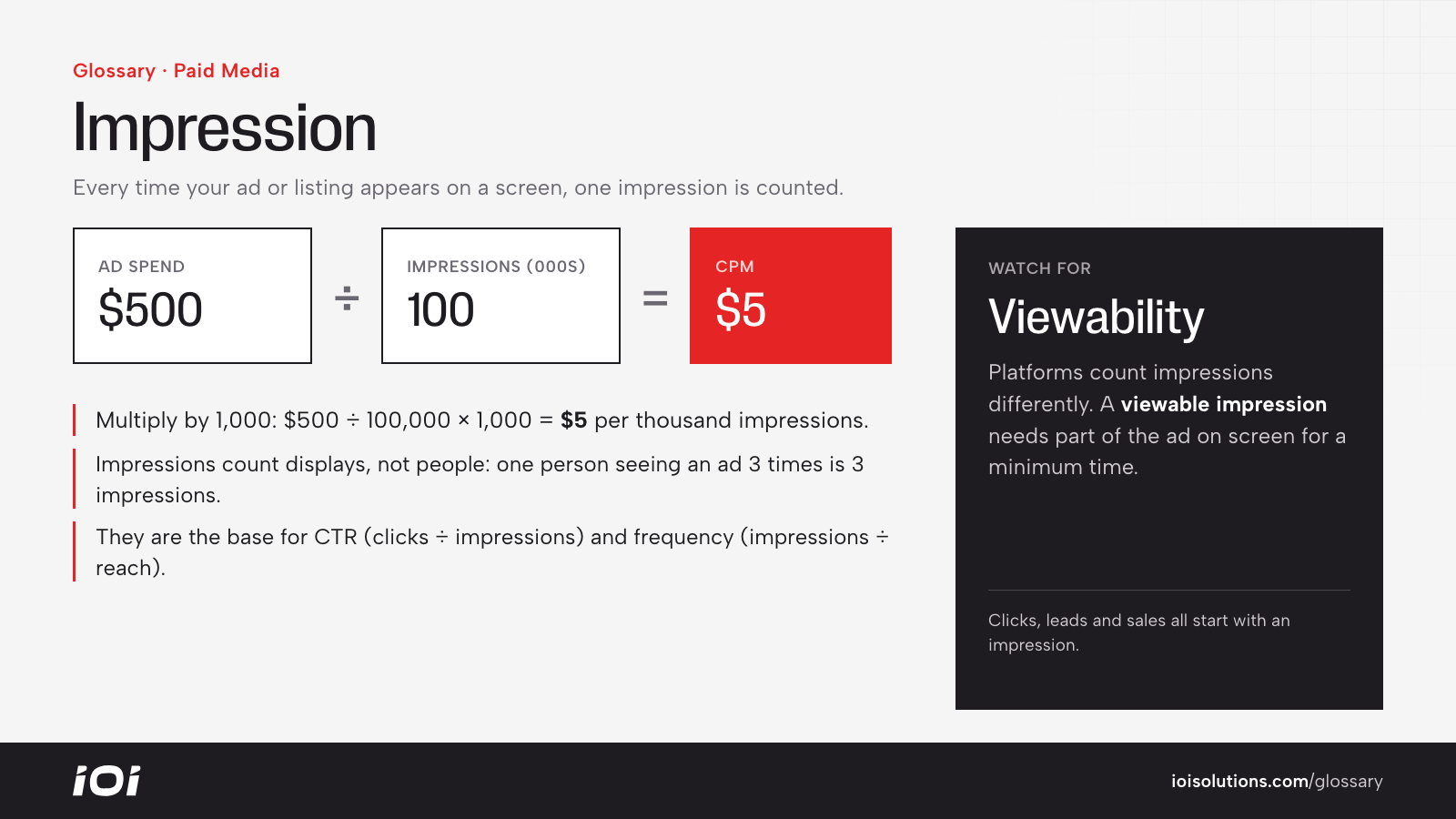
An impression is a single instance of a piece of content, usually an ad, being shown to someone. Every time your ad loads on a screen, the platform counts one impression. It doesn’t matter whether the person clicks, scrolls past, or even notices it. The same applies to organic content: when your page appears in search results, that’s an impression in Google Search Console, and when your post appears in someone’s feed, that’s an impression on social platforms.
Impressions are not the same as reach. Reach counts unique people. Impressions count total displays. If one person sees your ad three times, that’s three impressions and a reach of one.
Why Impressions Matter
Impressions are the top of the measurement chain. Every click, lead, and sale starts with someone seeing something. On their own, impressions don’t prove much, but they’re the denominator for several key metrics:
- Click-through rate (CTR): clicks divided by impressions.
- CPM (cost per thousand impressions): what you pay for every 1,000 displays.
- Impression share: in search advertising, the percentage of eligible impressions you actually received.
- Frequency: impressions divided by reach, showing how often each person saw your ad.
Impressions also matter for awareness campaigns, where the goal is getting your brand in front of the right people repeatedly so they remember you when they’re ready to buy.
How Impressions Work
Each platform defines an impression slightly differently. Search ads typically count an impression when the ad appears on a results page. Display and social platforms may count when the ad starts to load or when it enters the viewable part of the screen. Because of this, industry groups created the idea of a viewable impression, which generally requires a minimum portion of the ad to be on screen for a minimum amount of time.
The cost formula for impression-based buying is:
CPM = (Total ad spend / Total impressions) x 1,000
For example, if you spend $500 and receive 100,000 impressions, your CPM is $5. In programmatic channels, impressions are often bought individually through real-time bidding.
Impressions in Automotive Marketing
How you treat impressions depends on what the campaign is meant to do:
- Dealership search campaigns: A dealer might watch search impression share on “used trucks near me” to see whether budget limits are causing them to miss shoppers while competitors show up instead.
- Collision repair awareness: Most people don’t need a body shop until after an accident. A shop running local video or social ads is buying impressions to build familiarity, so the name comes to mind when it matters.
- Parts and accessories ecommerce: A brand might compare CPMs across Meta, TikTok, and YouTube to find where it reaches truck or Jeep enthusiasts most efficiently.
- Car shows and events: An event organizer might use impression-heavy campaigns in the weeks before a show to drive ticket sales and attendance.
Best Practices
- Don’t treat impressions as a success metric alone. High impressions with low engagement or conversions usually mean poor targeting or weak creative.
- Watch frequency. Too few impressions per person and you won’t be remembered. Too many and people tune out or get annoyed. The right level varies by channel and goal.
- Track impression share in search. Lost impression share due to budget or ad rank is a direct signal of missed opportunity.
- Prefer viewable metrics. When available, look at viewable impressions rather than served impressions.
- Compare CPMs within context. CPMs vary widely by platform, audience, season, and geography, so benchmark against your own history.
- Connect impressions to downstream results. Use view-through and assisted conversion data to see whether awareness spend is moving the needle.